Even in high school, if you get your kids hooked on the challenge of mathematics as mental play, they will never be satisfied with mere textbook math. There is always something fascinating just around the corner.
Active Calculus: A free, open-source calculus textbook with activities. See also Screencasts for Active Calculus.
Alcumus: Art of Problem Solving’s innovative online learning system adjusts to student performance to deliver appropriate problems and lessons.
Better Explained: Intuitive, often visual, explanations of high school math topics.
Bayesian Statistics for Dummies: Kevin Boone’s introduction to statistical questions that deal with conditional probabilities. See also the New York Times article “The Odds, Continually Updated.”
Calculus Concepts and Applications: A complete set of student-centered activities for a year-long Calculus I and Calculus II sequence.
Calculus Made Easy: “Being myself a remarkably stupid fellow, I have had to unteach myself the difficulties, and now beg to present to my fellow fools the parts that are not hard. Master these thoroughly, and the rest will follow. What one fool can do, another can.”
Desmos Graphing Calculator: Explore the relationships between equations and shapes, and try your hands at some of the Daily Desmos blog challenges.
Don Cohen’s Map of Calculus for Young People: Hands-on activities featuring advanced ideas, for students of any age.
Discovering Trigonometry: A basic introduction to trigonometry, starting with sticks and shadows.
Euclid’s Elements: David E. Joyce brings the text of Euclid’s thirteen books to life with Java applets. See also, An Introduction to the Works of Euclid.
Euclid in Colorful Diagrams: Oliver Byrne’s innovative, pictorial version of the first six books of the Elements of Euclid.
Flatland: Edwin Abbott’s “Romance of Many Dimensions.”
G’Day Math Courses: James Tanton unlocks the simplicity of seemingly complex ideas about arithmetic, algebra, probability, and more.
Gallery of Data Visualization: A collection of the world’s best and worst statistical graphs.
GeoGebra: Download software for playing with geometry and algebra, and the website offers a wealth of user-created instructional materials.
Green Tea Press: Free statistics and computer science books by Allen Downey.
How to Read Mathematics: “A math article usually tells only a small piece of a much larger and longer story.” Learn to read between the lines.
How to Succeed in Math: Articles by Stan Brown about how to succeed as a math student, how to use a graphing calculator, what it means to “show your work,” and other topics from algebra, trig, calculus, and statistics.
How to Think like a School Math Genius: James Tanton’s series of videos about five key principles for mathematical thinking for students approaching high school math.
Interactivate: Lots of projects to try, from middle school math to calculus.
Invent Your Own Computer Games with Python: Each chapter gives your student the complete source code for a new game and then teaches programming concepts from the example.
Julia Robinson Math Festival: Question sets from a collaborative, non-competitive celebration of thought-provoking problems.
Karl’s Calculus: Karl Hahn has a creative way of explaining the ideas of calculus. Includes sample problems.
La Habra High School’s Math History Timeline: Math discoveries, publications, and other tidbits from paleolithic number bones to the present.
Let’s Play Ancient Greek Geometry: Nico Disseldorp’s online game of completing Euclidean geometry construction puzzles in a certain number of moves.
MacTutor History of Mathematics Archive: My favorite place to begin any foray into math history.
Mathematical Problems of David Hilbert: With a link to Hilbert’s 1900 address to the International Congress of Mathematicians in Paris, surely the most influential speech ever given about mathematics. Wolfram MathWorld has an annotated list of all twenty-three problems.
Mathematical Reasoning: Writing and Proof: Ted Sundstrom’s online textbook for high school students and adults who want to develop the ability to think more abstractly.
Median by Don Steward: A collection of activities and exercises for middle school and high school students.
Muslim Rule and Compass: The Magic of Islamic Geometric Design: An article by Alex Bellos, with instructions for constructing a beautiful geometric pattern.
A New Algebra: Henri Picciotto offers a selection of interesting activities for algebra students.
Non-Euclid: Joel Castellanos’s website for exploring the mind-blowingly weird world of hyperbolic geometry. See also the hyperbolic art of M. C. Escher.
Project Euler: A list of programming challenges for advanced students.
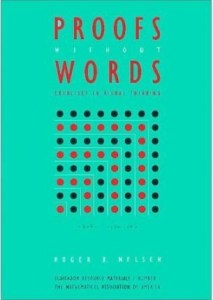
Proofs Without Words: I love these.
Purplemath: A good source of supplemental explanations in prealgebra and algebra. When your textbook just doesn’t make sense, look here for help.
Spurious Correlations: Tyler Vigen takes statistical humor to new heights.
Statistics Every Writer Should Know: Robert Niles’s introductory statistics tutorial for math-phobic journalists.
Stats Without Tears: Stan Brown’s free online statistics textbook.
Stella’s Stunners: More than 600 non-routine mathematics problems ranging from simple visual puzzles requiring no specific mathematical background, to problems that use the content of prealgebra up through precalculus.
Tips for All Your Math Courses: Articles by Stan Brown about how to succeed as a math student, how to use a graphing calculator, what it means to “show your work,” and other topics from algebra, trig, calculus, and statistics.
Triangular Numbers are Everywhere!: This worksheet from the IMSA Math Journal examines several examples of triangular numbers in mathematical problems. Can you figure out the patterns?
Trig Without Tears: “Or, How to Remember Trigonometric Identities.” How to learn and understand trig without memorizing a gazillion identities. Check out the author’s other mathematics articles, too.
What’s Special About This Number?: Distinctive facts about several numbers, 0-9999 the last time I looked.
Virtual Math Lab: Algebra tutorials from West Texas A&M University. Includes practice tests.
* * *
For more resource suggestions, check out my Math with Living Books pages.
This blog is reader-supported.
If you’d like to help fund the blog on an on-going basis, then please join me on Patreon for mathy inspiration, tips, and an ever-growing archive of printable activities.
If you liked this post, and want to show your one-time appreciation, the place to do that is PayPal: paypal.me/DeniseGaskinsMath. If you go that route, please include your email address in the notes section, so I can say thank you.
Which I am going to say right now. Thank you!
“Playing with Algebra and Beyond” copyright © 2015 by Denise Gaskins.
 Denise Gaskins' Let's Play Math