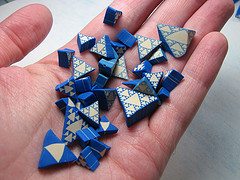
Mathematicians love to play with ideas. They experiment with puzzles. They tinker with the connections between shapes and numbers, patterns and logic, growth and change. To a mathematician, the fun of the game is in experimenting, in trying new things and discovering what will happen. Many modern strategy games were invented primarily for the fun puzzle of analyzing who would win.
Homeschooling with Math Anxiety
For example, consider the simplest form of the two-player strategy game Nim: Start with a pile of pennies, and take turns removing either one or two pennies from the pile until one player is forced to take the last coin, thus losing the game.
Play the game with your children several times, and then encourage them to think of some way to change the rules.
- How does the game change?
- Is it easier or harder to win?
- Does the player who goes first have an advantage?
Thinking like a Mathematician
Homeschoolers who think like mathematicians do not play only with games, but also with numbers, shapes, and patterns.
- We might pick a number and double it, and then double that, and keep doubling to see how high we can go.
- Or we may build a perfect square pyramid out of sugar cubes (with 1, 4, 9, 16, 25… cubes in each layer) as the centerpiece for our next tea party.
- Or we think about new and strange ideas: A line stretched into two dimensions becomes a square, and a square stretched into three dimensions becomes a cube, so what will become of a cube stretched into four dimensions?
Don’t be like the high school algebra teacher who caught a student playing tic-tac-toe and snatched away his paper, saying, “When you’re in my classroom I expect you to work on mathematics!”
When the boy’s friend, popular math writer Martin Gardner, heard the story, he responded that tic-tac-toe was an excellent introduction to group symmetry, probability, set theory, n-dimensional geometry, and other topics. “With a little expert guidance,” Gardner said, “it might have been much more rewarding than what his teacher was teaching.”
Learning to think like a mathematician is a lifetime adventure. When you begin to look at the world with a mathematician’s eye, you embark on a journey more varied than the voyage of Ulysses, more exotic than Marco Polo’s travels, and more adventuresome than a trip to Mars.
* * *
 This post is the last of three in my Homeschooling with Math Anxiety Series, which is an excerpt from my book Let’s Play Math: How Families Can Learn Math Together—and Enjoy It, now available at your favorite online book dealer.
This blog is reader-supported.
If you’d like to help fund the blog on an on-going basis, then please join me on Patreon for mathy inspiration, tips, and an ever-growing archive of printable activities.
If you liked this post, and want to show your one-time appreciation, the place to do that is PayPal: paypal.me/DeniseGaskinsMath. If you go that route, please include your email address in the notes section, so I can say thank you.
Which I am going to say right now. Thank you!
“Mathematicians Love to Play” copyright © 2012 by Denise Gaskins. Image at the top of the post copyright © Windell Oskay via Flickr (CC BY 2.0).
 Denise Gaskins' Let's Play Math
Nice article. Everyone can enjoy math games. It just depends on the attitude and what preconceived thoughts one has.
It’s more than just playing with games. Playfulness becomes the essence of our exploration in every area of learning…
Making mathematics fun for children and helping them not to be afraid of numbers is a crucial step.
I agree, Azadeh. And one excellent way to do that is to play around with math stories.