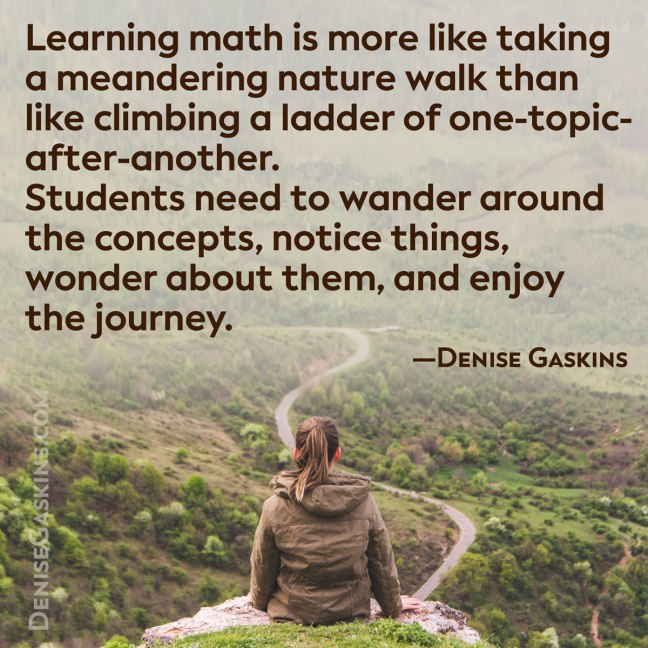
My students are so busy that time-consuming math projects are a luxury. How is it possible for older kids to play with mathematics?
Too often, the modern American school math curriculum is a relentless treadmill driving students toward calculus. (Does this happen in other countries, too?)
But that’s definitely not the only way to learn. For most students, it’s not the best way, either.
Here are a few ideas to get your older children playing with math…
Try This Scheduling Hack
Make time for interesting math, even if you have to skip the textbook work some days. (Did you know that many classroom teachers never finish a textbook?)
When my kids were homeschooling, my favorite scheduling hack was to invite friends over for a math club date on a regular basis, every week or two. That way, it was on the calendar, so I couldn’t procrastinate.
Two great places to find rich puzzles for older kids:
Play with Textbook Math
Don’t be in a hurry to rush through the book.
Take the attitude of exploration into your textbook math. Even high school math should be a playful discovery of ideas, not a drudgery.
Don’t try to do all the problems in a homework set, but pick a few to focus on.
Maybe try to solve a problem before you read the lesson — how would your students think it through? Then after you read the book’s method, which way do you like better? Why? Can you think of any other way to do it?
Set a timer to remind you not to spend too much time on textbook math. It can be mentally exhausting, just like a physical workout.
Never Too Old to Wonder
If you laid a good foundation of noticing and wondering about puzzles when your children were young, remind them of it whenever they get stuck.
Putting together a list of notices and wonderings can be a great way to start any tough math problem.
Or if they haven’t learned how to do this, then teach it now:
- Pick a hard problem from their math book, but don’t read the question — just the given facts and diagram (if there is one).
- Then notice everything you can, and wonder as much as you can.
- Take turns adding new notices and wonderings.
When you finally read them the question, they should have a good idea of how to answer it, just based on the things they’ve already seen in the set-up.
Get Off the Beaten Track
Take side-trips into enjoyable (but advanced) math.
- Learn discrete math.
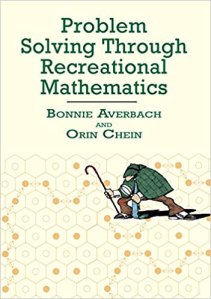
- Explore the textbook Problem Solving Through Recreational Mathematics.
- Read something by Martin Gardner.
- Or by Raymond Smullyan.
- Or work through one of the many puzzle books by Brian Bolt.
There are lots of playful things to do with math, even for older kids.
I’d love to hear your ideas, too! If you have a favorite resource or tip for playing math with older students, please share in the comments section below.
* * *
Please note: I am an Amazon affiliate. If you follow one of the book links above and buy something, I’ll earn a small commission (at no cost to you).
This blog is reader-supported.
If you’d like to help fund the blog on an on-going basis, then please join me on Patreon for mathy inspiration, tips, and an ever-growing archive of printable activities.
If you liked this post, and want to show your one-time appreciation, the place to do that is PayPal: paypal.me/DeniseGaskinsMath. If you go that route, please include your email address in the notes section, so I can say thank you.
Which I am going to say right now. Thank you!
“FAQ: Playful Math for Older Students” copyright © 2020 by Denise Gaskins. Image at the top of the post copyright © Vlad Bagacian via Unsplash.com.
 Denise Gaskins' Let's Play Math