Would you like your children to play with math during the holidays?
Check out the new printable math activity guide in my online store: Christmas Tree Math Games will keep the whole family playing through the New Year.
Would you like your children to play with math during the holidays?
Check out the new printable math activity guide in my online store: Christmas Tree Math Games will keep the whole family playing through the New Year.

Welcome to the 170th edition of the Playful Math Education Carnival — a smorgasbord of delectable tidbits of mathy fun. It’s like a free online magazine devoted to learning, teaching, and playing around with math from preschool to high school.
Bookmark this post, so you can take your time browsing.
There’s so much playful math to enjoy!
By tradition, we start the carnival with a puzzle/activity in honor of our 170th edition. But if you’d rather jump straight to our featured blog posts, click here to see the Table of Contents.
According to Tanya Khovanova’s Number Gossip, 170 is the smallest composite number where exactly four permutations of its digits make prime numbers.
To find permutations, think of all the different ways you can arrange the digits 1, 7, 0 into three-digit numbers. (When the zero comes first, those permutations actually make two-digit numbers, which DO also count.)
Can you figure out which permutations make prime numbers?
Hint: The permutation that makes the number “170” is not prime, but it is the product of three prime numbers. Which ones?
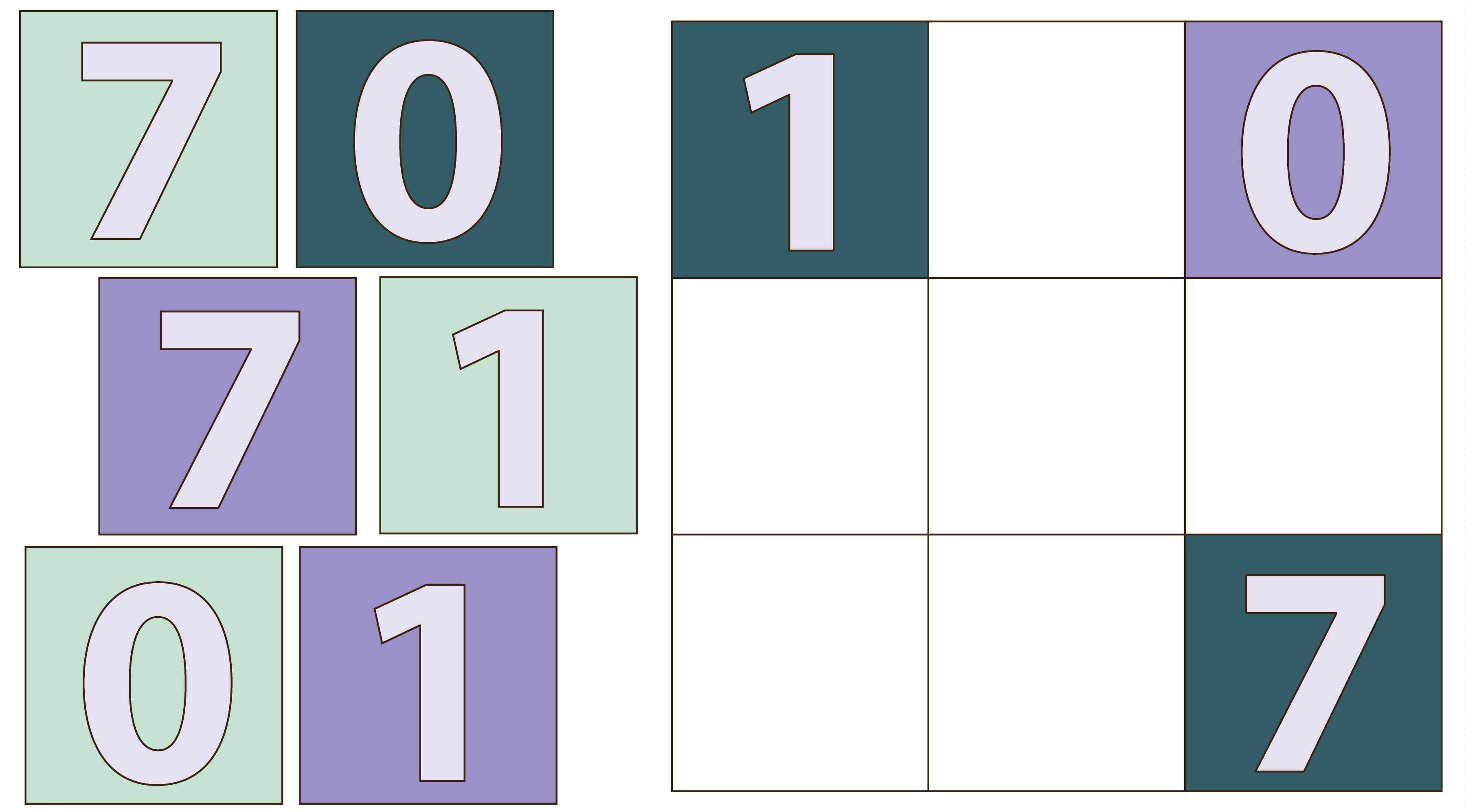
A Latin square is a grid filled with permutations: letters, numbers, or other symbols so that no row or column contains more than one of any character. You’ve probably seen the popular Latin-square puzzle called Sudoku. A Graeco-Latin square (also called an Euler square) is two independent Latin squares overlapping each other.
Can you complete this Euler square made by overlapping permutations of the digits of 170 with winter colors? Don’t repeat the same color OR the same number in any row or column.
 Denise Gaskins' Let's Play Math