
Welcome to the 171st edition of the Playful Math Education Blog Carnival — a smorgasbord of delectable tidbits of mathy fun. It’s like a free online magazine devoted to learning, teaching, and playing around with math from preschool to high school.
Bookmark this post, so you can take your time browsing over the next week or so.
There’s so much playful math to enjoy!
By tradition, we start the carnival with a puzzle/activity in honor of our 171st edition. But if you’d rather jump straight to our featured blog posts, click here to see the Table of Contents.
Try This Puzzle/Activity
171 is a triangular number, the sum of all the numbers from 1 to 18:
- 1 + 2 + 3 + … + 17 + 18 = 171.
- Can you think why a number like this is called “triangular”?
- What other triangular numbers can you find?
Also, 171 is a palindrome number, with the same digits forward and backward. It’s also a palindrome of powers:
- 171 = 52 + 112 + 52
- 171 = 23 + 43 + 33 + 43 + 23
So in honor of our 171st Playful Math Carnival, here is a palindrome puzzle that leads to an unsolved question in math:
- Does every number turn into a palindrome eventually?

Contents
And now, on to the main attraction: the blog posts. Some articles were submitted by their authors; others were drawn from the immense backlog in my rss reader. If you’d like to skip directly to your area of interest, click one of these links.
- Talking Math with Kids
- Exploring Elementary Arithmetic
- Adventuring into Algebra and Geometry
- Scaling the Slopes of High School Math
- Enjoying Recreational Puzzles and Math Art
- Teaching with Wisdom and Grace
- Giving Credit Where It’s Due
Art images and quotations are from the 2024 Joint Mathematics Meetings Art Exhibition. Click on each image to find out more about that artist’s work.

“Geometry is at the heart of a thousand years of art and architecture as represented in mosques, temples and cathedrals around the world. Constructions discovered by the ancient Greek mathematicians are merged with craftsmanship to produce paintings and mosaics of infinite variety. I explore and teach about the intersection of this art form with classical geometry by allowing the art to motivate a discussion of geometric fundamentals while using the math to enhance an appreciation of the art and suggest generalizations.”
Talking Math with Kids
- Johanna Buijs is creating a set of printable Math ABC Cards to spark fun discussions. So far, A=Azimuth and B=Bisect. Come back later to see what else she adds!
- Carla Dawson is talking math with a student in When Equations look like One-way Streets. How would you respond?
- Jenna Laib talks math with 5th-graders: Fraction Addition: Playing a Game With Many Shades of Fluency.
- For my entry to the carnival, here’s a math-talk memory from our homeschooling days: Middle School Math Proof.
- Christopher Danielson talks probability with a teenager: Same Idea or Different?
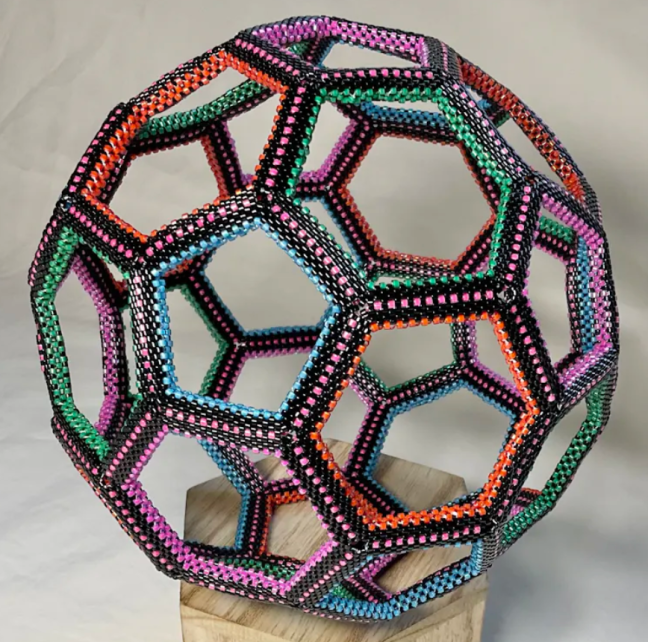
“My craft is driven by curiosity. I have no formal training in geometry, but I learn a little more every day, through the hands-on engineering of my sculptures. I see the world as a series of puzzles, components fitting together in a way that my brain works to recreate with beads. It is an intensely joyful experience to live in the world this way. Through my art I achieve a deeper communion with the universe than I might have ever thought possible.”
[Back to top.]
[Back to Table of Contents.]
Exploring Elementary Arithmetic
- Dan Meyer analyzes a subtraction math game: This Second Grade Math Problem Won’t Leave Me Alone.
- Erica gets her kids started on a lifelong habit in Math + Writing Activity: Keeping a Ledger.
- Marilyn Burns is Mulling about Teaching Division.
- Dan Finkel posts a free discussion-based lesson: Fraction Talks.
- John Golden shares Keri Herman’s Multiplication Mazes — a puzzle for fact practice and Jordan Burnham’s Boxzee — Flexible Computation Game.
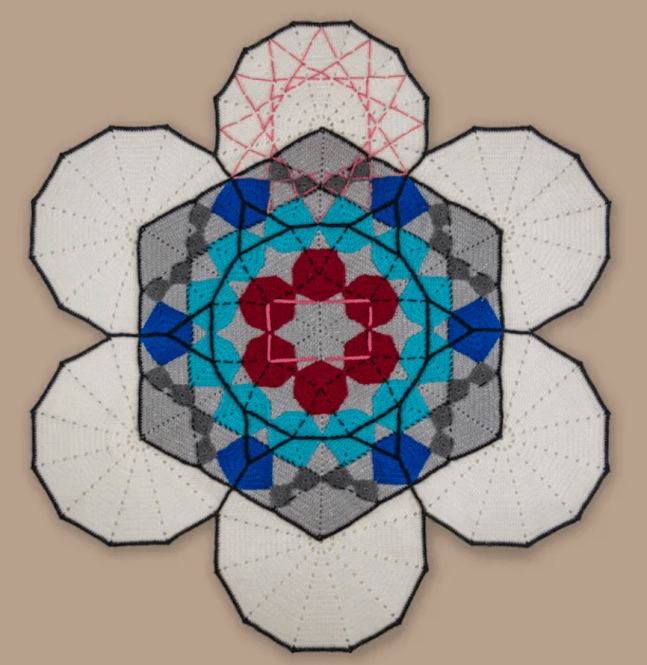
“I learned how to crochet in my childhood, but only recently discovered how to make math fun by crocheting mathematical geometry. I get great joy turning abstract mathematical geometry into easy to observe visuals. I find trying to figure out crocheting mathematical details very interesting. My goal is to present the beauty in the intersection of art and mathematics to a larger audience to increase appreciation for both. “
[Back to top.]
[Back to Table of Contents.]
Adventuring into Algebra and Geometry
- Core Math, India shares a Square Area Puzzle. And Mehrdad Basiry poses a Triangular Area Puzzle.
- JoAnn Sandford publishes a fun newsletter for math teachers called Play … Persist … Prove. This month’s edition features a great lesson: “Oops! I forgot” (page 3).
- Nick Corley helps students understand linear equations: Arithmetic Sequences with Visual Patterns + VNPS + Desmos.
- John Golden shares Leah Barber’s GEO — Middle School Geometry Game and Kacy Jeffries’s Coordistroy — Classroom Graphing Game.
- Pat Ballew discusses Solving Quadratic Equations By analytic and graphic methods; Including several methods you may never have seen.
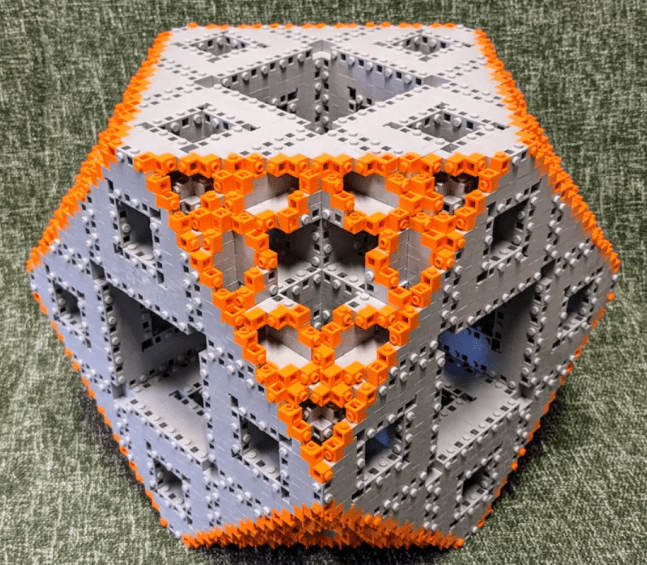
“A Menger sponge is a 3D fractal formed by starting with a cube and then drilling out the “middle-third” on each face, and then repeating this action again, and again, and …. This is a variation on a level-two Menger sponge (meaning two iterations of the drilling have been done) which has also had its corners cut off. This illustrates different viewpoints on the Menger sponge and shows the emergence of some 2D fractals in the cross sections. For emphasis, the cut-off corners are highlighted in orange.”
[Back to top.]
[Back to Table of Contents.]
Scaling the Slopes of High School Math
- John Golden shares Corrina Campau’s Algebra Spoons — an Algebra Representations Math Game.
- Patrick Honner poses a puzzle for the new year: 2024 and Differences of Squares. (Answer here, but don’t peek!)
- Pat Ballew examines a probability puzzle: Pick Two and Get One of Each?
- Karen Campe shares the January Calendar Problems, featuring a puzzle per day.
- Just for fun, Chalkdust Magazine asks, “Which integral are you?“
- And don’t miss the 223rd Carnival of Mathematics.
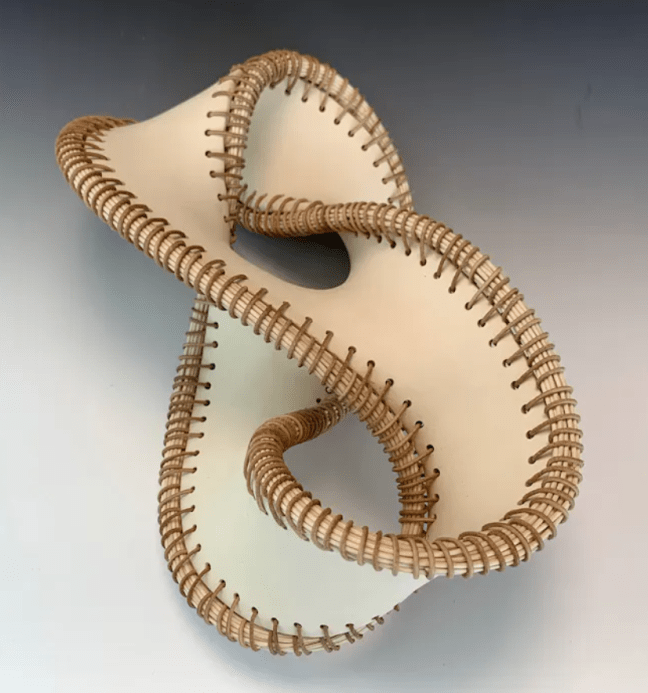
“My work explores the mathematics of symmetry, knots, fractals, tessellations and more, blending it with plant and animal forms as well as inorganic forms found in nature. This synthesis allows me to create innovative prints and sculptures that derive their beauty from a combination of complexity and underlying order. My goal is to use mathematics in my work in a manner that is compelling to those who understand it but does not serve as an impediment to those who don’t.”
[Back to top.]
[Back to Table of Contents.]
Enjoying Recreational Puzzles and Math Art
- Sarah Carter shares a few New Year’s Math Activities and Puzzles. And looking ahead to February, she’s collected a variety of Valentine’s Day Math Activities & Puzzles.
- Ben Orlin ponders A riddle about jigsaw puzzles.
- Christopher Danielson plays around with the Curry Triangle Paradox.
- Jonathan Halabi explores what happens when we throw out the rules: Adding Fractions Wrong.
- JoAnne Growney writes a triangular math poem: Thinking with my fingers. And she shares a circular poem: Geometry in Poetry. Math journal prompt: Write a shape-poem of your own.
- Pat Ballew plays with triangle relationships: Almost Pythagorean, a collection on a theme.
- Siobhan Roberts reports on a variety of creative answers to the question, What Can You Do With an Einstein?
- Sam J. Shah collects a list of inspiring math books in Archiving an Idea for the Future: Reading and Writing About Mathematics.
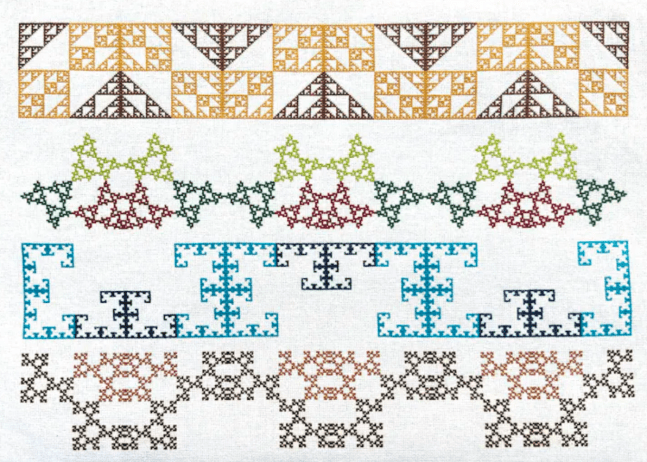
“I have been working with needle crafts since graduate school. I have also been interested in fractals and fractal geometry for more than 30 years. I have combined these mathematical and artistic interests to create cross stitch and back stitch pieces to illustrate the beauty and mathematics of fractals associated with iterated function systems. As a mathematician I like to seek fractal images that have symmetry or illustrate some interesting mathematical idea.”
[Back to top.]
[Back to Table of Contents.]
Teaching with Wisdom and Grace
- Have you considered Gameschooling Math? Play is a natural way to learn, for all ages.
- Keith Devlin puts the year in perspective with a few tidbits of math history: Counting Back in Hundreds.
- John Golden is Collecting history and cool math resources and asks “What would you add?“
- Jenna Laib ponders the danger of labeling students in How Amalia Multiplies: Listening and Learning from a Fourth Grader.
- Michelle shares 10 Lessons Learned as a Homeschool Teacher in Public School.
- Kristin Gray discusses Leveraging Digital Tools for Problem Posing.
- Howie Hua offers three favorite tips for teachers in his Small Changes, Big Impacts series: Part 1, Part 2, Part 3.
- Dylan Kane considers a productive way to handle productive struggle: Do It Less, Do It Well.
- Sunil Singh makes the case for Why We Need To Teach Number Theory In Math Education.
- Ben Orlin introduces The Battlestar Galactica Theory of Math Education.
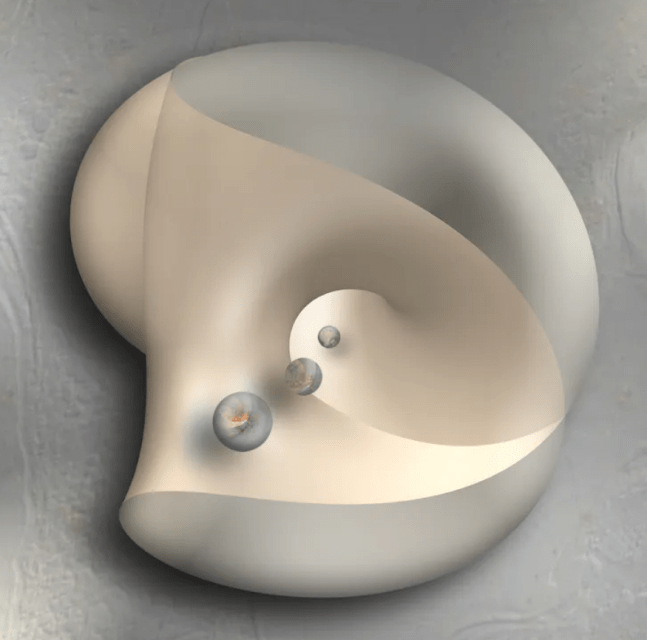
“Mathematics is a journey of discovery, and so is art. Both math and art rely on creativity, problem-solving skills, and the ability to see things in new ways. Geometry is the study of shapes and space. Artists use geometry to create perspective, design balanced and symmetrical compositions, or use patterns found in Nature and studied in mathematics to incorporate rhythm, movement, and harmony in their work. Interpreting the language of mathematics to develop new visualizations is both inspiring and gratifying.”
[Back to top.]
[Back to Table of Contents.]
Giving Credit Where It’s Due
Art images and quotations are from the 2024 Joint Mathematics Meetings Art Exhibition. The opening puzzle is from my blog post, A Puzzle for Palindromes.
And that rounds up this 171st edition of the Playful Math Education Blog Carnival. I hope you enjoyed the ride.
The next installment of our carnival will open sometime during the month of February at The Montessori Cosmos. Visit our carnival information page for more details.
We need volunteers! Classroom teachers, homeschoolers, unschoolers, or anyone who likes to play around with math (even if the only person you “teach” is yourself) — if you would like to take a turn hosting the Playful Math Education Carnival, please speak up!
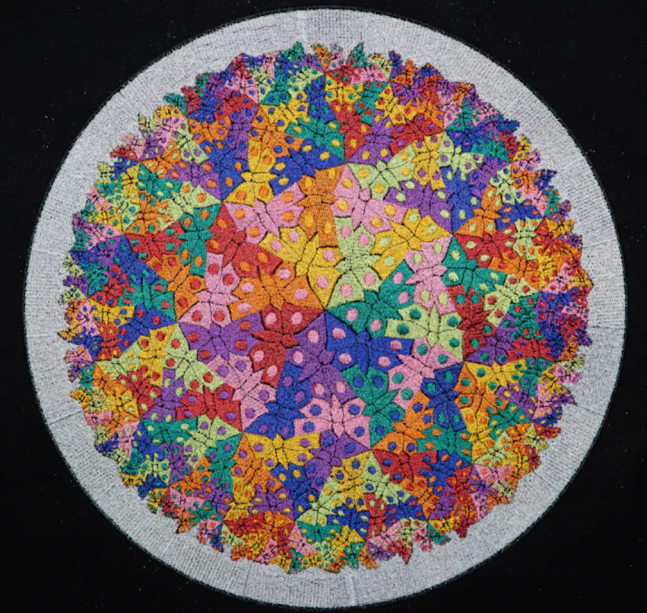
“This is a tessellation of the Poincaré circle model of hyperbolic geometry by Escher-inspired butterflies. The butterfly stitches follow the orientation of the butterflies and the spots have stitches perpendicular to the underlying butterfly. We stopped the butterfly pattern about 7/8 of the way to the edge of the bounding circle because the butterflies were becoming too small to implement with finite thickness thread and filled the rest with gray.”
* * *
Thank you for reading!
“Playful Math Education Carnival 171: Modern Math Artists” copyright © 2024 by Denise Gaskins. Image at the top of the post copyright © jowka23 / Depositphotos.
 Denise Gaskins' Let's Play Math