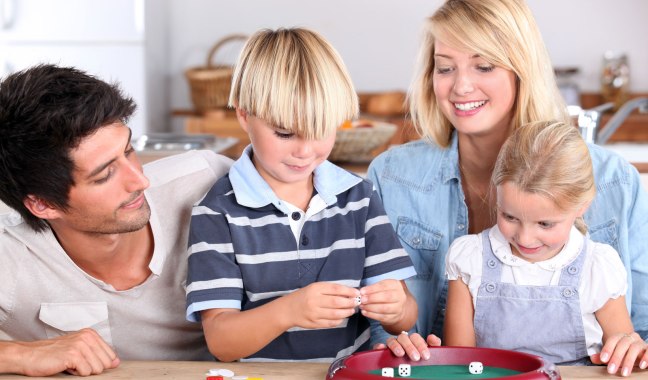
 Here are three quick math games you can fit in whenever you have a few minutes’ free time. Have fun playing math with your kids!
And if you enjoy these games, check out my Math Journaling Adventures project to discover how similar playful writing activities can help your students learn mathematics. Preorder your books today!
Save Twenty
Roll 5 dice three times, saving any you like, as in Yahtzee. Whoever gets the closest to 20 wins.
Broken Calculator
(Good for short car trips or when you’re stuck waiting in a restaurant or doctor’s office.)
Players take turns challenging the others to (orally) make a number.
For example:
- My calculator has a broken “1” key. How can I enter the number “11”?
Answers will vary, but here’s one option:
- Enter 22 ÷ 2.
For a greater challenge, let more than one key be broken.
Prime Number Game
The first player writes any whole number.
On each succeeding turn, copy the previous line, replacing any one number with an equivalent multiplication of two new factors. Factoring 1 times a previous number does NOT count!
The player who writes the last line (leaving no move for the opponent) loses the game — unless this happens within the first three lines, in which case the first player loses for picking such a boring number.
Sample game:
48
= 4 × 12
= 4 × 3 × 4
= 2 × 2 × 3 × 4
= 2 × 2 × 3 × 2 × 2 (loser)
Journaling with a Math Game Prompt
Games are the ultimate re-playable activity prompts. As children repeat a game, they try variations on their previous moves to gain extra advantage. This sort of experiment mirrors the approach a mathematician may take when faced with a problem. What if we try this, or that? How do things change, and what stays the same?
Encourage your students to write about their thoughts and discoveries.
After they master the ordinary version of a game, try a misère variation. In a misère game, the move that otherwise would win now makes you the loser. Students must reconsider their strategy and think more deeply about the game.
Or try to modify the game rules. What if they changed the number of cards to draw, or how many dice to throw? If the game uses dice, can they figure out a way to play it with cards or dominoes? Or transfer it to a gameboard? Or is there a way to use money in the game? Or can they change it into a whole-body action game? Perhaps using sidewalk chalk?
How is their new game like the original version? How is it different? Which one do they think is more fun to play?
Older students may want to analyze a game. Does one player have the advantage, or do both players have an equal chance of winning? What’s the best move? Can they find a strategy to increase their odds? How are fairness and randomness linked?
* * *
Are you looking for more creative ways to play math with your kids? Check out all my books, printable activities, and cool mathy merch at Denise Gaskins’ Playful Math Store. Or join my email newsletter.
This blog is reader-supported. If you’d like to help fund the blog on an on-going basis, then please join me on Patreon for mathy inspiration, tips, and an ever-growing archive of printable activities.
“Math Journal: Three Quick Number Games” copyright © 2025 by Denise Gaskins. Game ideas sourced from Math for Love and John Golden’s Math Hombre blog. Image at the top of the post copyright © photography33 / Depositphotos.
 Denise Gaskins' Let's Play Math