[An addendum to my earlier Charlotte Mason Math series.]
“Our business is to give [children] mind-stuff, and both quality and quantity are essential. Naturally, each of us possesses this mind-stuff only in limited measure, but we know where to procure it; for the best thought the world possesses is stored in books; we must open books to children, the best books; our own concern is abundant provision and orderly serving.”
— Charlotte Mason, Toward A Philosophy of Education
Most homeschool teachers, whatever our curriculum or schooling approach, understand the importance of teaching with living books. We read aloud biographies, historical fiction, or the classics of literature. We scour library shelves for the most creative presentations of scientific topics that interest our children, and encourage our high school students to go back to the original documents whenever possible.
And we teach math with a textbook.
Not that textbooks are inherently bad, because math is an abstract science. We need to meet the ideas — the “mind-stuff” — of math on their own terms, and textbooks can help with that.
But it’s not enough.
“The question is not, how much does the youth know? when he has finished his education––but how much does he care? and about how many orders of things does he care? In fact, how large is the room in which he finds his feet set? and, therefore, how full is the life he has before him?
“I know you may bring a horse to the water, but you cannot make him drink. What I complain of is that we do not bring our horse to the water.
“We give him miserable little textbooks, mere compendiums of facts, which he is to learn off and say and produce at an examination; or we give him various knowledge in the form of warm diluents, prepared by his teacher with perhaps some grain of living thought to the gallon.
“And all the time we have books, books teeming with ideas fresh from the minds of thinkers upon every subject to which we can wish to introduce children.”
— Charlotte Mason, Schoolbooks and How They Make for Education
Living Math Through History
History teaches our children to care about math.
The story of mathematics is the story of interesting people. They faced the normal challenges of daily life as well as the creative challenges of mathematical imagination. For some, calculation and problem-solving seemed as natural as breathing. Others worked for years in fits and starts before reaching a solution. Some had long and happy lives. Others died tragically young.
What a shame it is that our children see only the dry remains of these people’s passion. Worksheet exercises are the bare, abstract skeletons of what were once living puzzles.
Charlotte Mason’s contemporary, math professor James Glaisher, once said, “I am sure that no subject loses more than mathematics by any attempt to dissociate it from its history.”
By teaching math history, we can help our students build a mental picture of the ebb and flow of ideas through the centuries. They will see how men and women wrestled with concepts, made mistakes, argued with each other, and gradually developed the knowledge that today we take for granted.
String, Straightedge, and Shadow: The Story of Geometry
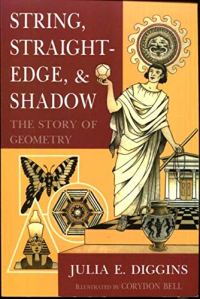 Julia Diggins wrote a lovely math book that used to be available through many libraries. But as old copies wore out or got removed from the shelves to make room for new books, it became difficult to find.
Thanks to the Internet Archive, you can now read several chapters online:
- Chapters 8, 9: Thales
- Chapters 11, 12: Pythagoras and his Theorem
- Chapter 13: Platonic Solids
- Chapter 14: The Irrationals
- Chapter 15: The Golden Mean
- Chapter 16: Archimedes
- Chapter 17: Eratosthenes
“Through the ages, men have searched to find the secrets of the universe. As these secrets were learned, they were written down in mathematical symbols. Today the search for secrets goes on: the mystery of the universe is still unfolding.”
— Julia E. Diggins, String, Straightedge, and Shadow
(I’m glad to say that Jamie York Press reprinted the book a few years back. You can find it here, or check your favorite bookstore.)
More Living Books for Math
For more ways to supplement your math lessons with living books, check out my blog posts:
- Hooray for (Math) History (an excerpt from my book Let’s Play Math: How Families Can Learn Math Together and Enjoy It)
- Living Books for Math (my two top picks for each age group, including adults)
Have fun reading math with your kids!
“But by the beauty of shape I want you to understand not what the multitude generally means by this expression, like the beauty of living beings or of paintings, but something alternatively rectilinear and circular, and the surfaces and solids which one can produce with compass, set square, and rule. For these things are not like the others, conditionally beautiful, but are beautiful in themselves.”
— Plato
* * *
Are you looking for more creative ways to play math with your kids? Check out all my books, printable activities, and cool mathy merch at Denise Gaskins’ Playful Math Store. Or join my email newsletter.
This blog is reader-supported. If you’d like to help fund the blog on an on-going basis, then please join me on Patreon for mathy inspiration, tips, and an ever-growing archive of printable activities.
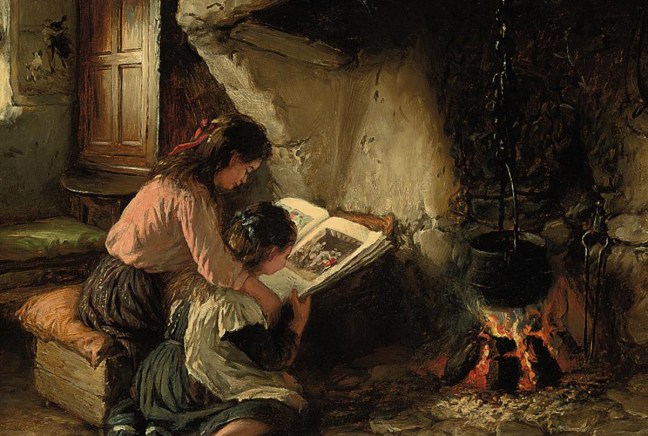
“Charlotte Mason Math: Living Books” copyright © 2025 by Denise Gaskins. Image at the top of the blog “The Reading Lesson” by Jonathan Pratt, public domain.
 Denise Gaskins' Let's Play Math