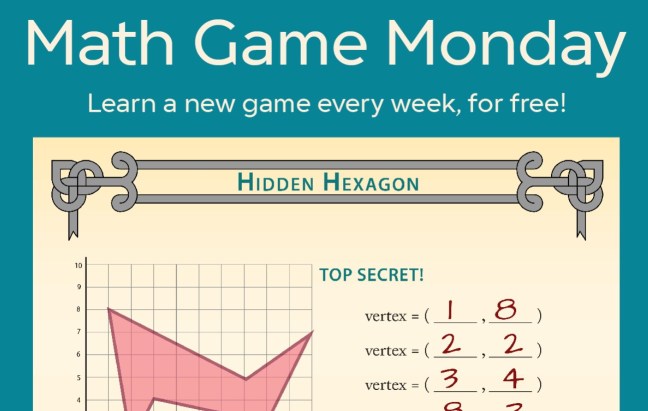
This game offers a fun twist on the old classic Battleship. Can you discover your opponent’s secret shape before they find yours?
Many parents remember struggling to learn math. We hope to provide a better experience for our children.
And one of the best ways for children to enjoy learning is through hands-on play.
Hidden Hexagon
Math Concepts: coordinate graphing (first quadrant), simple linear equations, irregular polygons.
Players: two players or two teams.
Equipment: printed gameboard or square grid paper for each player, pencils, ruler or other straightedge.
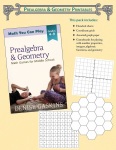 The FREE 68-page printable (pdf) Prealgebra & Geometry Printables file features hundred charts, coordinate grids, assorted graph paper, and all the game boards for the Math You Can Play: Prealgebra & Geometry book.
Set-Up
To make your own gameboards, give each player a sheet of square grid paper. Players outline two 10 × 10 grids and label the x and y axes 0–10. Label one grid “Top Secret” and the other grid “Clues.”
On your secret grid, draw a closed shape with six straight sides, with vertices on the grid points and at least one grid point entirely inside the shape. Use a ruler or straightedge for precise lines. Don’t let the sides of your shape cross each other. This is your hidden hexagon. Record the ordered pairs for each vertex beside the grid.

How to Play
Players alternate turns asking for information so they can guess their opponent’s secret shape. On your turn, name an equation for a horizontal, vertical, or diagonal line.
For example:
- The equation “x = 3” represents the vertical line that includes such points as (3,0) and (3,5).
- The equation “y = 10” indicates the top horizontal line on the gameboard, including points like (1,10) and (7,10).
- The equation “y = x” is the diagonal line from the origin slanting up at a 45° angle. It passes through such points as (2,2) and (9,9).
Your opponent checks that line against their hidden hexagon and tells whether each coordinate point is a vertex, on the perimeter, inside the shape, or outside.
For example, imagine your opponent has the hexagon shown above, and you ask for the y = 3 clues. Point (2,3) is inside the shape, and (8,3) is a vertex. All the other points are outside the hexagon.
Record this information on your Clues grid. Invent your own code, such as:
- Vertex = Mark the point with a star and record the coordinates as an ordered pair beside the grid.
- Perimeter = Mark the point with a shaded circle.
- Inside = Draw an open circle.
- Outside = Mark with an X.
After you discover all six vertices of the hidden hexagon, you may guess right away. Or you may keep playing to collect more information on the secret shape.
When you’re ready, connect the vertices on your Clues grid. Make sure the shape fits properly around all the marked points. Reveal your drawing and compare it to the hexagon on your opponent’s gameboard.
The first player to guess ends the game. If your drawing matches the hidden hexagon, you win the game. But if your guess is wrong on any point, the other player wins.
Variations
You can play Battleship-style: Players name individual points instead of a full line. If the game seems too long, try asking for two or three points per turn.
Words to Know
A hexagon is a six-sided polygon. It also has six vertices (singular vertex), which is the math word for corner points.
Is it a coincidence that the number of sides and corners match?
Most people know the familiar honeycomb pattern of regular hexagons. But your children may be surprised to hear that any six-sided polygon is a hexagon.
Exploration
After playing a few rounds, take time to compare observations. Think about the different shapes you’ve seen in your games. What tricks make a hidden hexagon difficult to guess?
Can you think of any other ways to draw a six-sided shape? Try making a concave hexagon, or one with no symmetry at all. Can a hexagon have a right angle? Can it have a reflex angle, greater than 180°?
If you use a whole page of square grid paper, does that give you more options for weirdly shaped hexagons? What if the vertices don’t have to be on a grid point?
Can you make a conjecture about hexagons?
History
Teacher coach Terry Kawas modified the traditional Battleship game to create a quadrilateral guessing game called Shape Capture. Teacher and author Christopher Danielson shared a wonderful geometry investigation called Hierarchy of Hexagons. If ideas can have children, this game of mine is their offspring.
* * *
 This game is an excerpt from Prealgebra & Geometry: Math Games for Middle School. Discover more of my books, printable activities, and cool mathy merchandise at Denise Gaskins’ Playful Math Store.
Special Offer: Would you like to access a growing archive of Math Monday games and other activity ideas as convenient printable pdf downloads, ready to print and play with your kids? Join me on Patreon for mathy inspiration, tips, printable activities, and more.
“Math Game Monday: Hidden Hexagon” copyright © 2025 by Denise Gaskins.
 Denise Gaskins' Let's Play Math