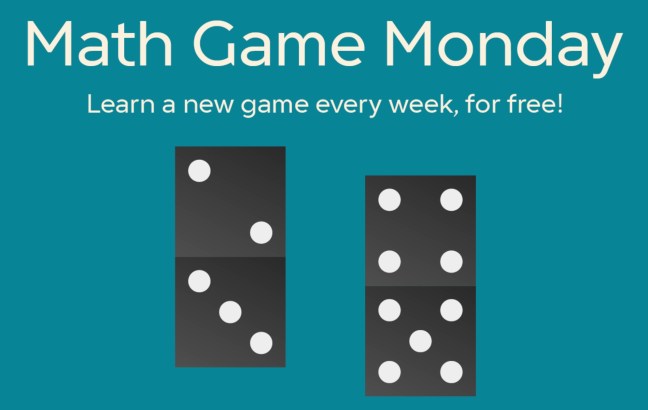
This game offers upper-elementary and middle school students plenty of practice doing estimation and mental math with fractions.
Many parents remember struggling to learn math. We hope to provide a better experience for our children.
And one of the best ways for children to enjoy learning is through hands-on play.
Domino Fraction War
Math Concepts: proper fractions, comparing fractions.
Players: two or more.
Equipment: one set of double-six or double-nine dominoes.
How to Play
Remove the double-blank tile. Turn all remaining domino tiles face down on the table and mix them around to make the wood pile.
Each player turns one tile face up and makes a proper fraction (smaller number on top) with the numbers on the two halves of the tile. The player who has the greatest fraction takes the other players’ tiles prisoner, placing his own and all the captured tiles face up at his side.
If there is a tie for greatest fraction, turn that hand of domino tiles face down and shuffle them back into the wood pile. Then the players all turn up new tiles for the next skirmish.
When there are no longer enough dominoes on the table for every player to draw one, the players count their prisoners. Whoever has captured the most tiles wins the game.

Variations
Instead of requiring the smaller number to be on top, you can allow improper fractions, but be careful with blank sides. A blank is a zero, and a fraction may never have zero in the denominator, so the blank always has to go on top.
Domino tiles work for any Math War variation. Turn up a tile and add, subtract, or multiply the two numbers — whatever you want to practice.
Domino War Trumps: Beginning with the youngest and continuing around the table, players take turns saying “high” or “low” to tell whether the greatest or least fraction will win that round. Players draw tiles as described above but hide them from each other. After seeing his or her tile, the player whose turn it is declares the trump. Then all players display their tiles.
Exponent War: If you draw the 3|5 tile, will you make 35 or 53?
History (and a Puzzle)
Domino-like tile games seem to have originated in China, and they came to Europe through the great trading cities of Venice and Naples. Some game historians claim the European game was invented independently, because European domino sets are different from Chinese sets in several ways. (For instance, Chinese tiles come in suits, like a set of playing cards.) Dominoes spread across France and reached England in the late eighteenth century, where the game became a favorite pastime in British pubs.
Encourage your children to examine a set of domino tiles and describe what they notice. For example, every possible combination (double-0, 0|1, 0|2, etc.) is a single tile, but there are no duplicates: 0|1 is the same tile as 1|0.
Ask them, “If you bought a set of dominoes at a garage sale, how could you tell whether any of the tiles were missing? Can you figure out how many tiles there should be?”
Spoiler: To find the answer, make a systematic list, and be careful not to count any of the combinations twice. A double-six set should have twenty-eight tiles, and a double-nine set will have fifty-five. A new set from the store may contain extra blank tiles, which can be decorated with paint or white nail polish to replace lost pieces.
* * *
This game is an excerpt from Multiplication & Fractions: Math Games for Tough Topics. Discover more of my books, printable activities, and cool mathy merchandise at Denise Gaskins’ Playful Math Store.
Special Offer: Would you like to access a growing archive of Math Monday games and other activity ideas as convenient printable pdf downloads, ready to print and play with your kids? Join me on Patreon for mathy inspiration, tips, printable activities, and more.
“Math Game Monday: Domino Fraction War” copyright © 2025 by Denise Gaskins.