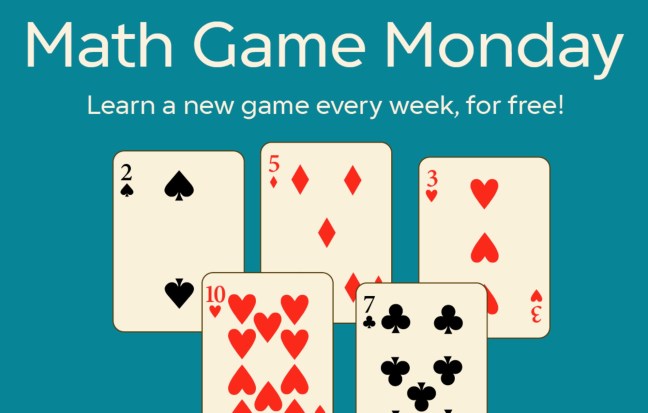
This equation game for elementary students builds creative, flexible thinking about addition and subtraction.
Many parents remember struggling to learn math. We hope to provide a better experience for our children.
And one of the best ways for children to enjoy learning is through hands-on play.
Target Ten
Math Concepts: addition, subtraction, multistep calculation.
Players: any number.
Equipment: one deck of math cards, pencils and paper, timer (optional).
How to Play
Deal five cards to each player, face up on the table.
Players list all the ways they can think of combining any two or more of their own cards to make a total of ten. Numbers may be added or subtracted, but each card may be used only once in each calculation. For instance, you could not use the expression 5 + 5 unless you were dealt two fives.
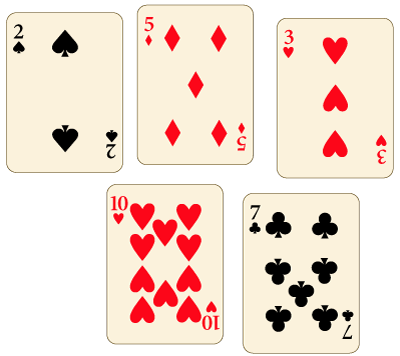
If you were dealt 2, 3, 5, 7, and 10, you might make the following combinations:
10
3 + 7
10 + 5 − 3 − 2
7 + 5 − 2
etc.
This is not a racing game, but you may want to set a reasonable time limit of perhaps two to ten minutes, depending on the age and patience level of the players.
Each valid expression scores 1 point per card used. The player with the highest score is the winner.
Variations
To eliminate the element of chance, deal five cards face up in the middle of the table. All players use these cards to see how many ways they can make ten.
House Rule: Will you count 3 + 7 as different from 7 + 3? If a player is dealt two threes and a seven, does that count as two different ways to make 3 + 7? I do not count these as separate combinations, but you may if you wish.
For Younger Students: Make this a cooperative game by working together to find all the possible ways to make ten in each player’s hand. Offer hints to help your students find the multistep combinations. “How many more does seven need to make ten? Can you find a way to combine two of your cards to make three? Here’s a five and a two…”
For Older Students: Allow multiplication and division. This will give your children more possible ways to make ten, but it will also give them an unfair advantage if they are playing against a younger child.
Target X: Before dealing to the players, turn up one card in the center of the table to be the target number for this hand.
History
Target Ten is based on “Five Cards Make 10” from Peggy Kaye’s delightful book, Games for Math. Kaye describes many other games and activities for exploring math with preschool and early elementary children. If you have not read her book, be sure to look for it the next time you visit your local library.
* * *
 This game is an excerpt from Math You Can Play Combo: Number Games for Young Learners. Discover more of my books, printable activities, and cool mathy merchandise at Denise Gaskins’ Playful Math Store.
Special Offer: Would you like to access a growing archive of Math Monday games and other activity ideas as convenient printable pdf downloads, ready to print and play with your kids? Join me on Patreon for mathy inspiration, tips, printable activities, and more.
“Math Game Monday: Target Ten” copyright © 2026 by Denise Gaskins.
 Denise Gaskins' Let's Play Math