
This game encourages players to reason about the relationships between length dimensions and volume in a 3-D shape.
Many parents remember struggling to learn math. We hope to provide a better experience for our children. And one of the best ways for children to enjoy learning is through hands-on play.
So what are you waiting for? Let’s play some math!
Prism Power
Math Concepts: rectangular volume, cubic units.
Players: two or more.
Equipment: printed gameboard or plain paper, pencils or markers, one six-sided die, 40–50 cubic blocks per player.
Set-Up
Interlocking cubes work well for this game, as do plain wooden cubes. We’ve also played with sugar cubes when we found them cheap — but do spread a napkin or something to catch the inevitable sugar crumbs.
Print a gameboard for each player. Or make your own scoresheet with four columns labeled length, width, height, and volume (total number of cubes) and use a second sheet of paper for your building property. Draw a straight line to represent the street-facing edge of your property.
If you have enough dice, players may all take their turns at the same time.
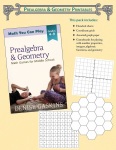 The FREE 68-page printable (pdf) Prealgebra & Geometry Printables file features hundred charts, coordinate grids, assorted graph paper, and all the game boards for the Math You Can Play: Prealgebra & Geometry book.
How to Play
Each player starts with two blocks, creating a rectangular prism (box shape). Place the long edge of your initial prism parallel to the street-edge of your paper property. This side is your building’s “length” throughout the game.
All players record their building’s measurements for length (2), width (1), height (1), and the initial volume (2 cubes). One side-edge of a block is one length unit, and the volume is the total number of blocks.
On your turn, roll the die and follow the instructions that match your number:
• 1 = Architect’s Choice: Add one layer to any dimension.
• 2 = Elbow Room: Make your prism one layer wider.
• 3 = Expanding Storefront: Make your prism one layer longer.
• 4 = Penthouse Apartment: Make your prism one layer taller.
• 5 = Community Investment Grant: Increase the smallest dimension by one.
• 6 = Zoning Violation: Remove one layer from the dimension of your choice.
After each turn, record your building’s new dimensions and volume on your scoresheet.
Notice that the street-facing length of your building may not always be the longest side, depending on how the dice roll. It often happens in algebra that the side we called “length” when we began a problem turns out to be shorter than the side we initially called “width.” That’s fine because these names make no difference in the final calculation of area or volume.
The game ends when any player’s building exceeds forty cubes. Finish that round, so all players have the same number of turns. Then count up your score based on the Architect’s Prizes below, and the highest score wins.
Architect’s Prizes
Award one point in each of the following prize categories:
• Forty or more cubes
• Tallest building
• Greatest volume
• Greatest perimeter around the base
• Most area on any one side
If two or more players tie for an award, each player gets a point.
Words to Know
What most people call a “box shape,” mathematicians call a right rectangular prism — a prism with a rectangle for its base.
A prism is any shape with a polygonal base — actually two identical bases, the top and bottom — and flat sides that connect the two bases. All the side edges are parallel to each other. Think of a deck of cards with each card cut into an identical polygon shape. When you stack all the cards in the deck, you create a prism with that polygon as the base.
When the deck of cards is stacked straight up, we call that a right prism because the side edges make a right angle with the table. Each side of a right prism is a rectangle, no matter what shape is the base. The common glass or plastic prism used to turn light rays into rainbows is a right triangular prism.
If the deck of cards slants sideways, making each side a parallelogram, the prism is oblique. Notice that one deck of cards can form either a right or oblique prism — or several oblique prisms at different angles — but the volume (total space enclosed) never changes. Any oblique prism has the same volume as a right prism with the same base and height.
Incidentally, the idea of imagining a shape as a stack of cards is called Cavalieri’s Principle (named after Bonaventura Cavalieri, one of Galileo’s students). Your children will use this principle in calculus to find the volume of two- and three-dimensional objects.
History
John Golden shared this game on his Math Hombre blog.
* * *
 This game is an excerpt from Prealgebra & Geometry: Math Games for Middle School, available at my bookstore (Thank you for cutting out the middleman!) and through many online retailers. Read more about my playful math books here.
Special Offer: Would you like to access a growing archive of Math Monday games and other activity ideas as convenient printable pdf downloads, ready to print and play with your kids? Join me on Patreon or choose the paid subscription on Substack for mathy inspiration, tips, printable activities, and more.
“Math Game Monday: Prism Power” copyright © 2026 by Denise Gaskins.
 Denise Gaskins' Let's Play Math