 I’ve written before about supplementing your children’s experience of math by playing games and reading good books.
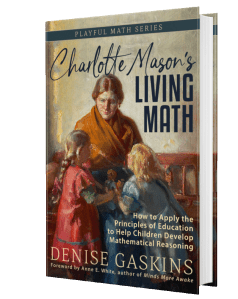
But as I’m working on my new book, I wanted to add another valuable supplement that we often overlook. So here’s a preview excerpt from Charlotte Mason’s Living Math…
Discover Math in Art
In addition to books, supplement your child’s experience of math with art. When students learn to visualize shapes, designs, and patterns, it makes them better at math. Even topics like algebra can be surprisingly visual.
Art lets children experiment with lines, curves, shapes and symmetries, exploring a wide range of mathematical structures and relationships.
While any piece of artwork has mathematical elements, geometric art and sculpture are easy places for beginners to start. Consider, for example, M. C. Escher’s tessellations, Islamic and Arabic decorative designs, Celtic knot patterns, or the playfulness of Op Art.
You can use the Notice-Wonder-Create cycle of learning: Choose an image to study, and begin by paying attention to everything you can see. What sort of math was the artist playing with?
Consider elements such as…
- Number: unit, counting, order, sequence, series, precision, approximation, and so on.
- Shape: line, angle, parallel, perpendicular, polygon, face, side, vertex, curve, arc, circle, ellipse, chord, radius, diameter, shape, space, boundary, position, depth, perspective, size, and so on.
- Pattern: symmetry, reflection, rotation, repetition, reverse, tessellation, illusion, rhythm, growth, spiral, structure, decoration, color (and relations on a color wheel), and so on.
Wonder about the things you notice, the choices the artist made, or what they might have been thinking. Wonder about relationships to mathematical concepts or to other artistic works. If you were creating this piece, what would you have changed or done differently?
Then create a math art image of your own, riffing off one or more of your noticings and wonderings.
Sources for Math Art
- John Golden’s “(Mathhombre) Miscellanea” Tumblr: mathhombre.tumblr.com, and “Math × Art” page: mathhombre.blogspot.com/p/mathart.html.
- “Mathematical Art Lessons” by Clarissa Grandi: artfulmaths.com/mathematical-art-lessons.html.
- “#MathArtChallenge” by Annie Perkins: arbitrarilyclosecom.wordpress.com/home.
- The Bridges Conference “Mathematical Art Galleries”: artgallery.bridgesmathart.org.
- “Mathematics and art” article: en.wikipedia.org/wiki/Mathematics_and_art, and “List of mathematical artists”: en.wikipedia.org/wiki/List_of_mathematical_artists.
- Islamic Art and Geometric Design: Activities for Learning by The Metropolitan Museum of Art: archive.org/details/IslamicArtandGeometricDesignActivitiesforLearning.
- Celtic Art, The Methods Of Construction by George Bain: archive.org/details/CelticArtTheMethodsOfConstruction.
- “What can you do with a page full of dots?” from my Let’s Play Math blog: denisegaskins.com/2017/03/23/dot-grid-doodling.
And Three Examples to Enjoy
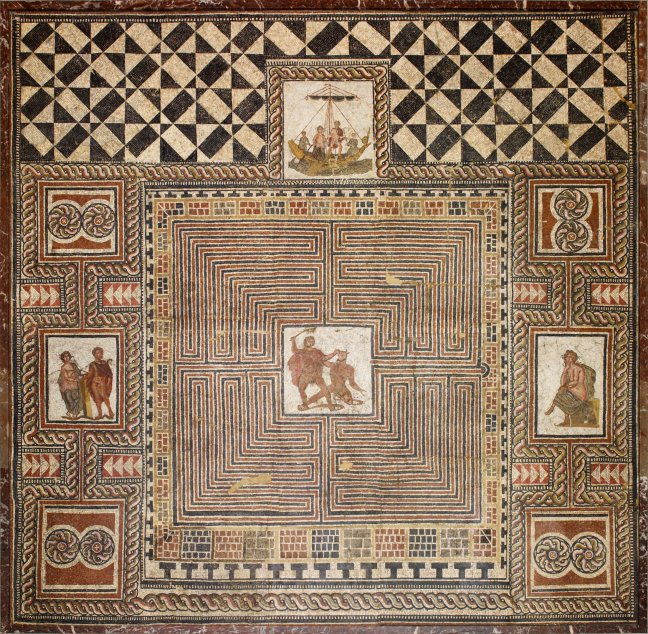
“Theseus Mosaic” by artist unknown, marble and limestone pebbles, circa 350.
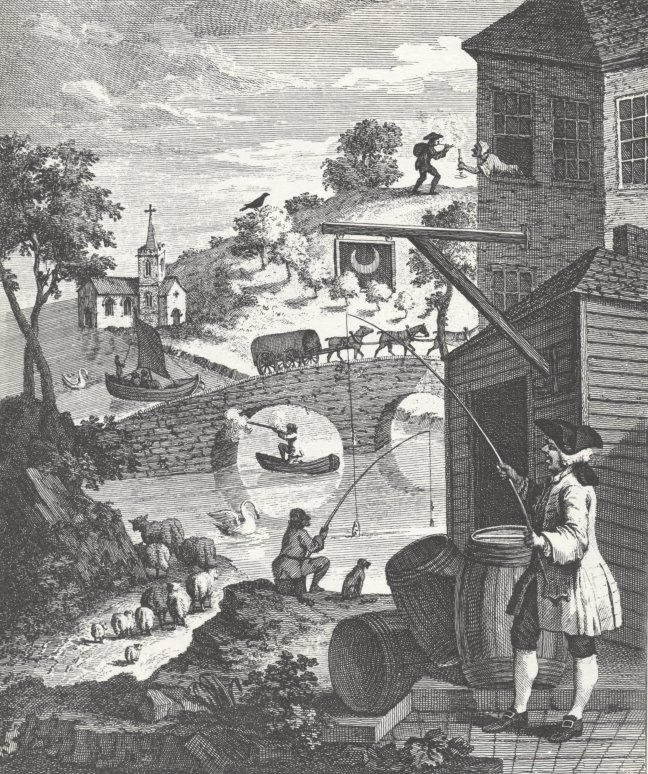
“The importance of knowing perspective” by William Hogarth, engraving on paper, circa 1750.
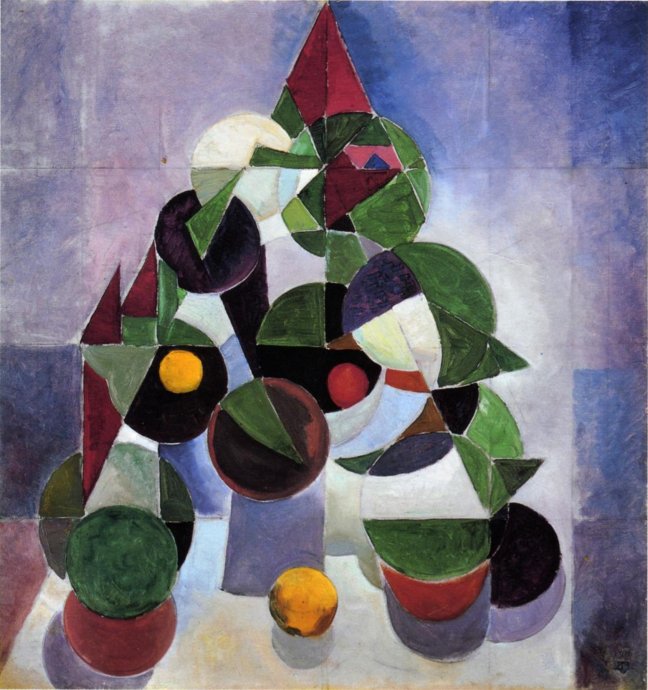
“Composition I (still life)” by Theo van Doesburg, oil on canvas, 1916.
Order Your Book Today
Don’t miss out! Choose your favorite pledge level, and reserve your copy today:
* * *
“Discover Math in Art” copyright © 2026 by Denise Gaskins. Image at the top of the post copyright © wadrus.p / Depositphotos.
Are you looking for more creative ways to play math with your kids? Check out all my books, printable activities, and cool mathy merch at Denise Gaskins’ Playful Math Store. Or join my free email newsletter on Substack.
This blog is reader-supported. If you’d like to help fund the blog on an on-going basis, then please join me on Patreon (or choose the paid level on Substack) for mathy inspiration, tips, and an ever-growing archive of printable activities.
 Denise Gaskins' Let's Play Math


Thanks for the link to the tumblr! I also have artists and lessons linked on the blog. (Need of updating, but that’s soon!) https://mathhombre.blogspot.com/p/mathart.html
Yep, John, I’ve got that link up above, too — as well as in my new book.
Keeping a blog updated is a lot of work, isn’t it? I’ve got several pages overdue for updates myself, but I’m not sure when I’ll get to them…