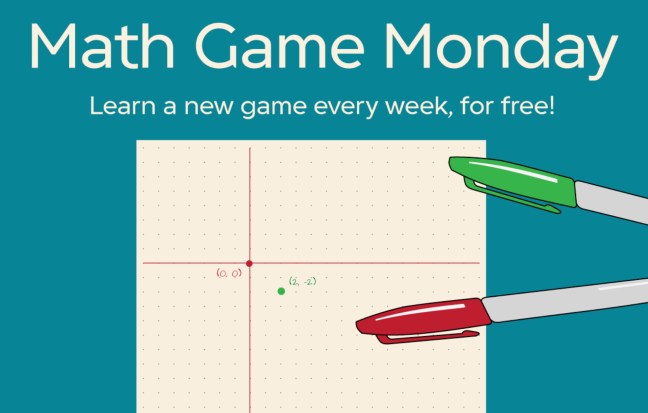
This is a fun and challenging logic/strategy game for upper-elementary and middle school. One of my favorites!
Many parents remember struggling to learn math. We hope to provide a better experience for our children. And one of the best ways for children to enjoy learning is through hands-on play.
So what are you waiting for? Let’s play some math!
Coordinate Gomoku
Math Concepts: ordered pairs, coordinate graphing (four quadrants).
Players: two players or two teams.
Equipment: dotty or lined square grid paper, different colored pencils or markers.
Set-Up
Players share one sheet of dotty or lined grid paper. Each player needs a different colored pencil or marker, and they may want to choose a symbol like X, O, star, or small triangle to make their marks perfectly distinct.
How to Play
The first player claims any dot on the grid by marking it with his or her symbol. If you are using lined graph paper, choose any place where two lines intersect.
This is the origin (0,0) for your game. Draw the horizontal and vertical lines (the x and y axes) that meet at that point.
On succeeding turns, you must name the coordinates of a point before you mark it. If you make a mistake naming the point, your opponent can give the correct (x,y) coordinates and mark it with their own symbol — and they still get to take their own turn.
The first player or team to mark five points in a horizontal, vertical, or diagonal row with no gaps wins the game.
Variations
House Rule: How do you want to handle overlines that have six or more points in a row? In traditional Gomoku, only an exact five-in-a-row line can win.
Swap2: Does the first player win too often? What you need is a variation on the “pie rule” — one person slices the pie, and the other gets first choice of piece. Reduce the first-player advantage with these starting moves, which are often used in tournament play. The first player marks two Xs and one O. The second player selects one of three options:
- Accept these moves and mark an O. Turns continue with the first player marking X.
- Take over the Xs, so the first player goes next with O.
- Or mark one additional X and O, then let the first player choose which letter to claim. Whoever plays O takes the next turn.
Words to Know
On a coordinate graph, the horizontal x-axis number line and the vertical y-axis number line meet at the point (0,0), called the origin. The origin is the point from which we measure all other coordinates.
Like zero on a number line, the origin is an arbitrary point. It can go anywhere on your paper.
The horizontal and vertical axes divide the coordinate plane into four areas called quadrants. In the first quadrant, both x and y coordinates are positive numbers.
If we draw the axes in the traditional position, so that the first quadrant is in the top right-hand section of the page, the other quadrants are numbered in order counterclockwise. What types of (x,y) numbers do you find in each quadrant?
History
Gomoku is a Japanese game played with stones on the Go board. Math teachers have played coordinate-graph Gomoku games with students for decades. The Nrich Maths website added the idea of letting the origin float to wherever the first point is marked.
* * *
 This game is an excerpt from 312 Things To Do with a Math Journal. Discover more of my books, printable activities, and cool mathy merchandise at Denise Gaskins’ Playful Math Store.
Special Offer: Would you like to access a growing archive of Math Monday games and other activity ideas as convenient printable pdf downloads, ready to print and play with your kids? Join me on Patreon or choose the paid subscription on Substack for mathy inspiration, tips, printable activities, and more.
“Math Game Monday: Coordinate Gomoku” copyright © 2026 by Denise Gaskins.
 Denise Gaskins' Let's Play Math