Check out the new playful math education carnival at eat play math blog. Math art, tessellations, review games, problem-solving challenges, and all sorts of mathy fun. Not to mention, Raspberry Tiramisu!
Welcome to the Math Teachers at Play #99 Blog Carnival, a monthly smorgasbord of links to bloggers all around the internet who have great ideas for learning, teaching, and playing around with math… Click here to go read the carnival blog!
June 17 marks World Tessellation Day, a holiday I created to bring awareness to the fun of finding and making tessellations.
Will you celebrate with us?
Here are 10 great ways to play with tessellations, learn about them, and introduce your children to a math concept that opens a variety of creative learning opportunities.
1) Learn about tessellations with your kids.
A tessellation is a tiled mosaic pattern of the same shape laid out over and over again, repeating into infinity. Tessellations can be found in nature, or they can be created by people. Learn more at these websites:
“My oldest son has somehow developed the horrid habit of counting on his fingers. We worked on the math facts all summer. He knows the answers in simple form, such as 9 + 4, but if it’s in a bigger problem like 249 + 54, he counts up to add or counts down to subtract, all using fingers. My younger children have no problem with mental math, but he can’t seem to get it. Are there any tips or tricks to stop this?”
Counting on fingers is not a horrid habit, it is a crutch. Please think for a moment about the purpose of crutches. The blasted things are an uncomfortable nuisance, but there are times when you can’t get anywhere without them. And if you need them, it does you no good for a friend to insist you should crawl along on your own.
That is how your son feels right now about his fingers. He is struggling with something his younger siblings find easy, and he can tell that you are frustrated. His confidence is broken, in a cast, and needs time for healing. So he falls back on what he knows he can do, counting up the answer.
Think positive: this means he still believes that math ought to make sense — that to understand what he is doing is more important than to guess at an answer. You want him to value sense-making, because otherwise he will try to memorize his way through middle school and high school math. That is the road to disaster.
… makes sense
… is more than just arithmetic
… is joyous
… makes them strong
… is meaningful
… is creative
… is full of fascinating questions
… opens up many paths to solutions
… is friendly
… solves big problems and makes the world better
… is a powerful tool they can master
… is beautiful
… lets them learn in their own ways
… is connected to their lives
… asks “why” and not just “how”
… opens the world
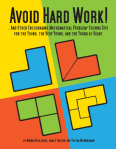
From the upcoming new book Avoid Hard Work by James Tanton and the Natural Math team.
Be clear on what you don’t know — and comfortable enough to admit it.
Seriously, those are wonderful videos. If you haven’t seen them before, go check them out. Be sure to come back, though, because I’ve just heard some great news.
Natural Problem-Solving Skills
Tanton has joined up with the NaturalMath.com team of Maria Droujkova, Yelena McManaman, and Ever Salazar to put together a book for parents, teachers, math circle leaders, and anyone else who works with children ages 3–10.
It’s called Avoid Hard Work, and it takes a playful look at ten powerful problem-solving techniques.
Join the Crowdfunding Campaign
For more details about Avoid Hard Work, including a 7-page pdf sample with tips and puzzles to enjoy, check out the crowdfunding page at Natural Math:
“Worksheet problems make my daughter’s brain freeze. Even simple things such as “2 + ___ = 2″ confuse her. What can I do?”
Can your daughter do math if you put away the worksheet and ask her a real-life problem: “I have a lunch sack. I put two cookies into the sack, and then I give it to you. When you look into the sack, you see two cookies there. Can you tell me what was in the sack at the beginning, before I put my cookies in?”
Or can she solve problems when the answer isn’t zero? Could she figure out how many you started with if she saw four cookies when she looked in the sack?
The idea of having a number for “nothing” can seem strange to young children.
My May “Let’s Play Math” newsletter went out last week to everyone who signed up for Tabletop Academy Press math updates, and again early this morning to everyone who signed up in the last week of May. This month’s issue featured a peek at the printable math model cards for my upcoming game book Math You Can Play: Multiplication & Fractions, along with a preview game from the book.
If you’re a subscriber but didn’t see your newsletter, check your Updates or Promotions tab (in Gmail) or your Spam folder. And to make sure you get all the future newsletters, add “Denise at Tabletop Academy Press” [denise.gaskins @ tabletop academy press .com, without spaces] to your contacts or address book.
If you missed this month’s edition, no worries—there will be more playful math snacks coming soon. Click the link below to sign up today!
Check out the new playful math education carnival at Math Misery? blog. Multiplication, fractions, humor, problem-solving challenges, and all sorts of mathy fun:
So this is Math Teacher’s at Play … the 98th edition! You know what’s really interesting about 98? It’s 47×2. No, that’s clearly false. 49×2=98. That’s much better. Ok, so here’s a question, are there more facts about 98 than there are non-facts (aka lies) about 98 or the other way around or are they equal in cardinality?
. . .
Make sure to give a the articles linked here a visit!
 Check out the new playful math education carnival at eat play math blog. Math art, tessellations, review games, problem-solving challenges, and all sorts of mathy fun. Not to mention, Raspberry Tiramisu!

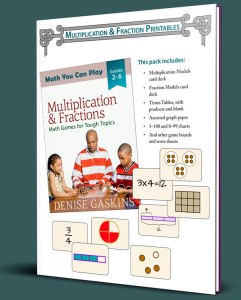 My May “Let’s Play Math” newsletter went out last week to everyone who signed up for Tabletop Academy Press math updates, and again early this morning to everyone who signed up in the last week of May. This month’s issue featured a peek at the printable math model cards for my upcoming game book Math You Can Play: Multiplication & Fractions, along with a preview game from the book.
 Denise Gaskins' Let's Play Math