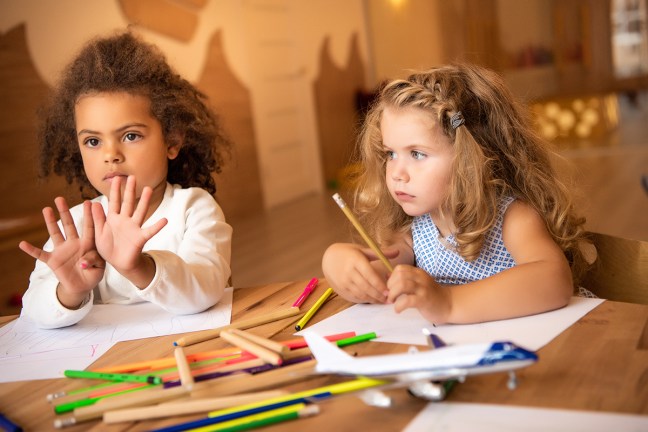
I stumbled across another blogger’s post on the common question, “What are the best math manipulatives for homeschooling?”
My answer to this question has changed over the years, as I’ve grown in my understanding of math and of education. As my current stance is far different from much of what I read from other homeschoolers, I’m going to lay out my reasoning below.
I’d love to hear your thoughts, especially if you disagree, because comparing ideas with one another is a great way to learn.
The Starter Set for Math
The most important math manipulatives for young children come built-in, part of their bodies from the beginning, always handy (literally) and ready to use for counting, comparison, or simple calculation. Yes, I mean their fingers.
In olden days, parents and teachers tried to stamp out the habit of counting on fingers, and stubborn children (like me) resorted to hiding our hands under our desks as we reasoned our way through early math. Nowadays, we know that allowing finger use can free a child’s mind to focus on thinking about mathematical relationships.
Another important math manipulative is scrap paper. Children should always be free to jot down tally marks, make simple sketches, or write down anything they need to help them figure out math. In this way, scrap paper (or a whiteboard) becomes an extension of children’s minds, holding the bits of detail that might otherwise leak out of their short-term memories, helping them focus on the broader concepts of math.
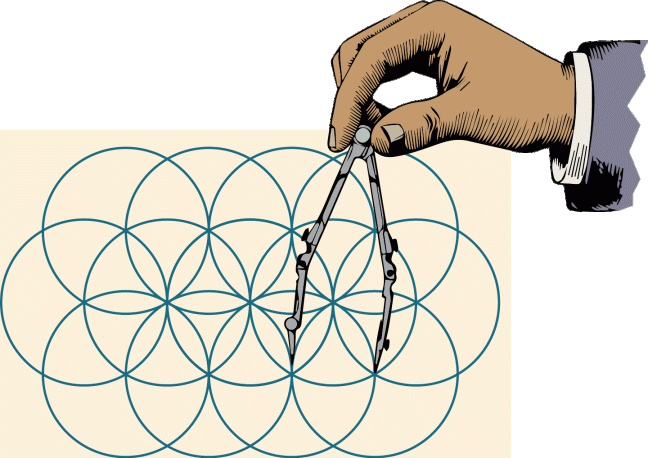
Finally, all children should have access to drafting tools like a ruler, compass, and plastic triangles. Creating math art is a great way to develop intuition about geometric concepts, as well as being fun.
Manipulatives for Counting and Number Facts
Many homeschool pundits claim the best math manipulatives are found items from around the house: dried beans, buttons, pebbles, leaves or small twigs, oat O’s cereal, raisins, and so on. Use a wide variety, they say, and vary the items from day to day to help children realize that number concepts don’t depend on the physical item we’re counting.
Found objects are useful for developing one of the important concepts of early math: number bonds, the pairs of number partners that combine to make a given total.
For example:
10 beans
= 1 bean + 9 beans
= 2 beans + 8 beans
= 3 beans + 7 beans, etc.
Number bonds, in turn, can lead a child to understand one of the fundamental ideas of arithmetic, the inverse connection between addition and subtraction.
For example:
10 = 3 + 7
is the same as
10 − 3 = 7
and
10 – 7 = 3
…because all three statements express the same mathematical relationship.
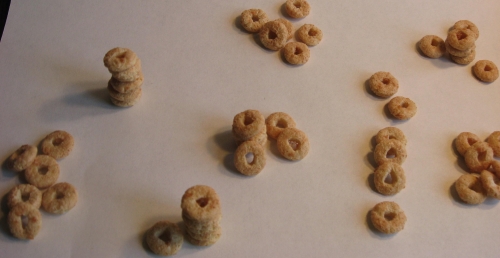
Pros: Found items are handy and cheap, easy to use for counting out small numbers and representing simple calculations.
Counting the items becomes an irritation as numbers grow larger, which pushes children away from dependence on the manipulatives toward using mental images and abstract number facts.
Cons: Found items rely on counting, which is the lowest level of mathematical reasoning.
Students can get stuck thinking of each number as a collection of items (such as 5=1+1+1+1+1) rather than as an entity in itself. This makes it harder for children to see the relationships between numbers.
Also, the mental leap between counting and abstract arithmetic can be too far, forcing children to rely on memorized facts and rules instead of building true conceptual understanding.
[Some people seem to view that last point as positive. They argue that young children are good at memorizing and parroting back information, so we ought to take advantage of this skill. I vehemently disagree with this argument. Memorized facts and rules make a weak foundation for future learning.]
More still to come…
This has grown rather longer than I expected. Let’s pause here, and I’ll be back next time with further thoughts…
* * *
In this blog series, I’ll be focusing primarily on manipulatives used to support elementary arithmetic, but I also like using manipulatives like pattern blocks for math art.
Do you use any type of manipulatives to get your children playing with math? I’d love to hear about your favorites!
This blog is reader-supported.
If you’d like to help fund the blog on an on-going basis, then please join me on Patreon for mathy inspiration, tips, and an ever-growing archive of printable activities.
If you liked this post, and want to show your one-time appreciation, the place to do that is PayPal: paypal.me/DeniseGaskinsMath. If you go that route, please include your email address in the notes section, so I can say thank you.
Which I am going to say right now. Thank you!
“Homeschool Musings: Math Manipulatives Part 1,” copyright © 2023 by Denise Gaskins. Image at the top of the post copyright © Depositphotos / AllaSerebrina.
 Denise Gaskins' Let's Play Math