The Science of Learning 1: Understanding

young girl holding a butterfly

We all want our children to thrive, to grow, to learn, to succeed in school and in life.

Cognitive science focuses on the “learning” part of life, studying how people acquire and retain information and then incorporate it into their understanding of the world. Earlier this year, Deans for Impact published a new edition of their white paper, “The Science of Learning,” summarizing cognitive science research and its implications for teachers.

What do we know about how students learn, and what does that mean for how we teach?

    That’s what The Science of Learning seeks to answer.

      The Science of Learning summarizes existing cognitive-science research on how students learn and connects it to practical implications for teaching. The report is a resource for teacher-educators, new teachers, and anyone in the education profession who is interested in how learning takes place.

      Download a copy and read it for yourself:

      In this series, we’ll go through Deans for Impact’s six key questions and learn how to apply the principles of science in teaching our children. First, let’s explore how students understand new ideas.

      Because if we want our children’s learning to stick, our focus must always be on helping them make sense of things.

      How Do Students Understand New Ideas?

      Principles from The Science of Learning:

      • Students learn by connecting new knowledge to what they already know.
      • Students have limited working memory capacity that can be overwhelmed if given too much information at once or if tasks are cognitively too demanding.
      • Cognitive development does not progress in a fixed sequence at age-related stages. Understanding does not happen all at once or just one time; the mastery of new concepts happens in fits and starts.

      Tips for Teachers

      • Encourage students to remember what they’ve already learned, and help them connect new knowledge to old.
      • Use stories, activities, and visuals that clearly relate to the concept being studied. Avoid distracting clutter that is merely decorative.
      • When working example problems, discuss the reasoning behind each step and help students make connections.
      • Don’t limit students to “grade level” ideas, but wonder about big concepts.
      • Don’t assume that learning something once is enough. Repetition and reinforcement make learning solid.

      My Comments

      We make sense of new ideas by connecting them to things we already know, by recognizing relationships.

      I appreciate the reminder of how important background knowledge is to new learning. It’s easy for me to jump straight into the new material, thinking that’s the interesting part of a lesson, but I need to let my students orient themselves by remembering what we’ve done before.

      Just as I begin a history read-aloud with, “Tell me what happened last time,” I can begin a math lesson with, “Remind me of what you know about division.” My goal is not to make connections for my students, but to open their eyes so they can see the relationships for themselves.

      Try This Today: Number Webs

      For each post in this Science of Learning series, I’ll share an activity idea that gives you and your children a way to put it into practice. Today, let’s play with relationships and see how many connections we can find between math ideas by creating Number Webs.

      For best results, get a large whiteboard or a sheet of poster-size paper.

      Write a number or math expression in the center of your space. Then take turns writing equivalent expressions, other ways to say the same thing. Draw lines to show how these new expressions branch out from the original to form families of related math.

      For example, if you begin with the number five, branches might include:

      • 1+4, 2+3, etc.
      • 10÷2, 15÷3, and so on
      • 20/4, 50/10, etc.
      • What else can you think of?

      As you build your number web, each transformation will spark new ideas. You can create branches off the branches. For example, you could shoot off from 15÷3 with an expression like (5+5+5)÷3, or (7+8)÷(9−6).

      For each bit of math you add, be prepared to explain why it fits in the family you chose, or how it’s different from the others and needs to start a new branch. Often an expression could fit in several places, and players may argue for their own point of view. But the player whose turn it is has the final say where to place his or her creation.

      Instead of (or in addition to) writing in a new expression, players may draw in a line that connects it to an expression on a different branch. Numbers relate to each other in various ways, and there is almost always more than one way to think about linking them. For example, you might join the division expression 15÷3 with the fraction 15/3 and the multiplication (⅓)×15.

      Don’t worry about keeping your Number Web neat and systematic. Explore and let the connections get a bit wild. There’s always another relationship to discover.

       
      * * *

      Read the whole Science of Learning series.

      “The Science of Learning 1: Understanding” copyright © 2026 by Denise Gaskins. The Number Webs activity is a brainchild of Sonya Post from Learning Well at Home (affiliate link). Image at the top of the blog copyright © Nadezhda1906 / Depositphotos.

      Are you looking for more creative ways to play math with your kids? Check out all my books, printable activities, and cool mathy merch at Denise Gaskins’ Playful Math Store. Or join my email newsletter.

      This blog is reader-supported. If you’d like to help fund the blog on an ongoing basis, then please join me on Patreon (or choose the paid level on Substack) for mathy inspiration, tips, and an ever-growing archive of printable activities.


      The Problem with Socratic Questions

      Statue of Socrates.

      “I cannot teach anybody anything, I can only make them think.”

      —Socrates

      “There is no education but self-education and only as the young student works with his own mind is anything effected.”

      —Charlotte Mason

      Two great teachers of the past agree that a child’s mind is no bucket. We cannot shovel in whatever information we please and call that “learning.”

      So how can we get children to think, to work with their own minds, to build their own relationships with knowledge?

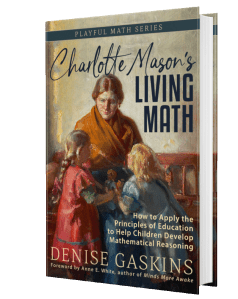
      Charlotte Mason's Living Math book by Denise Gaskins, hardcoverI try to answer that question, at least for math, in my new book Charlotte Mason’s Living Math, which is now available exclusively on my Playful Math Store.

      As I was finishing up the final bits of indexing and formatting the book for publication, I continued to tweak the manuscript. This ability to tinker endlessly is both a benefit and curse of indie publishing. For example, I added four new pages to explain my quibble with Socrates.

      You see, Socratic questions are very much a case of “Do what I say, not what I do.”

      Continue reading The Problem with Socratic Questions

      Four Stages of Learning Math (or Anything Else)

      young girl doing math homework

      Book, Charlotte Mason's Living MathThe following is an excerpt from Charlotte Mason’s Living Math, coming to your favorite bookstore or library this November.

      But if you’re impatient—or if you want the exclusive, deluxe, full-color paperback or hardcover edition—you can order your copy now on my Playful Math Store.

      This section comes from the chapter called “How Shall We Teach?” which also includes tips about textbooks, a little-known truth about the math facts, and what to do if you never understood math yourself.

      Continue reading Four Stages of Learning Math (or Anything Else)

      Dragons, Gryphons, and Math Mistakes

      statue of a gryphon

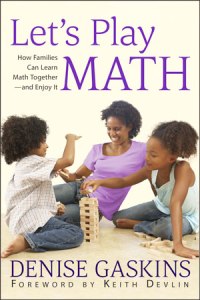
      Let's Play Math by Denise GaskinsThis post is adapted from my book Let’s Play Math: How Families Can Learn Math Together—and Enjoy It.

      Do you ever take your kids’ math tests? It helps me remember what it is like to be a student. I push myself to work quickly, trying to finish in about 1/3 the allotted time, to mimic the pressure students feel. And whenever I do this, I find myself prone to the same stupid mistakes that students make.

      Even teachers are human.

      Continue reading Dragons, Gryphons, and Math Mistakes

      Conversion Factors: How Old Are You in Nanoseconds?

      birthday cupcake with sparkler

      Homeschool Memories

      [Based on a problem I made up for my co-op students, once upon a time…]

      Conversion factors are special fractions that contain problem-solving information. Why are they called conversion factors?

      • “Conversion” means change, and conversion factors help you change the numbers and units in your problem.
      • “Factors” are things you multiply with. So to use a conversion factor, you will multiply it by something.

      Continue reading Conversion Factors: How Old Are You in Nanoseconds?

      Podcast: Charlotte Mason’s Living Math

      family doing math together

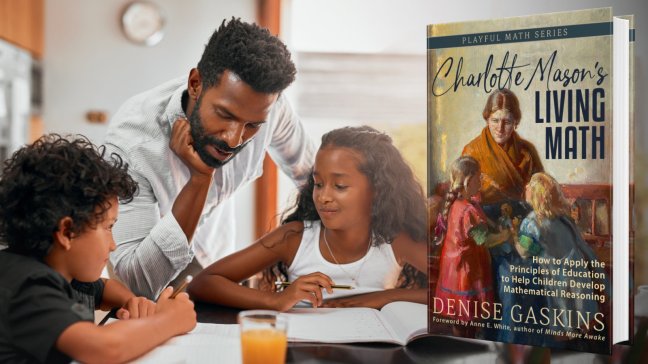
      Cindy Rollins, Dawn Duran, and I had a delightful chat about my new book, Charlotte Mason’s Living Math, which is now available in ebook (print editions coming soon!) at my Playful Math Store.

      We talked about how math is a whole world full of big, living ideas that we can explore with our children. What it means to have a living education in math, opening our children’s minds to big ideas about the relationships of numbers, shapes, and patterns. And how to tell if our kids really understand what they are doing, or if they’re just parroting back the steps we taught them.

      And lots more — listen for yourself…

      Continue reading Podcast: Charlotte Mason’s Living Math

      Make Your Own Nim Games

      tower of rocks on a beach

      Nim is a pure strategy game for two players. On each turn, players remove an option until finally no choice remains.

      Game options might include:

      • How many stones to take from a pile.
      • Which position to claim on a gameboard.
      • How far to count in a given sequence.

      The rules can vary at the players’ whim (as long as both players agree). How many possibilities do you start with, what are the rules for removing options, and how do you win or lose the game? Everything is open to change. And with every tweak, players must reanalyze their strategy.

      Continue reading Make Your Own Nim Games

      FAQ: Doing Math His Own Way

      FAQ learning subtraction math

      Isn’t it fun when children surprise us with their understanding?

      All my children have figured out ways to do things in math that I would never have expected, and I’ve learned quite a bit from listening to their explanations.

      But what if the child’s creative method makes it hard for them to learn what our textbook wants to teach?

      Continue reading FAQ: Doing Math His Own Way

      FAQ: Remembering What We Learn

      Mother and son working on math homework

      “When we do our daily lessons, my son does great. Everything seems to click. But when he sees the same topic later, in a review or on a test, it’s like he’s never heard of it before. How can I help him pull math up from the dregs of lost memory?”

      This is a common problem, and there’s no easy answer.

      You see, it’s easy for humans to convince ourselves we understand something when someone else explains it. It seems to make sense, but it doesn’t stick in our minds.

      If you think of times when you’ve tried to learn something new, you can probably remember the feeling—you thought you had it, but then when you tried to do it yourself, your mind went blank.

      So how can we help our kids when they can’t remember what to do?

      Continue reading FAQ: Remembering What We Learn

      Coming Soon: Charlotte Mason’s Living Math

      Charlotte Mason's Living Math Kickstarter

      Coming Soon! In March, I’ll be launching my newest book, Charlotte Mason’s Living Math: How to Apply the Principles of Education to Help Children Develop Mathematical Reasoning.

      And the Kickstarter prelaunch page is now live. That means you can sign up to get an email from Kickstarter as soon as the campaign launches:

      Visit the Prelaunch Page ❯

      (If you back the campaign on launch day, that encourages the Kickstarter folks to share it with more people.)

      Continue reading Coming Soon: Charlotte Mason’s Living Math