Math Musings: Lies My Teacher Told Me

I mentioned last time that the common phrase “Multiplication is repeated addition” is a mathematical lie we tell our children. And it’s not the only one.

Did you ever say, “Subtraction means take-away”? Or how about “Division is sharing”? I know I have, but both of those statements are also mathematical lies.

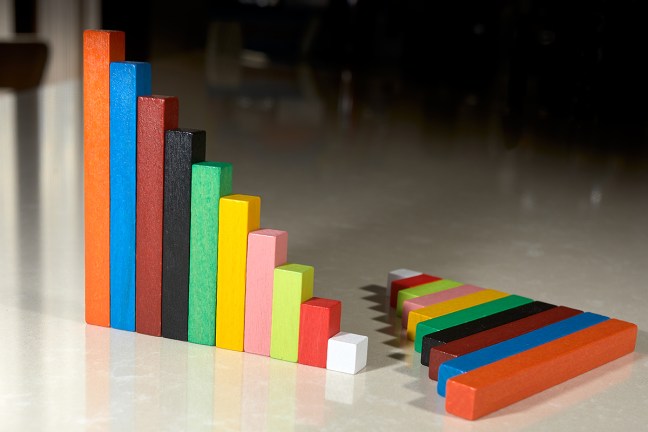
One of the reasons I like Cuisenaire rods so much is that they can help us avoid lying to our children about math.

Continue reading Math Musings: Lies My Teacher Told Me

Math Musings: Teaching the Big Ideas

Earlier, I wrote that “the big ideas of number relationships are found in algebra, not in arithmetic. If we want to bring our children into direct contact with these ideas, we need to teach with algebra in mind from the very beginning.”

Whether we teach the traditional way, beginning with counting and whole number arithmetic or take the road less traveled and explore algebra first — either way, we need to look at number relationships with an algebraic mindset.

So you might wonder, what are these big ideas of number relationships? How can we recognize them?

Continue reading Math Musings: Teaching the Big Ideas

Homeschool Musings: Math Manipulatives Part 3

We’ve talked about several types of math manipulative that homeschooling parents might use to help their children learn math (see part 1 and part 2), but we never stopped to ask the most basic question:

Why use math manipulatives at all?

Math manipulatives are a tool for solving educational problems, so we should first decide what problem we are trying to solve. That will help us know which tool to use.

Continue reading Homeschool Musings: Math Manipulatives Part 3

Publication Day: The Tabletop Math Games Collection

Now available on my publisher’s store: The Tabletop Math Games Collection, Volume One!

Tabletop Math Games Collection

So many great games for playing math from preschool through high school, including the Best Math Game Ever and how children can make up their own Creative Nim math and logic games.

These printable (pdf) activity books include instructions and tips for the teacher, math game pages in full-color and ink-saving black-and-white, plus a variety of dot-grid journaling paper. Available with 8 1/2 by 11 (letter size) or A4 pages. For ages 3 to adult.

Have fun playing math with your kids!

Continue reading Publication Day: The Tabletop Math Games Collection

Playful Math Carnival 168 via Find the Factors

The Playful Math Education Carnival is a monthly collection of mathy fun: tips, tidbits, games, and activities.

It’s like a free online magazine of mathematical adventures. If you like to learn new things and play around with ideas, you are sure to find something of interest.

Visit the Current Carnival

Iva Sallay’s put together a wonderful collectiom of great mathy activities and games to play with your kids.

You’ll find math projects, puzzles, stories, history, music, origami, and more — soooo much math to enjoy!

Would You Like To Host a Carnival?

The carnival is a joint effort. We need more volunteers.

Classroom teachers, homeschoolers, college professors, unschoolers, or anyone who likes to play around with math — if you would like to take a turn hosting the carnival, please speak up!

Find Out How To Volunteer

As always, you can browse the further-past editions of the Playful Math Carnival by scrolling backward down my blog.

And remember — Don’t miss Iva’s delicious carnival post:

Visit Carnival 168

 
* * *

Thank you for reading!

“Playful Math Carnival 168 via Find the Factors” copyright © 2023 by Denise Gaskins. Image at the top of the post copyright © Iva Sallay.

Homeschool Musings: Math Manipulatives Part 2

In my previous post, I examined fingers and found items (beans, buttons, leaves, and so on) as tools that can help our children learn math. This time, we move on to the kinds of math manipulatives you’ll find in stores or packaged with your favorite curriculum.

Standard base ten blocks

The standard base ten blocks consist of plastic or wooden cubes, a rod with the length of ten cubes, a flat shape the size of ten rods side-by-side, and a large cube equivalent to ten of the flat shapes stacked atop each other.

These are used primarily for modeling place value as a means of developing the standard arithmetic algorithms for addition and subtraction.

They can also be used for modeling decimals as a place value notation, without relying on fraction concepts. And with a bit of imagination (“Pretend the rods are stretchy, so we don’t know how long they really are”) they can model simple algebraic expressions.

Continue reading Homeschool Musings: Math Manipulatives Part 2