
In my previous post, I examined fingers and found items (beans, buttons, leaves, and so on) as tools that can help our children learn math. This time, we move on to the kinds of math manipulatives you’ll find in stores or packaged with your favorite curriculum.
Standard base ten blocks
The standard base ten blocks consist of plastic or wooden cubes, a rod with the length of ten cubes, a flat shape the size of ten rods side-by-side, and a large cube equivalent to ten of the flat shapes stacked atop each other.
These are used primarily for modeling place value as a means of developing the standard arithmetic algorithms for addition and subtraction.
They can also be used for modeling decimals as a place value notation, without relying on fraction concepts. And with a bit of imagination (“Pretend the rods are stretchy, so we don’t know how long they really are”) they can model simple algebraic expressions.
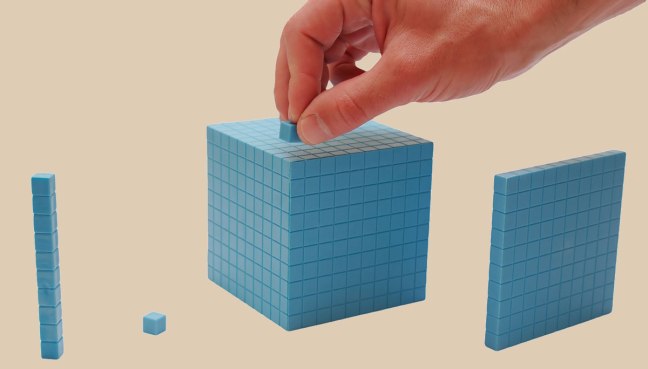
Pros: With fewer small pieces to count, base ten blocks make it easier for children to model and manipulate large numbers. Trading one size of block for another can help children make sense of the regrouping steps in the standard algorithm.
Cons: These blocks still rely on counting, which can delay children’s movement to higher levels of mathematical thinking. And their ease of use means they can become a crutch, holding students in the physical, hands-on stage when they should be moving to mental math.
Also, teachers are tempted to think the blocks so well embody the concept of place value that using them will magically build understanding. When children struggle with a calculation, the teacher tells them to build it with the blocks, imagining that will automatically clear away misconceptions.
But manipulatives are not magic. If an idea doesn’t already live in the child’s mind, a hunk of plastic or wood cannot create it. So the teacher’s unthinking reliance on math blocks can actually cripple learning.
Rods cut to scale and marked to show their number value
Now we come to the most powerful of the counting-based math manipulatives. These blocks begin with a cube to represent the number one, and then the numbers two through ten are modeled by rods the size of that many cubes in a row.
The rods are scored to show the size of the cubes, so children may count if they wish. But each length has a distinct color as well, which allows children to recognize the number value at a glance.
The most common scaled rods are the Mortensen math or Math-U-See blocks.
Scaled rods can be used to model all the basic arithmetic calculations, just like found items or base ten blocks. And the convenience of having a separate rod to represent each number makes it easier to show multiplication and division as rectangular area.
What makes these blocks more powerful than found items or basic base ten blocks is that they help children see numbers as individual entities that can have relationships among themselves.
For example:
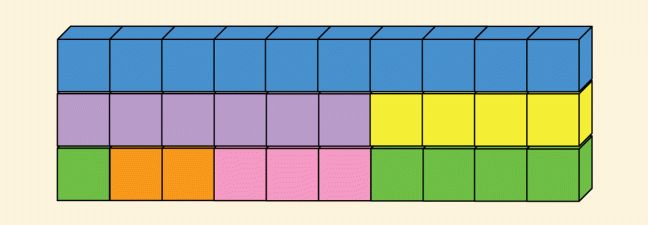
Blue = purple + yellow = (green + orange + pink) + (4 greens)
This pattern represents the numerical relationships:
10 = 6 + 4 = (1 + 2 + 3) + (4 × 1)
These facts are interesting not as something to put on a chart and memorize, but because we use them to develop the idea that numbers can represent a given quantity in many different ways.” And can encourage our children to think other ways they might express the same amount of stuff.
10 = 6 + 4 = (1 + 2 + 3) + (4 × 1)
= 1 + (4 ÷ 2) + (18 ÷ 6) + (100 ÷ 25) × 1, and so on
This type of thinking leads to the “How Crazy Can You Make It?” challenge, which is a fun way to move children away from blocks into mental number play.
Pros: I like scaled blocks because the larger number does not disintegrate when we split it into parts but remains itself in relationship with its smaller addends. So five remains five always, even when we add the idea that it can also be expressed as “two plus three.”
This property of the blocks also pushes both teacher and student beyond the childish view of subtraction as “take away’’ to a more mature understanding of subtraction as finding the difference between two numbers.
Cons: Children are still encouraged to think of counting as the basis of arithmetic. And because the blocks are so easy to manipulate and count, children may get stuck counting out answers long after they should have made the transition to higher levels of mathematical thinking, reasoning directly about the relationships between numbers.
More still to come…
Again, this post has grown longer than I expected. Let’s pause here, and I’ll be back next time to reveal my favorite math manipulatives…
* * *
Have you played the “How Crazy Can You Make It?” game with your children? It’s easy — just pick any target number, and everyone makes up their own expressions equal to that value. Admire each other’s creativity!
This blog is reader-supported.
If you’d like to help fund the blog on an on-going basis, then please join me on Patreon for mathy inspiration, tips, and an ever-growing archive of printable activities.
If you liked this post, and want to show your one-time appreciation, the place to do that is PayPal: paypal.me/DeniseGaskinsMath. If you go that route, please include your email address in the notes section, so I can say thank you.
Which I am going to say right now. Thank you!
“Homeschool Musings: Math Manipulatives Part 2” copyright © 2023 by Denise Gaskins. Image at the top of the post copyright © Depositphotos / monkeybusiness.
 Denise Gaskins' Let's Play Math