
Earlier, I wrote that “the big ideas of number relationships are found in algebra, not in arithmetic. If we want to bring our children into direct contact with these ideas, we need to teach with algebra in mind from the very beginning.”
Whether we teach the traditional way, beginning with counting and whole number arithmetic or take the road less traveled and explore algebra first — either way, we need to look at number relationships with an algebraic mindset.
So you might wonder, what are these big ideas of number relationships? How can we recognize them?
Ideas nourish our minds
Ideas, in the sense I’m using the word, are not just any old thought. Rather, they are the great Truths of a subject, the things that make our minds wake up and pay attention, that energize our thoughts and make us yearn for more.
Homeschooling pioneer Charlotte Mason explained it this way:
“As the body requires wholesome food and cannot nourish itself upon any [random] substance, so the mind too requires meat after its kind… The mind is capable of dealing with only one kind of food; it lives, grows, and is nourished upon ideas only; mere information is to it as a meal of sawdust to the body.’’
Facts are not ideas. If our children’s early math focuses on learning tables of math facts and the methods of calculation, we have fed them a meal of dust.
The big ideas of arithmetic apply to all numbers everywhere, not just the small numbers we count on our fingers. They tell us how numbers relate to each other, how they work together (or sometimes stand alone), and how we can manipulate them to discover new truths.
If we teach math as a series of facts and methods, we can easily find ourselves lying to our children or giving them crutches to lean on.
For example, we may tell them “Multiplication is repeated addition,” which is a lie that obscures the fundamental structure of multiplication. [For more information, see my post Math Musings: Lies My Teacher Told Me.] Or we may focus all our attention on teaching the standard pencil-and-paper algorithms, memorizing facts and procedures, without even realizing that those algorithms are themselves crutches designed to prevent the necessity of thinking about number relationships.
Instead of rushing to memorize facts and methods, let’s spend time playing with numbers and exploring new ways to express them, using ideas such as…
Commutativity, the any-order property
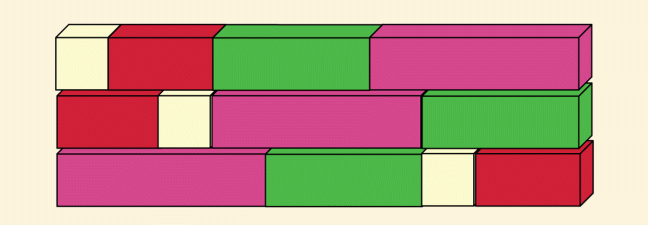
We can add numbers in any order and still get the same sum. In algebra, we might say:
white + red + green + purple
= r + w + p + g
= p + g + w + r
And in numbers, we can write:
1 + 2 + 3 + 4
= 2 + 1 + 4 + 3
= 4 + 3 + 1 + 2
How many other ways can we write it? How will you know whether you’ve found them all?
Are some expressions easier to calculate than others? Why?
For example, many people find it easiest to calculate if we put the numbers in this order:
2 + 3 + 1 + 4 = ?
Because 2 + 3 = 5 and also 1 + 4 = 5. When we recognize the two fives, we can see the total sum must be ten.
Make up your own sum of numbers. How many ways can you write it?
Are any of the other math operations commutative? How can you tell?
Associativity, the grouping property
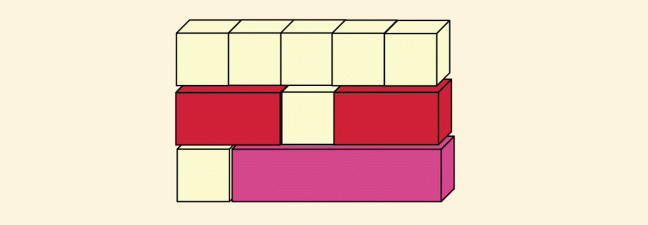
We can work a long sum by starting with any smaller part of it, grouping the numbers together as we please.
In algebra, we might say:
w + w + w + w + w
= (w + w) + w + (w + w) = r + w + r
= w + (w + w + w + w) = w + p
And in arithmetic, we might write:
5 = 1 + 1 + 1 + 1 + 1
= (1 + 1) + 1 + (1 + 1) = 2 + 1 + 2
= 1 + (1 + 1 + 1 + 1) = 1 + 4
= (1 + 1 + 1) + 1 + 1 = 3 + 1 + 1
How many other ways can we write it? How will you know whether you’ve found them all?
Make up your own sum of numbers. How many ways can you combine them?
These different ways to write a number are called the partitions of that number. Choose another small number. Can you find its partitions? (If you have scaled number blocks like Cuisenaire rods or Math-U-See blocks. those will be helpful as you search for possible combinations.)
Are any of the other math operations associative? How can you tell?
Choose a simple math equation like 3 + 6 = 9. Can you mix the commutative and associative properties — and anything else you know about numbers — to transform it into something crazy (but still true)?
Other big ideas of number relationships
Here are a few that come to mind:
- Parity (oddness and evenness)
- Inverse operations (like addition and subtraction, or powers and roots)
- The distributive property (how multiplication relates to addition)
- Factors and prime numbers
- Identity (for any of the basic operations, there is a number that doesn’t change its partner, like zero for addition)
- Numerical inverses (numbers that exactly balance their partners, like reciprocals for multiplication)
- Infinity (that you can always add one more)
- Infinitesimals (you can always find a smaller fraction)
- Density (there’s always a number between any two other numbers)
Can you think of any more? Or what would you say are the big ideas in other areas of math?
* * *
I love teaching with big ideas in mind, don’t you? They’re the sort of thing that catches the imagination of a child (or a teacher!) and sets it on fire.
This blog is reader-supported.
If you’d like to help fund the blog on an on-going basis, then please join me on Patreon for mathy inspiration, tips, and an ever-growing archive of printable activities.
If you liked this post, and want to show your one-time appreciation, the place to do that is PayPal: paypal.me/DeniseGaskinsMath. If you go that route, please include your email address in the notes section, so I can say thank you.
Which I am going to say right now. Thank you!
“Math Musings: Teaching the Big Ideas” copyright © 2023 by Denise Gaskins. Image at the top of the post copyright © Depositphotos / efks.
 Denise Gaskins' Let's Play Math