Welcome to the 170th edition of the Playful Math Education Carnival — a smorgasbord of delectable tidbits of mathy fun. It’s like a free online magazine devoted to learning, teaching, and playing around with math from preschool to high school.
Bookmark this post, so you can take your time browsing.
There’s so much playful math to enjoy!
By tradition, we start the carnival with a puzzle/activity in honor of our 170th edition. But if you’d rather jump straight to our featured blog posts, click here to see the Table of Contents.
Puzzle: Prime Permutations
According to Tanya Khovanova’s Number Gossip, 170 is the smallest composite number where exactly four permutations of its digits make prime numbers.
To find permutations, think of all the different ways you can arrange the digits 1, 7, 0 into three-digit numbers. (When the zero comes first, those permutations actually make two-digit numbers, which DO also count.)
Can you figure out which permutations make prime numbers?
Hint: The permutation that makes the number “170” is not prime, but it is the product of three prime numbers. Which ones?
For Younger Children: The 170 Square
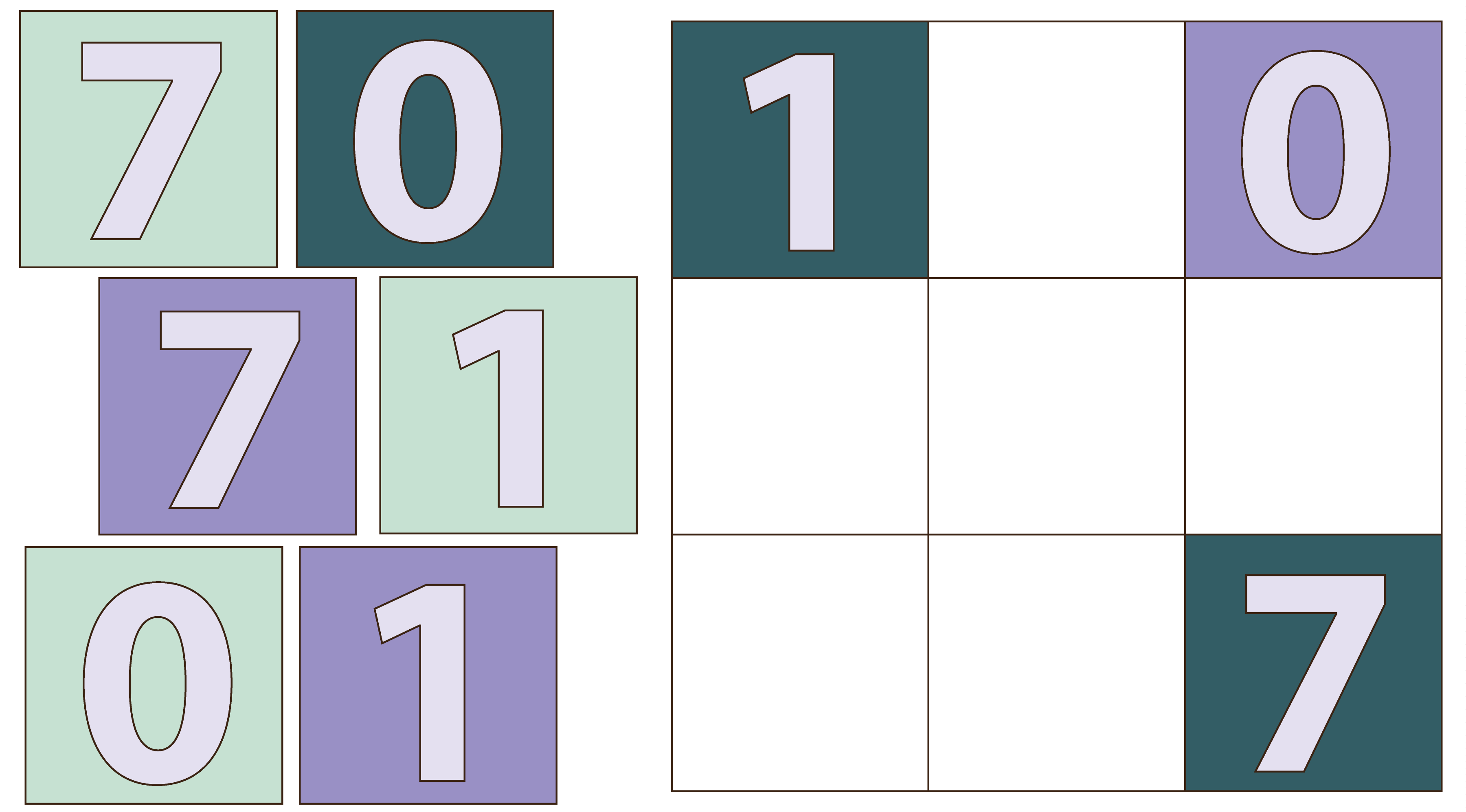
A Latin square is a grid filled with permutations: letters, numbers, or other symbols so that no row or column contains more than one of any character. You’ve probably seen the popular Latin-square puzzle called Sudoku. A Graeco-Latin square (also called an Euler square) is two independent Latin squares overlapping each other.
Can you complete this Euler square made by overlapping permutations of the digits of 170 with winter colors? Don’t repeat the same color OR the same number in any row or column.
Contents
And now, on to the main attraction: the blog posts. Some articles were submitted by their authors; others were drawn from the immense backlog in my rss reader. If you’d like to skip directly to your area of interest, click one of these links.
- Happy Holidays Math
- Talking Math with Your Kids
- Exploring Elementary Arithmetic
- Adventuring into Algebra and Geometry
- Scaling the Slopes of High School Math
- Enjoying Recreational Puzzles and Math Art
- Teaching with Wisdom and Grace
- Giving Credit Where It’s Due
Math art images are from John Golden’s Tumblr site (Mathhombre) Miscellanea, a great source for Notice-Wonder-Create prompts. Pick an image, think deeply about it, and then make your own math art!

Happy Holidays Math
“Opportunities for deep math for small children (whether intentional or not!) is always exciting for me.”
—Christopher Danielson, A Very Mathy Gift List
- Colleen Young collects a treasure trove of Mathematical Advent Calendars for readers of all ages.
- And check out Colleen’s other Christmas Mathematics Resources.
- Christopher Danielson puts together A Very Mathy Gift List full of delightful ideas.
- Sarah Dees curates a list of Christmas STEM Activities for Kindergarten and First Grade.
- Sarah Carter shares a Holiday Triples Puzzle, along with her archive of Christmas Math Posts.
- Amplify and Desmos Classroom celebrate the end of 2023 with 15 Days of Math (free sign-up required).
- Xi offers tips to beef up your savings just in time for all those holiday expenses in Monday Morning Math: Double your money!
- For my entry to the carnival, check out my post Holiday Math Puzzles and Activities for Christmas, Winter Break.
- Don’t forget the earlier Playful Math Carnivals! Visit the “Let It Snow!” Carnival #143.

[Back to top.]
[Back to Table of Contents.]
Talking Math with Your Kids
“I’m fascinated by how student ideas are shaped by context. We make connections — constantly!”
—Jenna Laib, “It Has All the Numbers on the Clock”
- Dan Finkel reads his fun new book Pattern Breakers.
- And David Butler reads his wonderful book Maths Sheep Play Sheep (also available as a free download to print and read with your kids).
- Chris Wright posts a great way to get kids playing with and talking about math: Printable Math Playing Cards, each with a fun puzzle or activity idea.
- Jenna Laib plays a 5-in-a-row game with first-graders, which leads to all sorts of math talk: “It Has All the Numbers on the Clock”: Context and Connections.

[Back to top.]
[Back to Table of Contents.]
Exploring Elementary Arithmetic
“Did this with Year 7 and blew their minds! So exciting to do something new in a framework they are so familiar with.”
—Sam Blatherwick, X (Twitter) Post.
- Lies My Teacher Told Me explores the real meaning of the basic arithmetic operations.
- Steve Wyborney launches a new series of puzzles: 170 New Esti-Mysteries.
- Karen Campe adds a twist to the traditional Number Pyramid puzzle by asking, “Does the order of the numbers in the bottom row matter?”
- Sam Blatherwick posts a fun alternative algorithm for multi-digit subtraction.
- Trumpita shares a comedic look at measurement systems: #SNL: Washington’s Dream.
- Fawn Nguyen creates a set of discussion-prompt puzzles: Given/Then with Decimals.
- Dylan Kane plays around with percents to create A Nice Worksheet.

[Back to top.]
[Back to Table of Contents.]
Adventuring into Algebra and Geometry
“I want them to lose themselves in flow so they can practice using their reference materials to develop as many ideas about the figure as they can.”
—Cheesemonkeysf, Ten True Statements
- Jim Doherty’s student wonders about the rules for counting surface area.
- Eda Aydemir designs a cool Think of a Number puzzle with Mathigon’s Polypad.
- JoAnn Sandford shares her Integer Operatons Mystery Numbers puzzles. (You can also find whole number and fraction mysteries on her Favourite Activities page.)
- Meanwhile, xkcd announces some Big Math News about the mysterious value of x.
- Henri Picciotto poses a series of Euclidean puzzles in A Construction Unit.
- Cheesemonkeysf gets students playing with geometry concepts in Ten True Statements: Using Cognitive Load Theory to Build Toward Mastery of Proofs.
- Pat Ballew takes a deep look at a simple shape: So You Thought You Knew Everything About Equilateral Triangles?

[Back to top.]
[Back to Table of Contents.]
Scaling the Slopes of High School Math
“If a woman’s dance is mathematics,
She dances alone.
But things are changing!”—JoAnne Growney, Write about a Math-Woman
- Sue VanHattum is looking for beta-readers for her delightful upcoming book series, Althea’s Math Mysteries.
- Tim Brzezinski creates an interactive tool for exploring the True Meaning of Sine, Cosine, Tangent Ratios within Right Triangles.
- Karen Campe posts the December Calendar Problems, one math problem per day from the old Mathematics Teacher journal.
- Vanessa Madu explains two key points of Bayesian statistics without a single equation: Nursery Rhymes for Curious Minds.
- Zeb Mason creates a card game to demonstrate the spread of a virus and the concept of herd immunity: Basic epidemiological modelling.
- JoAnne Growney shares Nicolo Tartaglia’s cubic equation Proof in a Poem. And be sure to check out how you can Write about a Math-Woman — and Win!
- Patrick Honner explains how Pierre de Fermat’s Link to a High School Student’s Prime Math Proof.
- And don’t miss John D. Cook’s Carnival of Mathematics #222 for more great links.

[Back to top.]
[Back to Table of Contents.]
Enjoying Recreational Puzzles and Math Art
“Start with play, notice, wonder and see where it takes you. Only your imagination is the limit to what you can create!”
—Hana Murray, Start with Play and See Where it Takes You
Games
- Erica demonstrates How to Play Roman Tic Tac Toe (Rota).
- The classic math game Farkle is a great way to get kids playing with big numbers. And don’t miss the rest of My Best (Free) Math Games for All Ages.
- Chris St. John creates an interactive site where you can play some of Ben Orlin’s Math Games with Bad Drawings. And don’t miss Ben’s Solo Flights: A Free Companion Text to Math Games with Bad Drawings.
Puzzles
- Lauren Siegel shares some fun printable T-Puzzles.
- Dan Shuster collects 180 Days of Low Floor High Ceiling Math Tasks.
- Simon Singh’s Parallel Universe encourages students to “Be challenged, get curious, do maths. Stretch your brain every week.”
- Tanya Khovanova poses a nice Quadrilateral in a Rectangle puzzle (solution here).
Art
- Paula Beardell Krieg describes two ways to make Spiraling Books.
- The Desmos Global Math Art Contest is here! Have a graph that you’re proud of? They’d love to see it.
- Hana Murray details her investigations with 21st Century Pattern Blocks in Start with Play and See Where it Takes You.
- Sam J. Shah is Knitting Math (continues in Part II).
- Dave explores the twists and turns of Fibonacci Paths.
Book Reviews
- The Mathical Book Prize shares some great reads in Math, Poetry, and Language Play and Space, Tech, and Sci-Fi…to the Math!
- Jonathan Halabi asks What is Math? and recommends a book on the subject.
- Ben Orlin sends us to the library with a great wishlist: What I’ve Been Reading. (More recommendations in the comments.)
Other Interesting Stuff
- Keith Devlin celebrates Fifty Years of Integer Sequences.
- Gil Kalai writes about what happens when ChatGPT Meets Elchanan Mossel’s Dice Problem.

[Back to top.]
[Back to Table of Contents.]
Teaching with Wisdom and Grace
“The challenge of education is to determine how best to support and encourage children so they can make strong, deep, and lasting connections in their own minds.”
—Denise Gaskins, The Necessity of Math Facts
- Simon Gregg reflects on life and learning: Play as the foundation.
- John Golden gathers advice on how we can Elicit Student Thinking.
- Karen Campe encourages teachers to look for One “Big Rule” To Rule Them All when teaching math concepts from algebra to precalculus.
- Dan Meyer explains the “Derring Effect” in Help Students Remember the Right Answers by Asking for the Wrong Answers First.
- Michael Pershan argues that Quizzes are Better Than Tests.
- Dylan Kane examines what we mean by Conceptual Understanding.
- And for my own carnival entry, this new post is one of my favorite ever: The Necessity of Math Facts. You may also enjoy Teaching the Big Ideas of Math.

[Back to top.]
[Back to Table of Contents.]
Giving Credit Where It’s Due
Math art images are from John Golden’s Tumblr site (Mathhombre) Miscellanea, copyrights belong to the original artists.
And that rounds up this edition of the Playful Math Education Blog Carnival. I hope you enjoyed the ride.
In case you missed it, our previous Carnival #169 was full of mathy goodness. The next installment of the Playful Math Carnival will open sometime during the month of January here at Let’s Play Math blog. Visit our blog carnival information page for more details.
We need volunteers for 2024! Classroom teachers, homeschoolers, unschoolers, or anyone who likes to play around with math (even if the only person you “teach” is yourself) — if you would like to take a turn hosting the Playful Math Education Blog Carnival, please speak up!
* * *
Thank you for reading!
“Playful Math Carnival 170” copyright © 2023 by Denise Gaskins. Image at the top of the post copyright © bedya / Depositphotos.
 Denise Gaskins' Let's Play Math