
As we’ve seen in earlier posts, there are more ways to solve any math problem than most people realize. Teaching children to follow memorized steps and procedures actually cripples their understanding of number relationships and patterns.
But what if our children get stumped on a multi-digit multiplication calculation like 36 × 15?
When Kids Say, “I Don’t Know How”
We can draw forth our children’s intuition about numbers, helping them learn to reason by using the Notice-Wonder-Create cycle.
As we explore the problem, taking turns with our students, we might say things like…
- I notice 36 is even and 15 is odd.
- I notice we are multiplying, so the answer will be bigger.
- I wonder, does multiplying always make things bigger?
- I notice that 36 is more than 30, and 15 is more than 10, so the product must be greater than 30 × 10 = 300.
- I wonder, will it be greater than 400?
- Oh, it must be greater, because I know three 15s are 45, so 30 × 15 would be 450. So thirty-six 15s would have to be more than that.
- I wonder, would drawing a picture help? What kind of picture might we draw?
And so on, until the child’s mind sparks with an “Aha!” that leads to a deeper understanding and progress toward a solution.
How to Solve It
So how might children think their way through this calculation?
Multiplication is commutative, which means we can think of it in two ways:
36 × 15 means
“How many are thirty-six 15s?”
OR
“How many are fifteen 36s?”
Either interpretation offers us a way to make sense of the math.
36 Fifteens: Place-Value Chunks
We can find 30 fifteens plus 6 more fifteens:
30 × 15 = 450
and
6 × 15 = 3 × 2 × 15
= 3 × 30 = 90
so
36 × 15 = 450 + 90 = 540
Fifteen 36s: Five is Half of Ten
We can find ten 36s, and then the extra five 36s will be half that amount:
10 × 36 = 360
and
5 × 36 = half of 360 = 180
so
36 × 15 = 360 + 180 = 540
Visual Thinking: Jumping in Chunks
We can draw a blank number line and sketch in whatever jumps seem convenient.
For 36 × 15, we can start with three jumps of 150:
10 × 15 = 150
Another 150 = 300
One more 150 = 450
That covers thirty of the 15s, so now we need to get six more of them.
2 × 15 = 30 brings us up to 480.
Another 30 gets to 510.
And one more 30 ends our jumping at 540.

Visual Thinking: Arrays and the Area Model
Children at this stage don’t really understand area, but they can imagine things in an array: chairs in rows, or horses on parade.
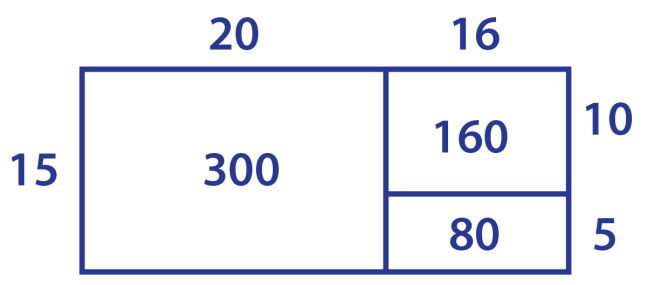
Use this intuition to draw the rectangles to scale. If we have 36 chairs in each row, and 17 rows, then the rectangle must be slightly more than twice as long as it is wide.
Many teachers develop the habit of breaking the rectangle in place-value chunks every time, which turns this valuable thinking tool into another rote procedure. Don’t fall into that trap! Look for creative ways to cut up your rectangle, to make the calculation easier.
For example, we can split 36 into 20 + 16:
20 × 15 = 300
And we can take advantage of “5 is half of 10”:
10 × 16 = 160
5 × 16 = half of 160 = 80
Doubling and Halving
When one of the factors is an even number, we can create an equivalent problem by cutting the even number in half and doubling the other number.
This doesn’t change the answer, but it often produces an easier calculation, especially if we can continue doubling-and-halving until one number gets down to a single digit.
36 × 15
= 18 × 30
= 9 × 60 = 540
Why does this work? We are simply rearranging the factors:
36 × 15 = (18 × 2) × 15
= 18 × (2 × 15) = 18 × 30
Break Down the Factors
For children who are ready to think more deeply about multiplicative relationships, we can break the big numbers down to their smaller factors.
36 × 15 = (6 × 6) × (3 × 5)
= (2 × 3) × (2 × 3) × (3 × 5)
Then we can look for ways to group them into simpler calculations.
Doubling five is an easy place to start, and then double it again to get 20, and times three to make 60. And the other three times three will make nine:
= [(2 × 5) ×2] × 3 × (3 × 3)
= 20 × 3 × 9 = 60 × 9
Why Do So Much Work?
Children don’t need to create every solution above. Each child only needs one way to think about the problem, one approach that makes it all make sense. Although it’s good if we can help them understand some of the alternatives, so they can choose what best fits the next problem they face.
But why do we make students work so hard when they could just use the standard algorithm to get a relatively quick answer?
The whole point of the standard algorithms — the reason they became so popular during the Renaissance and ended up revolutionizing science and industry — is that they can be done without thinking. All you do is follow the steps, and presto! There’s your answer.
We want our children thinking about numbers, noticing patterns, seeing relationships between ideas, reasoning about why things work. We want them to make sense of the math.
If we didn’t care about sense-making, if the answer was all that mattered, then we could just give our kids a calculator.
But we do care.
And that means even when the thinking looks messy, we know it’s worth it.
* * *
Did you enjoy this post? Check out the whole series: If Not Methods, Then What?
Are you looking for more creative ways to play math with your kids? Check out all my books, printable activities, and cool mathy merch at Denise Gaskins’ Playful Math Store.
This blog is reader-supported. If you’d like to help fund the blog on an on-going basis, then please join me on Patreon for mathy inspiration, tips, and an ever-growing archive of printable activities. If you liked this post, and want to show your one-time appreciation, the place to do that is PayPal: paypal.me/DeniseGaskinsMath. If you go that route, please include your email address in the notes section, so I can say thank you.
“If Not Methods: Multi-Digit Multiplication” copyright © 2024 by Denise Gaskins. Image at the top of the post copyright © natakot / Depositphotos.
 Denise Gaskins' Let's Play Math