“The Principality of Mathematics is a mountainous land, but the air is very fine and health-giving. People who seek their work or play in this principality find themselves braced by effort and satisfied with truth.”
— Charlotte Mason, Ourselves
Charlotte Mason (1842-1923) was a British school reformer at the turn of the twentieth century, a contemporary of William James and John Dewey. She advocated strongly for poor children, arguing they were equally capable of learning a wide and liberal curriculum as were the children of privilege.
Mason believed that all children from the time they are born share a natural curiosity and hunger for learning, and the adult’s role is to spread a “wide and generous feast” of inspiring ideas.
She was also a homeschooling pioneer, and the homeschooling revival of the late twentieth century rediscovered and popularized her books. Many found her principles a refreshing balance to the dominant educational paradigm of pragmatism.
My History with Charlotte Mason
But we were homeschooling long before the internet era, and our local library hadn’t yet caught on to the Charlotte Mason wave. I didn’t discover Mason’s philosophy until very late in our family’s homeschooling journey, when I stumbled on Anne White’s blog. She led me to several other Charlotte Mason bloggers, and at some point I landed on the Ambleside Online page with Mason’s books.
When I finally read Mason’s work, I was thrilled to discover a kindred spirit who put into words many of the educational principles I’d learned the hard way over the years. And she took those principles even farther toward a consistent philosophy of education.
I find much to admire in Mason’s writings (and a few things I disagree with). Since she is such an influential figure in modern homeschooling circles, I’d like to take several weeks to examine her educational principles, especially as applied to teaching math.
Charlotte Mason and Math
“Of all his early studies, perhaps none is more important to the child as a means of education than that of arithmetic … There is no one subject in which good teaching effects more, as there is none in which slovenly teaching has more mischievous results.”
— Charlotte Mason, Home Education
Math was not one of Charlotte Mason’s primary interests. She didn’t think or write as deeply about it as she did other subjects. When describing her curriculum, Mason said, “It is unnecessary to exhibit mathematical work done in the P.U.S. [Mason’s Parent Union Schools] as it is on the same lines and reaches the same standard as in other schools.”
This leaves us modern parents and teachers having to read our own interpretations into her words. It should be no surprise when we come to different conclusions. Quite naturally, we each consider our version to be “good teaching,” and we suspect those who disagree with us of perpetrating educational slovenliness.
As a homeschooling parent and math teacher, I too am human. I have my own limited understanding, on which I must build my interpretation of Mason’s writings. What follows are my conclusions and some of the reasoning behind them.
In Her Own Words
Mason especially appreciated and wanted children to experience two things about mathematics.
(1) Rightness: In many math problems — though not in all! — children come up against a firm rule or law, something that is solidly right when any other answer is wrong. She felt this was a valuable and humbling experience.
“It is a great thing to be brought into the presence of a law, of a whole system of laws, that exist without our concurrence — that ‘two straight lines cannot enclose a space’ is a fact that we can perceive, state and act upon but cannot in any wise alter, should give to children the sense of limitation which is wholesome for all of us, and inspire that sursum corda which we should hear in all natural law.”
— Charlotte Mason, Towards a Philosophy of Education
[Sursum corda means “Lift up your hearts,” a call to worship used in traditional responsive prayers.]
(2) Reason: Math gives children the chance to grapple directly with ideas and learn how to justify their reasoning.
“The practical value of arithmetic to persons in every class of life goes without remark. But the use of the study in practical life is the least of its uses. The chief value of arithmetic, like that of the higher mathematics, lies in the training it affords the reasoning powers, and in the habits of insight, readiness, accuracy, intellectual truthfulness it engenders.”
— Charlotte Mason, Home Education
To Be Continued…
Next time, more about reason and proofs.
* * *
Are you looking for more creative ways to play math with your kids? Check out all my books, printable activities, and cool mathy merch at Denise Gaskins’ Playful Math Store. Or join my email newsletter.
This blog is reader-supported. If you’d like to help fund the blog on an on-going basis, then please join me on Patreon for mathy inspiration, tips, and an ever-growing archive of printable activities.
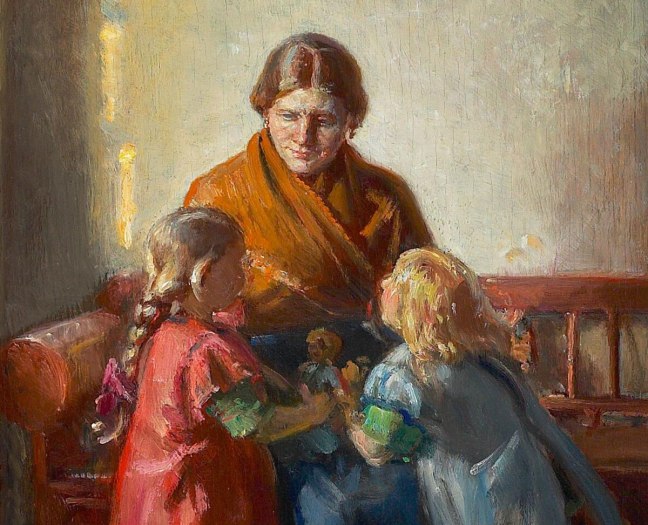
“Introduction to Charlotte Mason Math” copyright © 2024 by Denise Gaskins. Image at the top of the post “Interior with a woman and two children,” Michael Ancher, public domain. Charlotte Mason quotes from the Ambleside Online website.
 Denise Gaskins' Let's Play Math