In our search for a Charlotte Mason math education, we must take into consideration Mason’s approach to all learning, not just the things she said about math. We must be guided by the core principles of her philosophy, even in math
“We hold that the child’s mind is no mere sac to hold ideas; but is rather, if the figure may be allowed, a spiritual organism, with an appetite for all knowledge. This is its proper diet, with which it is prepared to deal; and which it can digest and assimilate as the body does foodstuffs.”
— Charlotte Mason, Principle 9
For instance, we must offer our students living ideas (not mere facts) in math, just as we do in literature and history.
Masons “20 Principles” outline the essentials of her educational philosophy. If we truly apply these principles to math, it can radically transform how we teach the subject.
Let’s examine a few of her principles in more detail…
What Is a Child?
“Children are born persons.”
— Charlotte Mason, Principle 1
From their birth, children are persons, with minds hungry for knowledge and able to digest solid mental food.
Children are not computers for us to program, so we must not focus on teaching step-by-step procedures.
Children are not puppies for us to train, so we must not focus on drill and practice.
Children are not garden plants that passively absorb the nutrients we supply, so we must be careful not to smother them with too much instruction.
Unfortunately, for many homeschooling parents, this is the only type of math we know:
• teach rules and procedures
• drill math facts
• practice until it’s automatic
• follow the textbook’s instructions
We can’t provide our children a generous diet of living mathematical ideas until we change our own way of thinking about math.
We need to discover the sursum corda that Mason said math can provide, the sense of awe and wonder that calls to our children’s hearts.
A Full and Generous Curriculum
“But we, believing that the normal child has powers of mind which fit him to deal with all knowledge proper to him, give him a full and generous curriculum; taking care only that all knowledge offered him is vital, that is, that facts are not presented without their informing ideas.”
— Charlotte Mason, Principle 11
Because we believe children are persons, just as we adults are, we have confidence that they can learn and figure things out for themselves.
They are not born “good at math” or “bad at math,” but with the possibility of learning. While it’s true that not everyone has the propensity to become a professional mathematician, all children (barring a severe learning disability) are capable of mastering school-level mathematics.
Children do not need a teacher to prepare lessons that bring the world down to their level. Instead, the teacher’s job is to provide a generous buffet of knowledge, full of living ideas, at which the child may feast.
But we must be careful not to offer children mere information, bare facts alone, without those living ideas. Even in math, facts and procedures alone cannot nourish a child’s mind.
Our school experience leads most people to think of mathematics as a list of facts and procedures, tools we can use to solve problems. But in reality, math is a whole world of ideas and concepts, a diverse ecosystem of living knowledge just waiting to be discovered.
We can explore this world of mathematics with our children, playing with numbers, shapes, and patterns, noticing connections, wondering about relationships, finding delight in new understanding.
Narration, the Act of Knowing
“As knowledge is not assimilated until it is reproduced, children should ‘tell back’ after a single reading or hearing: or should write on some part of what they have read.”
— Charlotte Mason, Principle 14
Humans do not learn just by reading or listening, but by thinking, by wrestling with ideas and putting their thoughts into words.
Narration is for our minds as the act of digestion for our bodies, the way we assimilate knowledge and make it part of ourselves. When children explain how they figured out a math problem, this solidifies their knowledge of the concepts.
We need to take our focus off the answers to math homework problems, and instead focus on the reasoning behind those answers.
Thinking, sense-making, is our goal. Right answers are merely the side-effect.
Don’t send your children off to work homework problems on their own. You keep the math book and read the problems aloud. Let them have scratch paper (or even better, a whiteboard with colorful markers) to work the problem as they explain their reasoning aloud.
Don’t tell them whether an answer is right or wrong.
Instead ask, “How do you know?”
Justifying our answers, convincing ourselves and our listeners that something is true, this is the heart of mathematical thinking.
Read the Whole Series
To Be Continued: Next time, one more key principle…
* * *
Are you looking for more creative ways to play math with your kids? Check out all my books, printable activities, and cool mathy merch at Denise Gaskins’ Playful Math Store. Or join my email newsletter.
This blog is reader-supported. If you’d like to help fund the blog on an on-going basis, then please join me on Patreon for mathy inspiration, tips, and an ever-growing archive of printable activities.
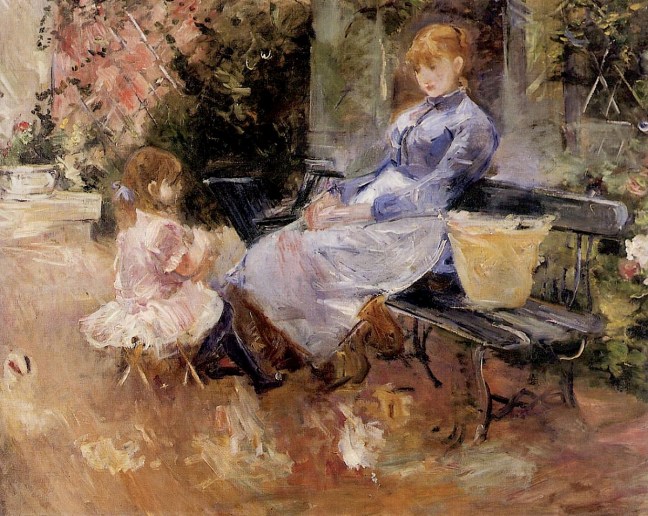
“Charlotte Mason Math: Practice Your Principles” copyright © 2024 by Denise Gaskins. Image at the top of the post “La Fable,” Berthe Morisot, public domain. Charlotte Mason quotes from the Ambleside Online website.
 Denise Gaskins' Let's Play Math