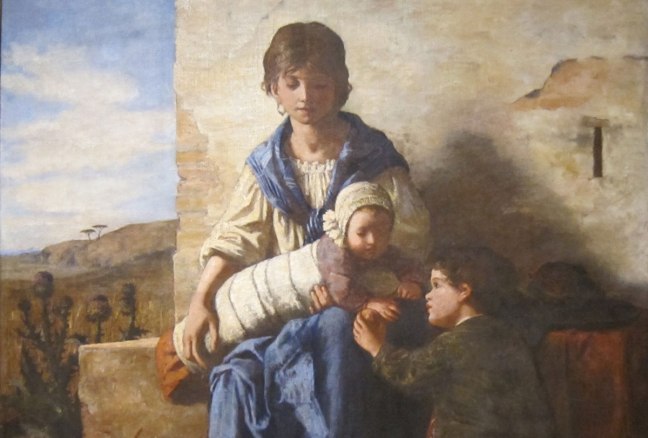
“Therefore, we are limited to three educational instruments––the atmosphere of environment, the discipline of habit, and the presentation of living ideas. The P.N.E.U.* Motto is: Education is an atmosphere, a discipline, and a life.”
— Charlotte Mason, Principle 5
This principle is the key to a Charlotte Mason education. Most of her books consist of drawing out the meaning and implications of this motto.
When we think about applying Mason’s educational principles to math, we must focus on providing the right atmosphere, developing appropriate habits, and presenting living ideas.
What is the mathematical atmosphere of our home or classroom? Is math a natural and welcome part of life? Or does it exist only in schoolbooks and in some nebulous “future” for which our children must prepare?
What about the people in our children’s lives? Do we adults enjoy and use math, or do we dread and avoid it? Is our mathematical worldview positive, eager to learn and grow, or negative, seeing math as a chore to endure?
Our Mathematical Worldview
Our first educational task is to fix our own attitude, our mathematical worldview, our vision of what math is all about and what success at math entails. We need to see math as profoundly worthy in its own sake, as a wonderfully wide and beautiful landscape of ideas that we can explore with our children.
This mathematical worldview sets the atmosphere for our math lessons.
When we learn to see math this way, we’ll discover there’s only one discipline our children need — that is, the habit of thinking, of reasoning, of using their minds to make sense of numbers, shapes, and patterns.
Math is never about following instructions and doing what the textbook tells us to do. Our children need to be grappling with living ideas, or they aren’t doing math.
If our kids only follow steps and procedures — the way most of us learned in school — they may not realize there are any living ideas in math at all.
But this habit of reasoning will automatically bring students into direct contact with what Charlotte called the Captain ideas that quicken our imagination.
The Habits of Learning
“Of all his early studies, perhaps none is more important to the child as a means of education than that of arithmetic.
“The practical value of arithmetic to persons in every class of life goes without remark. But the use of the study in practical life is the least of its uses. The chief value of arithmetic, like that of the higher mathematics, lies in the training it affords the reasoning powers, and in the habits of insight, readiness, accuracy, intellectual truthfulness it engenders.”
— Charlotte Mason, Home Education
Arithmetic may be the most important of a child’s early studies. Why? Not because of the practical skills of doing math, but because early arithmetic provides training in how to study, how to learn new things.
In particular, the study of arithmetic establishes (or should establish) several important habits.
These are not new abilities we must develop. The child already has these abilities and needs to develop the habit of applying them to schoolwork.
Namely:
Insight — the habit of observing facts and making connections, noticing details, wondering about relations, looking for patterns.
Readiness — confidence in our their ability to learn and to make sense of ideas.
Accuracy — being careful to say what they mean, being precise about definitions and how they use symbols. (Accuracy in calculation is a natural outflow of accurately understanding what the symbols mean.)
Intellectual truthfulness — saying and doing only what they know is true, being able to justify (explain) their reasoning.
Avoid Slovenly Teaching
“There is no one subject in which good teaching effects more, as there is none in which slovenly teaching has more mischievous results.”
— Charlotte Mason, Towards a Philosophy of Education
Good teaching must be teaching that establishes these habits of the reasoning powers. So slovenly teaching will be teaching that does not establish these habits.
Mason gives an example:
“Multiplication does not produce the ‘right answer,’ so the boy tries division; that again fails, but subtraction may get him out of the bog. There is no must be to him; he does not see that one process, and one process only can give the required result.
“Now, a child who does not know what rule to apply to a simple problem within his grasp, has been ill taught from the first, although he may produce slatefuls of quite right sums in multiplication or long division.”
— Charlotte Mason, Home Education
A teacher who allows this sort of behavior has completely failed at training the child’s reasoning powers.
- Instead of showing insight, taking time to make sense of what the math problem is asking, the child rushes to perform calculations.
- Instead of accuracy, understanding what the calculation means, the child tries procedures at random.
- Instead of truthfulness, the child gives wild guesses, hoping to stumble upon whatever answer the teacher has in mind.
We can train children to follow procedures and produce right answers. But unless our kids learn to apply the habit of reasoning, thinking and making sense of math, we will have failed as their teacher.
Read the Whole Series
- Introduction to Charlotte Mason Math
- Reason and Proof
- Practice Your Principles
- Our Educational Tools
To Be Continued: Next time, watch out for sawdust…
* * *
*Charlotte Mason and Emeline Petrie Steinthal founded the Parents’ National Educational Union (P.N.E.U.) in 1887, to provide resources and support for teachers and homeschoolers in the United Kingdom.
Are you looking for more creative ways to play math with your kids? Check out all my books, printable activities, and cool mathy merch at Denise Gaskins’ Playful Math Store. Or join my email newsletter.
This blog is reader-supported. If you’d like to help fund the blog on an on-going basis, then please join me on Patreon for mathy inspiration, tips, and an ever-growing archive of printable activities.
“Charlotte Mason Math: Our Educational Tools” copyright © 2024 by Denise Gaskins. Image at the top of the post: “Woman and Children” by Elizabeth Boott Duveneck, public domain. Charlotte Mason quotes from the Ambleside Online website.
 Denise Gaskins' Let's Play Math