Even in Mason’s day, testing drove much of educational policy, but we must not allow ourselves to fall into the trap of teaching for a test. Just as we do not study history in order to win a trivia contest, so we do not study math merely to produce answers on an exam.
“Arithmetic, Mathematics, are exceedingly easy to examine upon and so long as education is regulated by examinations so long shall we have teaching, directed not to awaken a sense of awe in contemplating a self-existing science, but rather to secure exactness and ingenuity in the treatment of problems.”
— Charlotte Mason, Towards a Philosophy of Education
Remember Mason’s twin goals of rightness and reason. Even if you use a math book that focuses on memorizing rules and cranking out answers, you and your child can look for the ideas behind the rules: “Why does this work? How can we know for sure?”
Not just because the book says so, but because you search out and discover the innate sense of it. That is the essence of mathematics.
How to Teach Math
“Mathematics depend upon the teacher rather than upon the text-book and few subjects are worse taught; chiefly because teachers have seldom time to give the inspiring ideas, what Coleridge calls, the ‘Captain’ ideas, which should quicken imagination.”
— Charlotte Mason, Towards a Philosophy of Education
When Mason says that mathematics depends on the teacher, she does not mean that we need to prepare lessons for our children to swallow. Rather, we must guard against what she calls “a meal of sawdust” in math with even more diligence than in other subjects.
“Life is no more self-existing than it is self-supporting; it requires sustenance, regular, ordered and fitting. This is fully recognised as regards bodily life and, possibly, the great discovery of the twentieth century will be that mind too requires its ordered rations and perishes when these fail. We know that food is to the body what fuel is to the steam-engine, the sole source of energy; once we realise that the mind too works only as it is fed, education will appear to us in a new light.
“For the mind is capable of dealing with only one kind of food; it lives, grows and is nourished upon ideas only; mere information is to it as a meal of sawdust to the body; there are no organs for the assimilation of the one more than of the other.”
— Charlotte Mason, Towards a Philosophy of Education
Mason did not believe in searching for the perfect textbook that would guide her students to learn math. Some curricula may be better than others for our particular children, for it should be no surprise that personal taste affects mental digestion as well as physical. But even if we use the best math program available, we must not blindly trust the book to guide us. The book is our servant: we are the boss.
Answer-Getting vs. Problem-Solving
Whatever curriculum we use, we need to focus our lessons on mathematical reasoning. And to do that, we must recognize the difference between answer-getting and problem-solving.
Answer-getting asks “What is the answer?” and decides whether it is right, then goes on to the next question.
Problem-solving asks “Why do you say that?” and then listens for the student to explain his thinking.
Problem-solving is less interested in “right” or “wrong” — it cares more about “makes sense” or “needs justification.” Many times, my children and I didn’t even bother to work out the calculation at the end of a math problem, because the thing that intrigued us was the web of interrelated ideas we found along the way.
Such as:
- How can we recognize this type of problem?
- What other problems are related to it, and how might they help us understand this one? Or can this problem help us figure out those others?
- What could we do if we had never seen a problem like this one before? How would we reason it out?
- Why does the formula work? Where did it come from, and how is it related to basic principles?
- What is the easiest or most efficient way to manipulate the numbers? Does this help us see more of the patterns and connections within our number system?
- Is there another way to approach the problem? How many different ways can we think of? Which way do we like best, and why?
The Essence of Living Math
We can use any textbook to teach Charlotte Mason math, as long as we ask — and teach our children to ask — the essential mathematical question.
“The mathematical question is ‘Why?’ It’s always why. And the only way we know how to answer such questions is to come up, from scratch, with these narrative arguments [proofs] that explain it.”
— Paul Lockhart, Measurement
“The next point is to demonstrate everything demonstrable. The child may learn the multiplication-table and do a subtraction sum without any insight into the rationale of either. He may even become a good arithmetician, applying rules aptly, without seeing the reason of them; but arithmetic becomes an elementary mathematical training only in so far as the reason why of every process is clear to the child. 2+2=4, is a self-evident fact, admitting of little demonstration; but 4×7=28 may be proved.
“He has a bag of beans; places four rows with seven beans in a row; adds the rows thus: 7 and 7 are 14, and 7 are 21, and 7 are 28; how many sevens in 28? 4. Therefore it is right to say 4×7=28.”
— Charlotte Mason, Towards a Philosophy of Education
Notice that in Mason’s vignette, it’s not the teacher who demonstrates, but the child. The more we adults remain silent and let children explain their thinking, the more deeply each child’s own relationship with the ideas of mathematics will grow.
Notice also that the demonstration need not be physical. A sketch or an oral explanation that answers the mathematical question “Why?” would also count as a demonstration.
For example, consider this problem: “Both 497 and 210 are multiples of 7. Is 497 + 210 a multiple of 7?” My daughter’s answer: “Well, duh. If you take any pile of sevens and mix it with another pile of sevens, you have to get something that’s a big pile of sevens.”
As we practice Mason’s educational principles, mathematics truly becomes a living subject. And in this way, we help our children learn to delight in rightness and reason.
Read the Whole Series
- Introduction to Charlotte Mason Math
- Reason and Proof
- Practice Your Principles
- Our Educational Tools
- How Shall We Teach?
To Be Continued: Finding time for those Captain ideas…
* * *
Are you looking for more creative ways to play math with your kids? Check out all my books, printable activities, and cool mathy merch at Denise Gaskins’ Playful Math Store. Or join my email newsletter.
This blog is reader-supported. If you’d like to help fund the blog on an on-going basis, then please join me on Patreon for mathy inspiration, tips, and an ever-growing archive of printable activities.
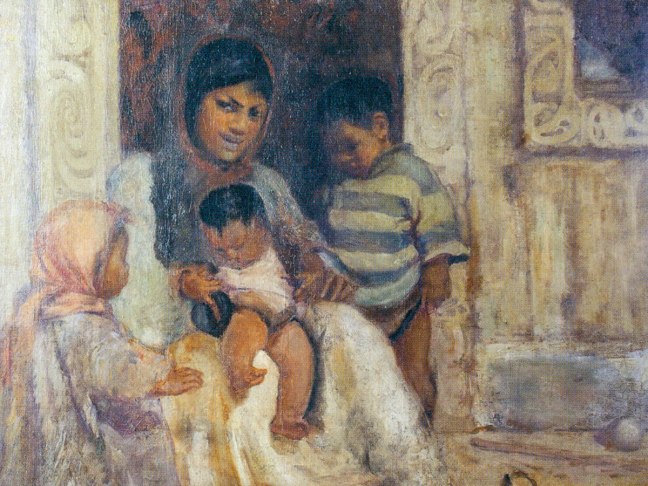
“Charlotte Mason Math: How Shall We Teach?” copyright © 2024 by Denise Gaskins. Image at the top of the post: “Woman with children” by Dorothy Kate Richmond, public domain. Charlotte Mason quotes from the Ambleside Online website.
 Denise Gaskins' Let's Play Math