“Teachers have seldom time to give the inspiring ideas, what Coleridge calls, the ‘Captain’ ideas, which should quicken imagination. How living would Geometry become in the light of the discoveries of Euclid as he made them!”
— Charlotte Mason, Towards a Philosophy of Education
The Captain ideas are the great Truths of a subject, the things that make our minds wake up and pay attention, that energize our thoughts and make us yearn for more.
In math, living ideas are the big principles that tie together many branches of the subject. Things like:
• Proportion — where two quantities are connected so they scale up or scale down in tandem. For instance, if we double the number of cars in the driveway, that automatically doubles the number of tires.
• Transformation — how we can change things while keeping important attributes the same. Like, if we shrink a square, its area will change, but the angles stay the same.
• Identity — things that are always true and don’t change. For example, any number times one is always equal to itself.
• Infinity and infinitesimals — things that are impossibly big or unimaginably small.
• Inverse operations — things that undo each other, like addition and subtraction.
We can discover these great ideas with our children by taking our focus OFF of checking right answers. Instead, we want to look more closely at the questions, the problems themselves.
We need to notice what the problem is all about and wonder how it connects to other questions and problems.
A Living Idea for Young Students
Charlotte points out that young children can understand that “two and two make four and cannot by any possibility that the universe affords be made to make five or three.”
The big idea here is equality. What do we mean when we say that 2 + 2 equals 4?
• How is 2 + 2 like the number 4, and how is it different?
• Can we find anything else that equals 2 + 2? Not 5, but how about 5 − 1?
• How about 6 − 2, or 7 − 3, or 8 − 4? We could extend that pattern into a whole, infinite family of expressions that are all equal to each other.
• What else might we say is equal to 2 + 2? Not 3, but how about 1 + 3? Or 0 + 4, −1 + 5, −2 + 6, and so on?
• And how does that first family of expressions, using subtraction, relate to the second family, using addition? How are they alike, and how are they different?
• What other patterns might we discover?
There are no “right” answers here. We’re just playing with the idea of equality, exploring the world of mathematics and having fun with numbers.
Living Ideas in Geometry
For another example, geometry lessons for young students are often full of vocabulary. “This is a triangle. This is a square. Color all the rectangles on the page, etc.”
But what if instead we set our children free to explore the world of shapes? What if we gave them a handful of spaghetti and let them break it into different-sized pieces to create designs?
How much of Euclidean geometry might they discover on their own, through play, by building shapes and noticing how they fit together?
Certainly, they would realize, through hands-on experience, what Charlotte Mason pointed out — that two straight lines can make an angle, but no matter how we arrange them, they cannot enclose a space.
That’s one of the theorems of Euclid, but it’s also, quite literally, child’s play.
Or they might notice that we can put two lines end-to-end and make any angles we want. But there’s something special about the angles we make when one line crosses another, not at the end. What can we notice about the patterns made by crossed lines?
Again, this is a theorem from Euclid — but how much richer is our understanding when we meet the idea first through playful exploration.
Math Journaling
Remember the power of narration.
Just as keeping a nature journal focuses our attention, making us notice details so we can record our observations, and giving us something to look back on and compare with new discoveries, so a math journal serves likewise to focus our attention when we explore the world of mathematics.
For example, consider the spaghetti-stick investigation. While children will absorb some mathematical principles through informal play, they will learn much more by taking the time to put into words the things they have noticed and wondered about.
• Two lines cannot enclose a space, but three can. What kinds of shapes can we make with three lines? How are they similar? How are they different from each other?
• Can every set of three lines enclose a space? Is it possible to find three lines that won’t make a triangle, no matter how we move them about? What makes those three lines special?
• What happens to our shapes and angles as we add more lines?
When children write down, or we scribe for them, the relationships they discover, they begin to see more clearly how vast and interesting this landscape of shapes can be.
And vocabulary has real meaning when they can use it to express their own thoughts, to describe the sharpness of an acute angle contrasted with the dullness of a wide, obtuse angle, or to classify the different types of quadrilaterals they can create.
Read the Whole Series
- Introduction to Charlotte Mason Math
- Reason and Proof
- Practice Your Principles
- Our Educational Tools
- How Shall We Teach?
- Finding Time for Big Ideas
To Be Continued: Next time, using (and abusing) math manipulatives…
* * *
For more on this topic, you may enjoy my blog post Math Musings: Teaching the Big Ideas.
Are you looking for more creative ways to play math with your kids? Check out all my books, printable activities, and cool mathy merch at Denise Gaskins’ Playful Math Store. Or join my email newsletter.
This blog is reader-supported. If you’d like to help fund the blog on an on-going basis, then please join me on Patreon for mathy inspiration, tips, and an ever-growing archive of printable activities.
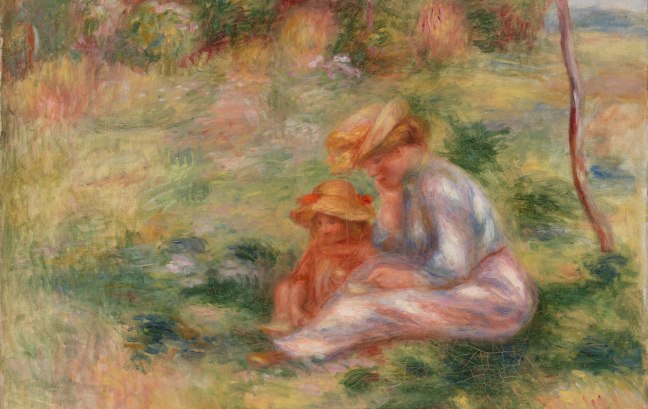
“Charlotte Mason Math: Finding Time for Big Ideas” copyright © 2024 by Denise Gaskins. Image at the top of the post: “Woman and Child in the Grass” by Pierre-Auguste Renoir, public domain. Charlotte Mason quotes from the Ambleside Online website.
 Denise Gaskins' Let's Play Math