Two passages in Charlotte Mason’s writing about math are in my opinion widely misunderstood. The first relates to the proper use of manipulatives.
Mason believed strongly in the importance of physical objects and oral work (mental math) in early math education. In her priorities, the use of written calculation fell in distant third place.
“A bag of beans, counters, or buttons should be used in all the early arithmetic lessons, and the child should be able to work with these freely, and even to add, subtract, multiply, and divide mentally, without the aid of buttons or beans, before he is set to ‘do sums’ on his slate.”
— Charlotte Mason, Home Education
But she also writes against the misuse of specially designed math manipulatives such as base ten blocks, warning against “an elaborate system of staves, cubes, etc.”
“It is quite true that the fundamental truths of the science of number all rest on the evidence of sense but, having used eyes and fingers upon ten balls or twenty balls, upon ten nuts, or leaves, or sheep, or what not, the child has formed the association of a given number with objects, and is able to conceive of the association of various other numbers with objects. In fact, he begins to think in numbers and not in objects, that is, he begins mathematics.
“Therefore I incline to think that an elaborate system of staves, cubes, etc., instead of tens, hundreds, thousands, errs by embarrassing the child’s mind with too much teaching, and by making the illustration occupy a more prominent place than the thing illustrated.”
— Charlotte Mason, Home Education
Some people interpret this passage as representing a rule, something like “Beans are better than blocks,” or perhaps “Household items work better than special math tools.” Thus they see no place for Cuisenaire rods, base ten blocks, or other store-bought manipulatives in a Charlotte Mason education.
Such arguments skim the surface of the passage but entirely miss the point.
The Danger of Over-Teaching
When Mason says that base ten blocks “embarrass the child’s mind with too much teaching” and “make the illustration occupy a more prominent place than the thing illustrated,” she is warning against a particular mischievous result of poor teaching.
Too many teachers let manipulative use become a procedure, when it should be a thinking tool. They instruct children to lay out manipulative blocks in certain patterns (or to draw the pattern the blocks would make) in order to count out an answer.
To see this error in painfully real life, watch the online video, “The unintended consequences of the TERC Investigations Math Curriculum.” (See my blog post here.)
The problem of over-explaining and forcing manipulative use can happen as easily with beans as with base ten blocks. If someone made a child demonstrate every math calculation with beans because that’s the way Mason explained it, that would be just as abusive as the TERC block-drawing video.
Always Focus on the Child’s Thinking
Manipulatives — whether beans or blocks — can be a wonderful tool for teaching elementary math concepts. Converting the blocks to pictures may make it easy for children to sketch and communicate their ideas.
But blocks and pictures should be steps along the way to abstraction, and no student should be forced to use them any longer than necessary. As shown in the video above, fourth grade addition is much longer than necessary.
If retained past their usefulness, manipulatives become mere busywork. They distract a student from the important goal of reasoning about the problem.
But that is not a problem in the blocks themselves. It is slovenly teaching.
Mason is inclined to think that using base ten blocks will tempt us into such an educational error, while found objects like beans will be less problematic. Beans are a nuisance to keep track of and thus less likely to be overused.
Manipulatives and Magical Hopes
There is another, perhaps more subtle, way in which parents and teachers are tempted to misuse math manipulatives. We imagine that these tools will do the teaching for us. If only we get our children to act out their math with beans or blocks, they will surely understand what to do.
Math education specialist Deborah Loewenberg Ball calls this way of thinking a “magical hope.”
“My main concern about the enormous faith in the power of manipulatives, in their almost magical ability to enlighten, is that we will be misled into thinking that mathematical knowledge will automatically arise from their use. Would that it were so!
“Unfortunately, creating effective vehicles for learning mathematics requires more than just a catalog of promising manipulatives. The context in which any vehicle — concrete or pictorial — is used is as important as the material itself.”
— Deborah Loewenberg Ball,
Magical Hopes: Manipulatives and the Reform of Math Education
Or to paraphrase Charlotte Mason: “Mathematics depend upon the teacher rather than upon the manipulatives.”
We must learn to use these math tools in a way that brings our children in contact with the rightness of a mathematical concept and helps them to reason about it. Anything else is slovenly teaching.
What Would Charlotte Do?
“The way to mind is a quite direct way. Mind must come into contact with mind through the medium of ideas. It is necessary for us who teach to realize that things material have little effect upon mind, whether the teaching is given by means of bars of wood or more scientific apparatus.”
— Charlotte Mason, Towards a Philosophy of Education
Mason agrees that manipulative are not magic. They do not communicate ideas on their own.
But personally, I think if Mason had the opportunity to sit and chat with a master math teacher like Caleb Gattegno, she would have gladly adopted Cuisenaire rods for use in her math classrooms from elementary through high school. (She would need a time machine, however, as the rods were invented three decades after she died.)
Used properly, Cuisenaire rods enable children’s minds to grapple directly with the structures of mathematics — to form their own relationships with ideas ranging from arithmetic to algebra. (For example, see my blog post here.)
All we adults need do is lay out the buffet and show our kids how to feast.
Read the Whole Series
- Introduction to Charlotte Mason Math
- Reason and Proof
- Practice Your Principles
- Our Educational Tools
- How Shall We Teach?
- Finding Time for Big Ideas
- The Trouble with Manipulatives
To Be Continued: Next time, more ways to avoid slovenly teaching…
* * *
Are you looking for more creative ways to play math with your kids? Check out all my books, printable activities, and cool mathy merch at Denise Gaskins’ Playful Math Store. Or join my email newsletter.
This blog is reader-supported. If you’d like to help fund the blog on an on-going basis, then please join me on Patreon for mathy inspiration, tips, and an ever-growing archive of printable activities.
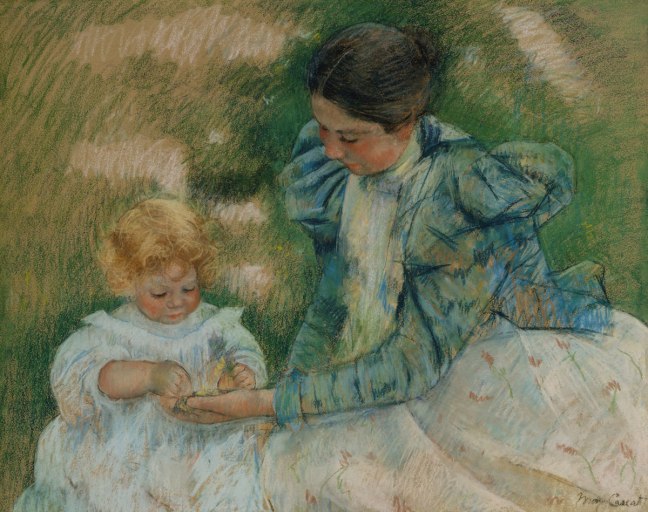
“Charlotte Mason Math: The Trouble with Manipulatives” copyright © 2024 by Denise Gaskins. Image at the top of the post: “Mother Playing with Child” by Mary Cassatt, public domain. Charlotte Mason quotes from the Ambleside Online website. Deborah Loewenberg Ball quote from “Magical Hopes: Manipulatives and the Reform of Math Education.”
 Denise Gaskins' Let's Play Math