The second place where a surface-level reading of Charlotte Mason’s books can lead to misunderstanding involves the treatment of wrong answers. Mason wrote:
“… quite as bad as these is the habit of allowing that a sum is nearly right, two figures wrong, and so on, and letting the child work it over again. Pronounce a sum wrong, or right — it cannot be something between the two. That which is wrong must remain wrong: the child must not be let run away with the notion that wrong can be mended into right.”
— Charlotte Mason, Home Education
Does this call to mind images of your own childhood schoolwork? It does for me: laboring over a worksheet or quiz and then taking it to my teacher to be graded. Right was right, and wrong could not be mended. In such a performance-oriented setting, mistakes can take on the flavor of moral failure.
Is this authoritarian approach the way Mason wants us to teach math to our children? Where is the summa corda — the joyful praise — in that?
No. Please, no. Very definitely no.
Mason wanted us to avoid slovenliness in our teaching. In this passage, she warned against several forms this might take.
Slovenly teaching allows children to guess at an answer.
The teacher allows children to answer without thinking through the problem. Such teaching fosters slipshod habits of mind and a disregard for truth.
“Multiplication does not produce the ‘right answer,’ so the boy tries division; that again fails, but subtraction may get him out of the bog. There is no ‘must be’ to him: he does not see that one process, and one process only, can give the required result.”
— Charlotte Mason, Home Education
One way to prevent such guessing is to ask your children how they figured out their answer, or how they know it makes sense. Can they convince you (and themselves) the answer is true?
If students believe you ask for explanations only when the answer is wrong, they will immediately guess at a different answer. But if you develop the habit of always asking for justification, whether an answer is correct or not, then your children will likewise develop the habit of reasoning things through.
And when students make careless mistakes, the process of talking through the problem affords them an opportunity to notice and correct their solutions.
Slovenly teaching has the right answer always in mind.
The teacher expects a predictable response for every math problem. She pushes and prompts the student to say whatever she is looking for, offering hints or even flat-out telling the child what to do.
“Arithmetic is valuable as a means of training children in habits of strict accuracy, but the ingenuity which makes this exact science tend to foster slipshod habits of mind, a disregard of truth and common honesty, is worthy of admiration! The copying, prompting, telling, helping over difficulties, working with an eye to the answer which he knows, that are allowed in the arithmetic lesson, under an inferior teacher, are enough to vitiate any child.”
— Charlotte Mason, Home Education
Pinterest is full of teaching tricks like these “fraction butterfly” posters. The picture has nothing to do with the meaning of the numbers or the relationships between them, and in fact it suggests different things in different classrooms. In one, it serves to compare two fractions, in another to add or subtract them.
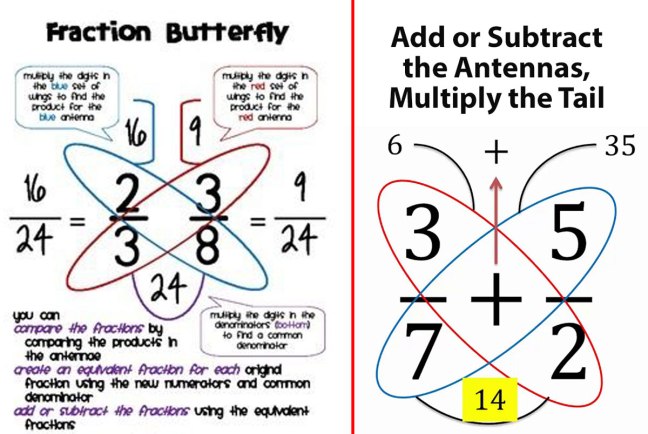
The butterfly has no inherent logical sense, no connection to understanding what a fraction means or how fractions behave in the real world. It exists only as a mnemonic trick to help the student produce whatever answer the teacher has in mind.
For more examples of slovenly teaching tricks and suggestions of what you might try instead, download the free ebook Nix the Tricks.
Slovenly teaching has the child rework a problem until it is correct.
The previous warning leads into this one, for parents and teachers are most easily tempted to over-guide our children with meaningless mnemonic tricks when we have given them too difficult a problem to solve.
“The young governess delights to set a noble ‘long division sum,’ — 953,783,465 ÷ 873 — which shall fill the child’s slate, and keep him occupied for a good half-hour; and when it is finished, and the child is finished too, done up with the unprofitable labour, the sum is not right after all: the last two figures in the quotient are wrong, and the remainder is false. But he cannot do it again — he must not be discouraged by being told it is wrong; so, ‘nearly right’ is the verdict, a judgment inadmissible in arithmetic.”
— Charlotte Mason, Home Education
Thus the teacher exhausts and exasperates the child, especially when homework problems are long and involve many steps.
Remember that Mason valued the process of reasoning. She wanted children to think about their math problems and be able to demonstrate that a solution is correct.
When we focus our own attention on the answers rather than the thinking that produced them, we make children believe that education is all about their performance, not about what goes on inside their heads. School becomes a game of figuring out what the teacher wants.
But when we focus on reasoning, each mistake becomes an opportunity for a child to analyze his or her own solution: “What went wrong? Did I make a careless error, or is this a concept I don’t understand as well as I thought? How might I avoid this mistake next time?”
Mistakes often point to a gap in understanding, which gives us a chance to build a firmer foundation for the next day’s work. So this passage cannot be telling us never to revisit a wrong answer. But we are to treat the child humanely — with respect as a human person — even in the process of correcting his math.
“The future is before him: he may get the next sum right, and the wise teacher will make it her business to see that he does, and that he starts with new hope. But the wrong sum must just be let alone.”
— Charlotte Mason, Home Education
Read the Whole Series
- Introduction to Charlotte Mason Math
- Reason and Proof
- Practice Your Principles
- Our Educational Tools
- How Shall We Teach?
- Finding Time for Big Ideas
- The Trouble with Manipulatives
- Wrong Answers and Slovenly Teaching
To Be Continued: Next time, practical tips for a living math education…
* * *
Are you looking for more creative ways to play math with your kids? Check out all my books, printable activities, and cool mathy merch at Denise Gaskins’ Playful Math Store. Or join my email newsletter.
This blog is reader-supported. If you’d like to help fund the blog on an on-going basis, then please join me on Patreon for mathy inspiration, tips, and an ever-growing archive of printable activities.
“Charlotte Mason Math: Wrong Answers and Slovenly Teaching” copyright © 2024 by Denise Gaskins. Image at the top of the post: “Playing with the Kittens” by Émile Munier, public domain. Charlotte Mason quotes from the Ambleside Online website. You can find Tina Cardone’s book Nix the Tricks here.
 Denise Gaskins' Let's Play Math