Memories…
We were eclectic homeschoolers back in the Dark Ages before there was an internet. Our primary curriculum was the public library.
As we went along, I noticed how many of our homeschooling friends felt uncomfortable with math, and even hated or feared the subject.
Math anxiety runs rampant in Western culture. By one researcher’s estimate, more than 90% of adults experience some level of math anxiety — that is, discomfort, avoidance, and even emotional pain when faced with a math calculation.
So I became a sort of “math evangelist” in the homeschooling community, spreading the news that we can find beauty and fun even in math.
How Is There Beauty in Math?
Mathematical beauty is when our mind’s eye is opened to see something new — or to see something old in a new light.
We find beauty when we step outside the cage of rules and procedures, when we begin to figure math out for ourselves.
Beauty happens when we explore, when we play with big ideas and catch a glimpse of wonder.
Look for Beauty in Big Ideas
So be on the alert for opportunities to explore mathematical ideas with your children. Watch for things like…
Classification: How are different things similar? How are similar things different?
Equivalence: When are two things so similar that we can treat them as identical?
Transformation: How can we change something into something else? Which changes preserve equivalence? Which changes destroy it?
Symmetry: How is this thing like itself? Does it express balance through reflection, rotation, or other forms of transformation?
Find Beauty in Mathematical Play
Stress can build walls in our minds that keep us from learning. Playfulness breaks down those walls. That’s why Maria Droujkova, founder of Natural Math, likes to play with wrong answers:
When a kid is feeling bad about being stuck with a problem, or just very anxious, I sometimes ask him to make as many mistakes as he can, and as outrageous as he can.
Laughter happens (which is valuable by itself, and not only for the mood — deep breathing brings oxygen to the brain).
Then the kid starts making mistakes. In the process, features of the problem become much clearer, and in many cases a way to a solution presents itself.
— Maria Droujkova, Natural Math discussion of math club activities
Mathematical playfulness gives children the freedom to think their own way about numbers, shapes, and patterns.
School math rarely allows for freedom. To memorize things you don’t understand is tedious. To always follow someone else’s rules is boring.
But to indulge in creative reasoning, to figure things out for ourselves, that’s exciting and fun.
Here’s an Idea You Can Play With
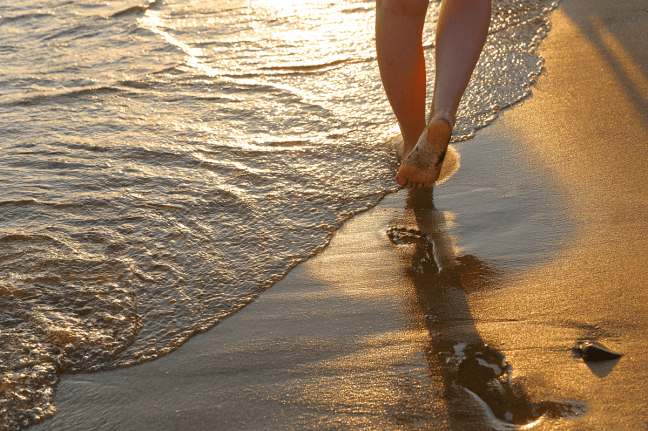
Have you ever considered frieze patterns? Those are patterns that repeat in a line, like you might find on a wallpaper border strip. Or the patterns your footprints might leave as you walk, hop, or spin your way through snow or along a sandy beach.
Try making footprint patterns in a straight line across the room:
- How many different ways can you move?
- In what ways are your movements similar?
- How are they different?
- What types of symmetry can you find in your footsteps?
- Can you identify translations (straight movements), reflections (mirrored patterns, like left and right footprints), and rotations?
* * *
Are you looking for more creative ways to play math with your kids? Check out all my books, printable activities, and cool mathy merch at Denise Gaskins’ Playful Math Store. Or join my email newsletter.
This blog is reader-supported. If you’d like to help fund the blog on an on-going basis, then please join me on Patreon for mathy inspiration, tips, and an ever-growing archive of printable activities.
“Musings: Mathematical Beauty” copyright © 2025 by Denise Gaskins. Image at the top of the blog copyright © galdzer / Depositphotos.
 Denise Gaskins' Let's Play Math