
From the very beginning of a child’s experience with math, we want to focus on reasoning, making sense of numbers, thinking about how they relate to each other and how we can use these relationships to solve problems.
The basic idea of addition is putting like things together: combining parts to make a whole thing, putting together sets to make a collection, or starting with an original amount and adding the increase as it grows. Connecting two numbers in relationship with a third number we call the sum.
When you work with young children learning addition, remember the two key mental-math strategies I mentioned in the previous post.
- Use friendly numbers.
For early single-digit addition, the most important friendly numbers are 5 and 10, the pairs of numbers that make 10, and the doubles.
- Estimate, then adjust.
When children apply their creative minds to reasoning about math, they can use friendly numbers to get close to an answer, and then tweak the result as needed.
Let’s Try an Example
For instance, how might children think through an addition puzzle such as 6 + 8? If they try to count on their fingers, they’ll probably lose track, so how can we make it easy enough to solve in our heads?
In the explanations below, I’ll model the thinking on a rekenrek, a useful tool for young children just beginning to explore number relationships. As they grow more comfortable with numbers, they’ll be able to visualize the patterns mentally.
You can buy a rekenrek from your favorite school supply company, or make your own with craft beads.
Friendly Fives
When we look at six beads and eight beads on a rekenrek, it’s easy to see a pair of fives. That leads to our first simplified calculation.
6 + 8 = 5 + 5 + 1 + 3
= 10 + 4

Friendly Doubles
What other patterns might we find? Oh, look, it’s the same as double-six plus two extra:
6 + 8 = 6 + 6 + 2

Another Pair of Doubles
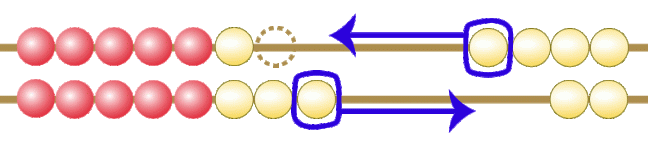
We could imagine moving one bead from the eight row up to join the six, making double-seven:
6 + 8 = 7 + 7
Make a Friendly Ten
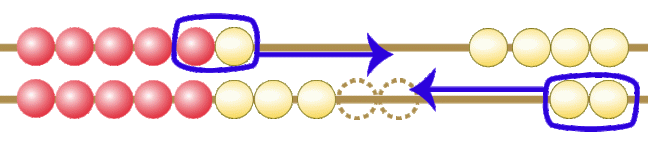
Or move two beads from the six row down to join the eight, making a ten:
6 + 8 = 4 + 10
Looking Ahead
This sort of number play works far beyond the range of traditional math facts. If the calculation was 36 + 48, children who are comfortable manipulating numbers might see 3 + 4 tens and 6 + 8 ones, making the answer seventy-fourteen, a funny name for eighty-four.
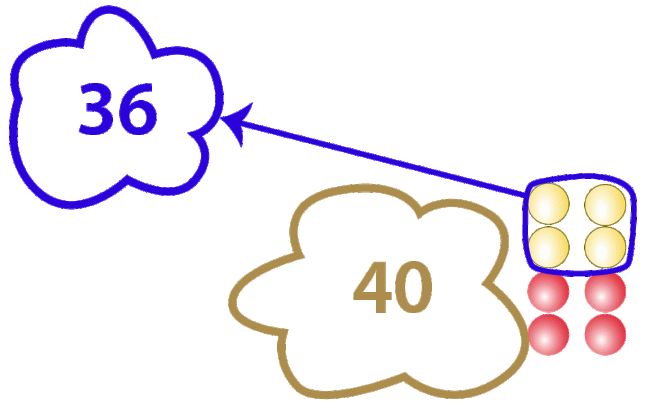
Or they might notice that forty-eight is almost fifty and imagine moving a couple pieces from the other pile to make the calculation easier. Or move four pieces over to the thirty-six, making double-forty plus four extra pieces.
With larger numbers, we don’t try to visualize all the individual beads. Imagine two piles of stuff, which we can shift mentally as needed:
36 + 48 = 40 + 40 + 4
Read the Whole Series
Check out all the posts in my Mental Math Series:
- Mental Math Is the Key to Algebra
- Three Basic Principles
- Early Addition
- Coming Soon: Early Subtraction…
* * *
For help with adding larger numbers, check out my post Mental Math: Addition.
Are you looking for more creative ways to play math with your kids? Check out all my books, printable activities, and cool mathy merch at Denise Gaskins’ Playful Math Store. Or join my email newsletter.
This blog is reader-supported. If you’d like to help fund the blog on an on-going basis, then please join me on Patreon for mathy inspiration, tips, and an ever-growing archive of printable activities.
“Mental Math: Early Addition” copyright © 2025 by Denise Gaskins. Image at the top of the blog copyright © skyfotostock1 / Depositphotos.
 Denise Gaskins' Let's Play Math