This challenging game stretches everyone’s working memory and offers children the delightful possibility of stumping an adult.
Many parents remember struggling to learn math. We hope to provide a better experience for our children. And one of the best ways for children to enjoy learning is through hands-on play.
So what are you waiting for? Let’s play some math!
The Number That Must Not Be Named
Math Concepts: addition, subtraction, multiplication, division, integers, fractions, factoring, powers and roots, prime numbers, and other number properties.
Players: two or more (a cooperative game).
Equipment: none.
Set-Up
Because all calculations are done mentally, players must agree on what types of numbers are allowed. For example, beginners may want to start with the positive whole numbers 1–100. As players gain experience, you can expand the range of possibilities.
How to Play
The first player names any number within the permissible range. Players take turns naming mathematical operations, performing each calculation mentally but never saying their answer aloud.
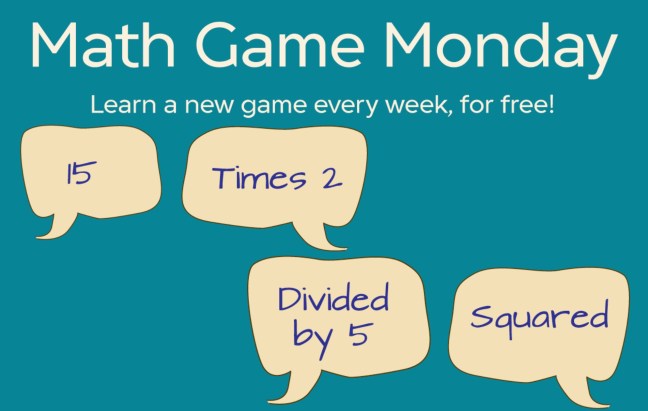
For example, suppose the first player names “15.” Turns may then proceed as follows, with the number changing as shown in parentheses:
- “Times two.” (30)
- “Divided by five.” (6)
- “Squared.” (36)
- “Subtract it from one hundred.” (64)
- “Square root.” (8)
- “Cube root.” (2)
- “To the fifth power.” (32)
- “Plus one.” (33)
- “Nearest prime number.” (31)
- etc.
Players try to show style by naming operations that haven’t been used, especially something particular to the current number. Since the last calculation left the number at thirty-one, you might say “plus sixty-nine.” This proves you’ve been paying attention and gives everyone’s brain a brief rest on the nice, round number 100.
If a player names a calculation that makes no sense or that takes the number outside the agreed-upon range, that player is out of the game.
At any time, one player may challenge another to name the current number. If the challenged player says the wrong number, that player drops out of the game. But if the answer is correct, then the challenger is out.
The game continues until only one player remains, or until the players decide to stop.
History
When I was a kid, our teachers used to make students keep up with a long chain of mental calculations. This game offers students a chance to fight back and see if they can stump the teacher.
I found the game on Joel David Hamkins’s blog. Your children may also enjoy his Rule-Making Game:
* * *
 This game is an excerpt from Prealgebra & Geometry: Math Games for Middle School. Discover more of my books, printable activities, and cool mathy merchandise at Denise Gaskins’ Playful Math Store.
Special Offer: Would you like to access a growing archive of Math Monday games and other activity ideas as convenient printable pdf downloads, ready to print and play with your kids? Join me on Patreon or choose the paid subscription on Substack for mathy inspiration, tips, printable activities, and more.
“The Number That Must Not Be Named” copyright © 2026 by Denise Gaskins.
 Denise Gaskins' Let's Play Math