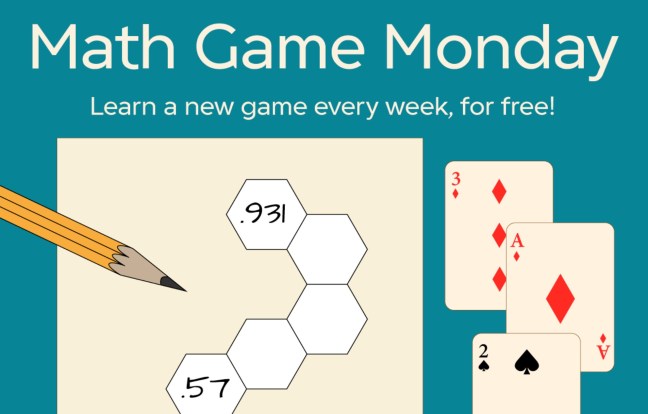
This game challenges students to think strategically about the meaning of decimal numbers and place value.
Many parents remember struggling to learn math. We hope to provide a better experience for our children. And one of the best ways for children to enjoy learning is through hands-on play.
So what are you waiting for? Let’s play some math!
Decimal Point Pickle
Math Concepts: decimals, place value, numerical order.
Players: any number.
Equipment: one deck of math cards, whiteboard and markers for each player, or pencils and blank paper.
Set-Up
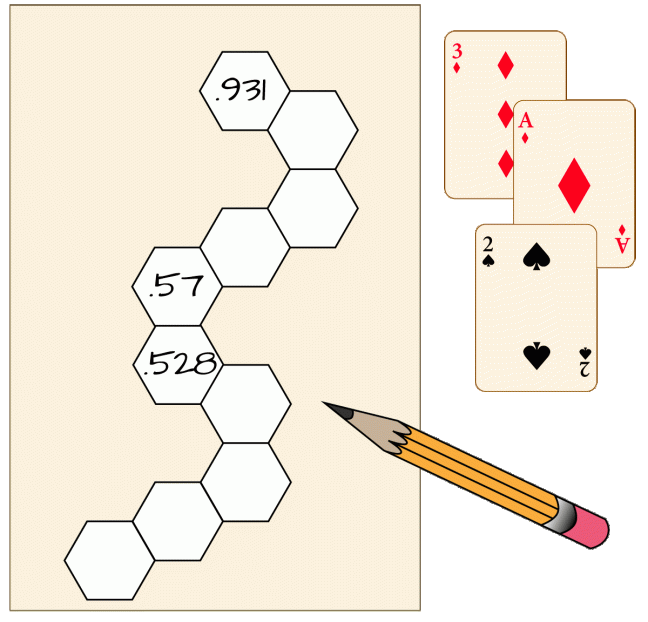
Each player draws a path with ten spaces big enough to write in three-digit numbers. Decimal Pickle paths can be utilitarian or creative: a simple row of boxes, a curvy chain of circles, a series of stair steps, a caterpillar of ovals with legs, or a string of flowers with open centers for writing in. But every path needs to have ten spaces with a clear beginning and end.
If you draw the Pickle paths on paper, you can laminate these drawings or slip them into sheet protectors for repeated play. But if you make a new drawing each time, then the game can express the children’s personalities as their artistic skills develop.
How to Play
Remove the tens from the deck, but add the queens to represent zeros (or leave in the tens and count them as zeros). Shuffle the deck and place it face down where all players can reach.
On your turn, flip over the top card. If the card is black, stop flipping: that is your number. If the card is red, keep it and flip up an additional card. Again, if it’s black, you stop, but if it’s red, flip over one last card. You never flip more than three cards.
Now, arrange your card(s) to make a decimal number less than one. If you’ve drawn a single (black) card, you have no choice — for instance, if you draw a black seven, you must make .7. If you draw a red card and then a black card, you have two options — for instance, a red two and a black six lets you make either .26 or .62. Queens are zeros, so the smallest number you can make is a queen = .0, and the largest is three nines = .999.
Say your number, and write it into one of the spaces on your path. Always make sure the numbers increase from the beginning of your path to the end. If there’s no place to fit in your number and keep the least-to-greatest pattern, then you miss that turn.
Discard face up next to the draw pile. If you run out of cards in the draw pile, shuffle the discards to replenish it. The first person to fill a path, with all the numbers in order from least to greatest, wins the game.
Variations
Play that you always flip over two or three cards (color doesn’t matter). Or play without the three-card limit, so you might hit a 10-digit or longer decimal.
Or leave the 10s in the deck, letting them take two decimal digit places — so if you turn up a 7 and a 10, you could make the numbers .710 or .107. If you draw more than one 10 card, you may end up with a four-digit (or longer) decimal.
House Rule: Decide how strict you will be about the “increasing order” rule and repeated numbers. Can a player use both .6 and .60 as part of a valid train? Or will the player have to keep trying for new cards to replace one of the equivalents?
History
Blogger John Golden invented this version of the Number Train game.
He writes:
“The fifth-grade came up with two names, Destination Elimination (which I like because it rhymes), and Decimal Pickle. This was suggested by a student whose answer for everything is ‘pickle.’ But here, it reminded me of a childhood game that none of the kids knew but kind of fits: the baseball game Pickle.
“As often with a new game, I played me vs. the class first. It was clear that the blackjack-esque possibility of extra cards was exciting, and they quickly got the idea that it was a big advantage. I didn’t castigate anyone for saying ‘point two three’ but often asked, ‘So how do you say that number?’”
* * *
 This game is an excerpt from Multiplication & Fractions: Math Games for Tough Topics. Discover more of my books, printable activities, and cool mathy merchandise at Denise Gaskins’ Playful Math Store.
Special Offer: Would you like to access a growing archive of Math Monday games and other activity ideas as convenient printable pdf downloads, ready to print and play with your kids? Join me on Patreon or choose the paid subscription on Substack for mathy inspiration, tips, printable activities, and more.
“Math Game Monday: Decimal Point Pickle” copyright © 2026 by Denise Gaskins.
 Denise Gaskins' Let's Play Math