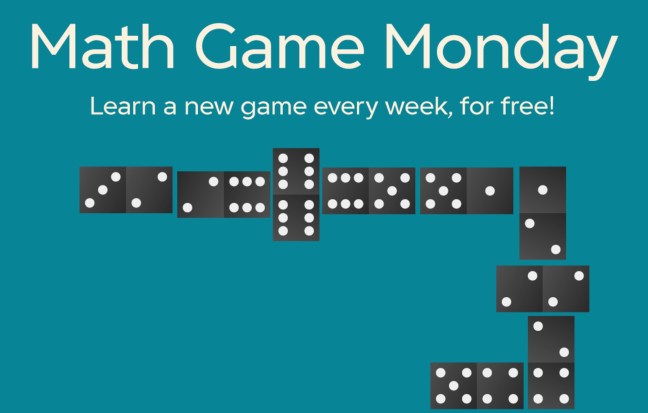
This classic family game is a great way to play with numbers and logical strategy.
Many parents remember struggling to learn math. We hope to provide a better experience for our children. And one of the best ways for children to enjoy learning is through hands-on play.
So what are you waiting for? Let’s play some math!
Dominoes
Math Concepts: subitizing dot patterns, thinking ahead.
Players: two or more.
Equipment: one set of double-six or double-nine dominoes, or two sets for five or more players.
Set-Up
Turn all domino tiles (also called bones) face down on the table and mix them around. Each player draws several tiles, as follows:
- Two players draw seven tiles each.
- Three or four players draw five tiles each.
- Five or more players use a double set of dominoes and draw five each.
Set your tiles upright on their sides, so the other players cannot see them. These tiles are your hand, and the ones left on the table are called the wood pile (also known as the bone yard).
How to Play
Whoever has the highest double goes first, placing that tile face up on the table. If no doubles are available, turn everything face down, reshuffle, and draw again.
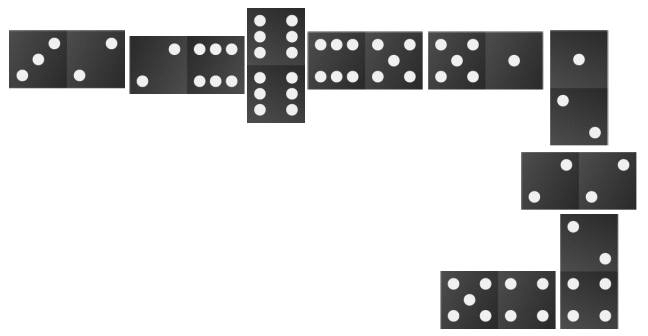
Play proceeds to the left around the table. Domino tiles are played end-to-end in a long row (the train), with only the outer ends available for adding new tiles. On your turn, you may play one of the tiles in your hand to either open end of the train if the dots (called pips) on one side of your tile match the tile on that end.
Doubles are placed crosswise to the direction of the train, with the middle of the domino touching its neighboring tiles. Players may not match tiles to the ends of the doubles, however, only to the middle of the other side, continuing the train in whichever direction it was growing.
If you have no tile that will play, draw one tile from the wood pile. If you can play that one, do so. Otherwise, add it to your hand. This marks the end of your turn. If you cannot play from your hand and there are no tiles left to draw, you must pass.
The first player to run out of tiles wins the game (or in Muggins, wins that round). If no player is able to go out, then all players add up the pips on their remaining tiles. The player with the smallest sum wins.
Variations
Domino games vary tremendously around the world, and even from one family to another within the same town. Whenever you play with friends, be sure to agree on the rules before you draw the first tile.
Cross Dominoes: Make a double train. After the first double tile is played, the next four tiles must match it. Two of these are placed normally, at the middle of each side of the first tile, and the other two connect to the ends. If players do not have a matching tile, they must pass. After the four matching tiles have made a cross shape, play continues normally, except in four directions instead of two.
Muggins: Play as for Cross Dominoes, but keep score as you go along. At the end of each turn, the player adds up the pips showing on the live tiles at all four ends of the train, including both halves of any exposed doubles. If these make a multiple of five, the player adds that number to his or her score. At the end of each round, players add up the pips remaining in their hands, round to the nearest five, and subtract those points from their total so far. The first player to reach 200 points (or some other agreed-upon total) wins the game.
Fives and Threes: Play as for Muggins, but score all multiples of three or five.
History (and a Puzzle)
Domino-like tile games seem to have originated in China, and they came to Europe through the great trading cities of Venice and Naples. Some game historians claim the European game was invented independently, because European domino sets are different from Chinese sets in several ways. (For instance, Chinese tiles come in suits, like a set of playing cards.) Dominoes spread across France and reached England in the late eighteenth century, where the game became a favorite pastime in British pubs.
Puzzle: Encourage your children to examine a set of domino tiles and describe what they notice. For example, every possible combination (double-0, 0|1, 0|2, etc.) is a single tile, but there are no duplicates: 0|1 is the same tile as 1|0.
Ask them, “If you bought a set of dominoes at a garage sale, how could you tell whether any of the tiles were missing? Can you figure out how many tiles there should be?”
Spoiler: To find the answer, make a systematic list, and be careful not to count any of the combinations twice. A double-six set should have twenty-eight tiles, and a double-nine set will have fifty-five. A new set from the store may contain extra blank tiles, which can be decorated with paint or white nail polish to replace lost pieces.
* * *
 This game is an excerpt from Counting & Number Bonds: Math Games for Early Learners. Discover more of my books, printable activities, and cool mathy merchandise at Denise Gaskins’ Playful Math Store.
Special Offer: Would you like to access a growing archive of Math Monday games and other activity ideas as convenient printable pdf downloads, ready to print and play with your kids? Join me on Patreon or choose the paid subscription on Substack for mathy inspiration, tips, printable activities, and more.
“Math Game Monday: Dominoes” copyright © 2026 by Denise Gaskins.
 Denise Gaskins' Let's Play Math