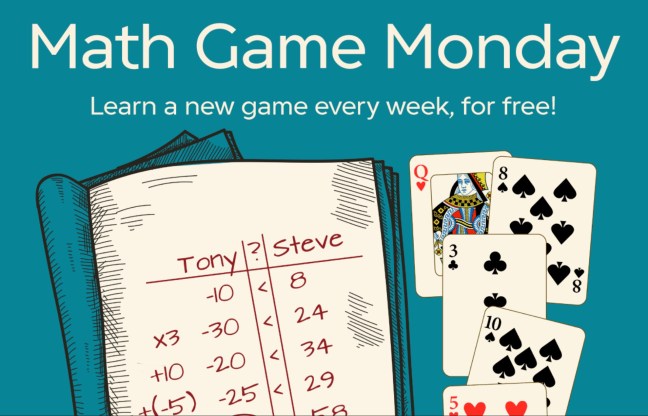
This game helps students make sense of those confusing rules about multiplication with inequalities.
Many parents remember struggling to learn math. We hope to provide a better experience for our children. And one of the best ways for children to enjoy learning is through hands-on play.
So what are you waiting for? Let’s play some math!
Greater Than
Math Concepts: integer addition, integer multiplication, working with inequalities.
Players: two players or two teams.
Equipment: printed gameboard or sheet of paper, one deck of playing cards, pencils or markers.
 The FREE 68-page printable (pdf) Prealgebra & Geometry Printables file features hundred charts, coordinate grids, assorted graph paper, and all the game boards for the Math You Can Play: Prealgebra & Geometry book.
Set-Up
Agree on which color represents negative numbers. Face cards count as ten, aces as eleven.
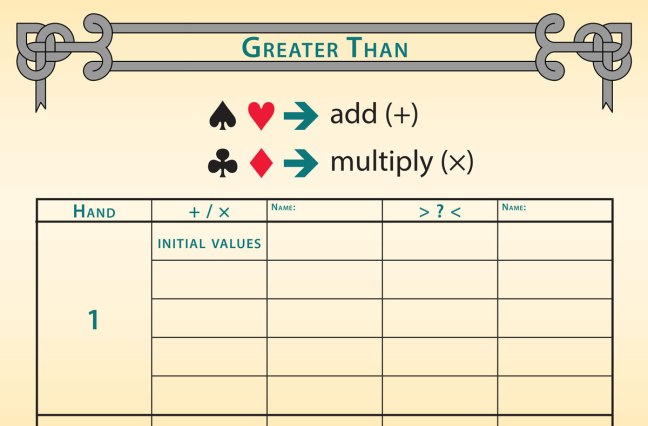
The suits also represent operations:
- Spades and hearts = add the number.
- Clubs and diamonds = multiply by the number.
Print a gameboard for players to share. Or prepare a scoresheet with three columns: one for each player’s running score, and a column in the middle for the inequality sign. Choose a player to deal the first hand.
How to Play
Deal four cards to each player or team. Players each choose one card as their initial value, holding the card face down in front of them. At the dealer’s signal, both players reveal their cards.
If the two cards played have the same value, players return them to their hands and choose a different starter card.
Write the players’ initial numbers in their columns. In the middle column, draw an inequality symbol (> or <) with its open end toward the greater value.
The non-dealer plays first. Choose one card from your hand and lay it on the table. Write the operation represented by that card in the first box of the next line on the gameboard (or beside the next line of the scoresheet). Then do the indicated calculation:
- If your card is a spade or heart, add the value to each player’s current score.
- If your card is a club or diamond, multiply each player’s score by that number.
Write the new sum or product in each player’s column on the scoresheet. Finally, draw the correct inequality symbol in the middle column.
A hand consists of two turns for each player, beginning with the non-dealer. So the dealer takes the next turn, playing a card, writing it at the start of the third line, and doing the calculations based on the values in the previous line. The non-dealer fills the next line, and the dealer plays the final line of that hand. Players do not draw new cards after each turn, so plan ahead how best to use the cards you have.
After the dealer’s second turn, whoever has the greater value wins that hand. Circle the winning score. Mix all cards back into the deck and pass it to the other player to deal the next hand.
The first player to win three hands wins the game.
Sample Game
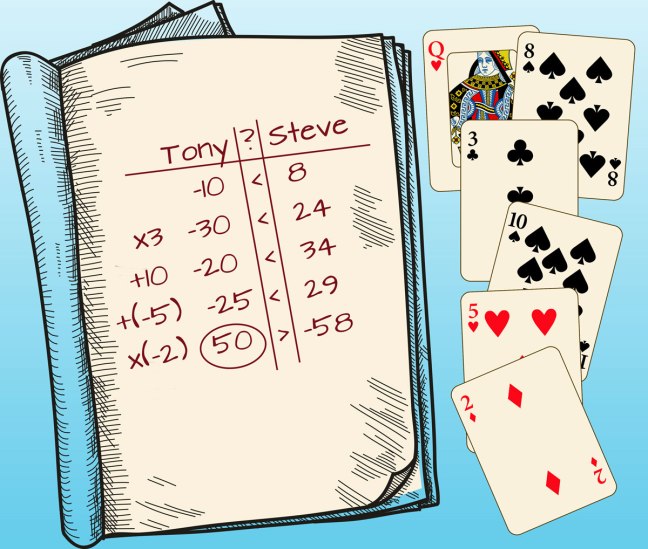
Tony challenges Steve to a game of Greater Than. Tony deals the first hand, and the players reveal their initial cards. Tony plays the queen of hearts, for a value of −10. Steve has the eight of spades, for a value of +8.
As the non-dealer, Steve goes first. He plays the three of clubs and writes “×3” on the next row. Then he multiplies both scores by three and writes each product in that player’s column. He writes the less-than sign “<” to show that he’s in the lead.
Tony lays down the ten of spades, adding 10 to each score. Steve chooses the five of hearts, adding −5 to the scores. Steve still has the greater value, but Tony gets one more turn.
Tony plays the two of diamonds, which multiplies both scores by −2. Multiplying by a negative number changes the sign of the scores, and Tony wins the hand with 50 points.
Variations
House Rule: Does having the last play offer too great an advantage? Give the dealer one less card at the start of each hand.
Or add a level of risk to the game by having both players reveal their operation cards at the same time, as they did with their initial numbers. On each turn, choose a card and hold it face down until both players are ready. The card with the lesser value does its operation first. (And remember that −9 is less than +2.) This means the dealer may play before the non-dealer, depending on which cards they choose.
History
John Golden, who created this game, writes:
“I think this is a good educational game, but only close to a good strategy game. I can’t quite figure out what’s missing, so if you have a variation or adaptation to try, please let me know.”
If you think of a variation to share, post it in the comments on his original Math Hombre blog post:
* * *
 This game is an excerpt from Prealgebra & Geometry: Math Games for Middle School. Discover more of my books, printable activities, and cool mathy merchandise at Denise Gaskins’ Playful Math Store.
Special Offer: Would you like to access a growing archive of Math Monday games and other activity ideas as convenient printable pdf downloads, ready to print and play with your kids? Join me on Patreon or choose the paid subscription on Substack for mathy inspiration, tips, printable activities, and more.
“Math Game Monday: Greater Than” copyright © 2026 by Denise Gaskins.
 Denise Gaskins' Let's Play Math