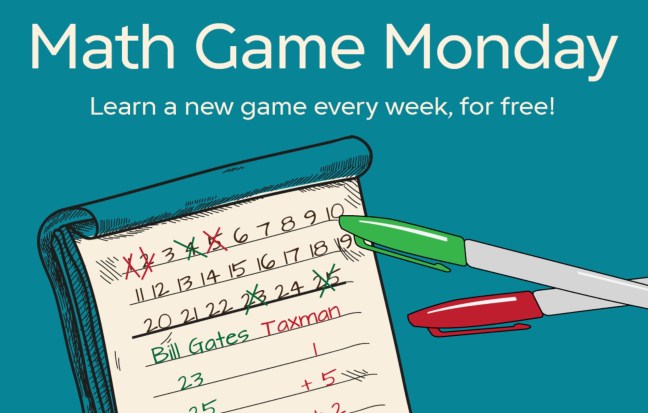
This game makes children think about multiplication and notice how prime numbers are special.
Many parents remember struggling to learn math. We hope to provide a better experience for our children. And one of the best ways for children to enjoy learning is through hands-on play.
So what are you waiting for? Let’s play some math!
Tax Collector
Math Concepts: multiplication, prime numbers, factors and multiples.
Players: two or more players or two teams.
Equipment: blank paper or a printed hundred chart, pencils or markers. Calculator optional.
Set-Up
Choose a set of numbers (the more numbers, the longer the game) such as 1–30 or 1–100. Write the numbers at the top of your paper, so you can mark them out as they are used. Or use a printed hundred chart to mark numbers, keeping score in the margins or on scratch paper.
How to Play
One player is the tax collector, and all the others work together as a team of shop owners. Or the players on one team are tax collectors, and the other team entrepreneurs.
First, a shop owner marks any available number by crossing it out or coloring that square on the chart. Add this number to the running total of shop owner profits.
Once a number is marked by any player, it cannot be used again.
After each shop-owner turn, the tax collector marks all the factors of that number that have not been previously scored. Add these numbers to the running total of taxes.
Continue turns with shop owners claiming a profit amount and the tax collector looking for factors to tax. The game ends when the shop owners have no legal play — that is, there are no numbers with factors left. The tax collector claims all remaining numbers.
Whoever collects the most money (profit or tax) wins.
Warning: You must always pay the tax collector! No shop owner may mark a number that doesn’t have any factors remaining. If you try to claim a number with no factors, the tax collector takes that whole amount as a penalty.
Variations
The Factor Game: Alternate roles on each turn. The first player chooses a number, and the second collects the tax. Then the second player chooses a number, and the first one collects the tax. At the end of the game, neither player gets the unclaimed numbers.
Factor Blaster: Players alternate roles, as in the Factor Game, and they may choose any unmarked number — including numbers without factors for the other player to claim. In Tax Collector or the Factor Game, you may choose only one prime number (you’ll find out why as you play), but the lack of penalties in Factor Blaster makes the prime numbers into prime targets.
History
In Simply Great Math Activities: Number and Operations, authors Bill Lombard and Brad Fulton write:
“The tax collector usually wins the first game so handily that the students are left believing there is no way for them to win this game. However, assure them there are many ways for the taxpayer to win, and ask them to play another game.”
Teacher coach Terry Kawas created the Factor Blaster variation that emphasizes the importance of prime numbers, to prepare for teaching prime factoring.
* * *
 This game is an excerpt from Prealgebra & Geometry: Math Games for Middle School. Discover more of my books, printable activities, and cool mathy merchandise at Denise Gaskins’ Playful Math Store.
Special Offer: Would you like to access a growing archive of Math Monday games and other activity ideas as convenient printable pdf downloads, ready to print and play with your kids? Join me on Patreon or choose the paid subscription on Substack for mathy inspiration, tips, printable activities, and more.
“Math Game Monday: Tax Collector” copyright © 2026 by Denise Gaskins.
 Denise Gaskins' Let's Play Math