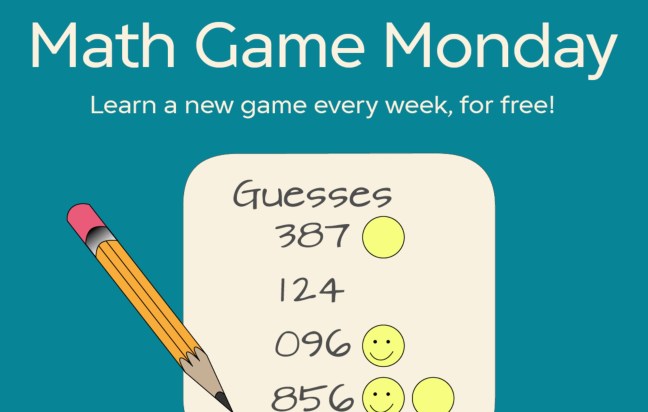
This game challenges players to make logical deductions about number permutations.
Many parents remember struggling to learn math. We hope to provide a better experience for our children. And one of the best ways for children to enjoy learning is through hands-on play.
So what are you waiting for? Let’s play some math!
Codebreaker
Math Concepts: permutations, logical deduction.
Players: two or more.
Equipment: paper and pencil, or whiteboard and marker.
How to Play
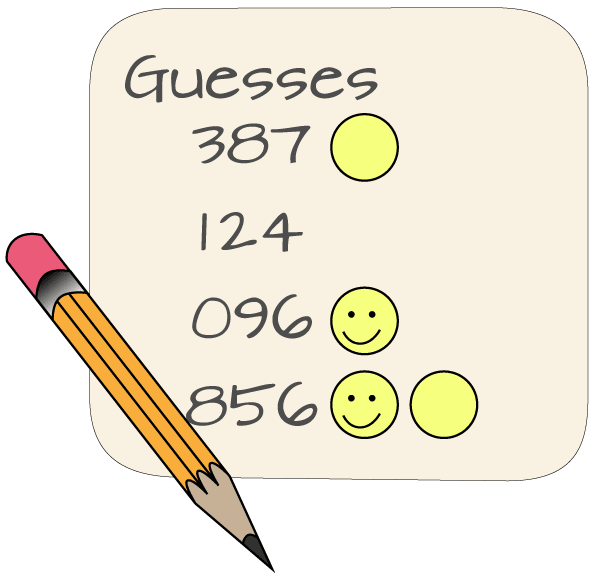
One player (the codemaker) thinks of a three-digit number between 000 and 999, writes this number on a piece of paper, and folds the paper to hide it. The other players (codebreakers) draw a two-column chart labeled Guesses and Clues. Players can each keep separate written records, or all may share a single chart on a whiteboard.
The codebreakers take turns guessing a three-digit number, which they record in the guess column. The codemaker responds with the appropriate clues:
- If one of the digits is the right number in the right place, say “There’s one number correct,” and draw a smiley face in the clues column. Do not tell which digit won the smiley.
- If one of the digits is a correct number but in the wrong place, say “There’s one number right, but it’s not where it belongs,” and draw an empty circle in the clues column.
- If more than one digit matches the secret code, tell the total number of correct and almost-right digits—and draw that many smiley faces and plain circles—but never reveal which digit matches which clue.
With two players, a round of play is two numbers, so each player has a chance to be the codemaker. Whoever breaks the code with the fewest guesses wins. For group play, whoever guesses the number gets to be codemaker for the next round.
Variations
For beginners, don’t allow repeating digits, and make it easier by using only the numbers 1–5. A secret number like 142 would be fine, but not 223. Advanced players can use four- to six-digit numbers and allow repetition.
Or try playing without paper, keeping track of guesses and clues in your head. This is a mind-bending challenge, but it can be done.
History
In the wee morning hours on a cross-country road trip, I made up the paperless version of Codebreaker to keep the driver awake. In my mind, it was a modification of the commercial board game Mastermind, but according to Wikipedia, similar guessing games with numbers or words date back at least a century.
* * *
 This game is an excerpt from Addition & Subtraction: Math Games for Elementary Students. Discover more of my books, printable activities, and cool mathy merchandise at Denise Gaskins’ Playful Math Store.
Special Offer: Would you like to access a growing archive of Math Monday games and other activity ideas as convenient printable pdf downloads, ready to print and play with your kids? Join me on Patreon or choose the paid subscription on Substack for mathy inspiration, tips, printable activities, and more.
“Math Game Monday: Codebreaker” copyright © 2026 by Denise Gaskins.
 Denise Gaskins' Let's Play Math
Love this game. I learned it as Pico Fermi Bagel. I play this with my classes but use 4 numbers and call it “Yes, No, Maybe.” I use Y and M instead of the smiley face and circle.
It’s a flexible, classic game. Loads of fun, and lots of thinking, however we play!