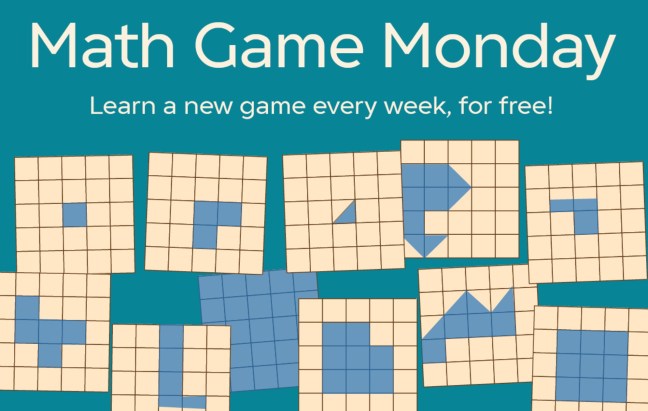
This game pushes students to consider area and perimeter beyond the basic shapes.
Many parents remember struggling to learn math. We hope to provide a better experience for our children. And one of the best ways for children to enjoy learning is through hands-on play.
So what are you waiting for? Let’s play some math!
Area Battle
Math Concepts: area, square units, perimeter, regular and irregular polygons.
Players: two to four.
Equipment: homemade game cards, pencils or markers.
 The FREE 68-page printable (pdf) Prealgebra & Geometry Printables file includes Area Battle card templates, along with all the game boards for the Math You Can Play: Prealgebra & Geometry book.
Set-Up
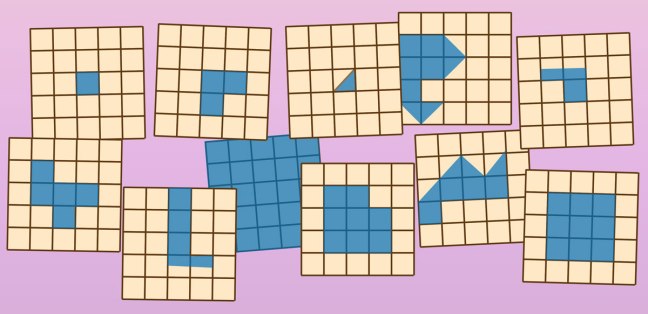
Students cut square grid paper into 5 × 5 squares. Each student creates a personal deck of eleven cards, as follows:
- Regular or irregular polygons, one with each shaded-in area: 1, 2, 3, …, 8, and 9 square units. The area must be easy to count, so build each polygon from a combination of squares and half-squares.
- Two additional polygon cards with areas of the player’s choice.
Claim your deck: Mark the back of each card with your insignia (initials, emoticon, math symbol, etc. — your choice). Decorate as desired, so long as it doesn’t bleed through the paper and obscure your polygons.
How to Play
Stack your card deck face down in front of you. Draw the top two cards for your hand.
On your turn, call “high” or “low” for whether the greatest or least area wins the trick. Then each player chooses a card from their hand and holds it face down. When all players are ready, turn the cards up, and the winner captures them all. Each player keeps a pile of prisoner cards.
In case of a tie, those players reveal their other card, and the longest perimeter takes the trick. If it’s still a tie, leave the cards on the table for the winner of the next trick.
Players draw one or two new cards to replenish their hands before the next turn.
The game ends when at least one player runs out of cards. Whoever has captured the most prisoners wins the game. Give the prisoner cards back to their owner, unless you are playing the Spoils of War variation.
Variations
In between games, players can make new cards. But they must always play with a deck that fits the rules: nine cards with the areas 1–9, plus two extras.
Perimeter Battle: On each turn, the low or high perimeter takes the trick. In case of a tie, the greatest area wins the second fight.
Spoils of War: If you win the game, you may claim one card from your prisoner pile to replace the matching card from your deck. Erase the identification and add your own symbol on the back. You may offer your old card to the losing player as a consolation prize, or keep it as a backup card.
History
When John Golden created and tested this game, the students gave it “universal thumbs up as to whether they would recommend it to other teachers. They were requesting time to play in class later, which is surely a good sign.”
* * *
 This game is an excerpt from Prealgebra & Geometry: Math Games for Middle School. Discover more of my books, printable activities, and cool mathy merchandise at Denise Gaskins’ Playful Math Store.
Special Offer: Would you like to access a growing archive of Math Monday games and other activity ideas as convenient printable pdf downloads, ready to print and play with your kids? Join me on Patreon or choose the paid subscription on Substack for mathy inspiration, tips, printable activities, and more.
“Math Game Monday: Area Battle” copyright © 2026 by Denise Gaskins.

