
“I cannot teach anybody anything, I can only make them think.”
—Socrates
“There is no education but self-education and only as the young student works with his own mind is anything effected.”
—Charlotte Mason
Two great teachers of the past agree that a child’s mind is no bucket. We cannot shovel in whatever information we please and call that “learning.”
So how can we get children to think, to work with their own minds, to build their own relationships with knowledge?
 I try to answer that question, at least for math, in my new book Charlotte Mason’s Living Math, which is now available exclusively on my Playful Math Store.
As I was finishing up the final bits of indexing and formatting the book for publication, I continued to tweak the manuscript. This ability to tinker endlessly is both a benefit and curse of indie publishing. For example, I added four new pages to explain my quibble with Socrates.
You see, Socratic questions are very much a case of “Do what I say, not what I do.”
Not Telling, but Asking Questions
Traditional math lessons often sound like a lecture. A living math lesson sounds more like a conversation, and children often do most of the talking. We pose a conundrum, a puzzle, a problem for our students to investigate. Then they do the work of thinking it through, comparing it with what they already know, making sense of the math.
There’s very little of what we might call teaching—that is, telling our children what to do. Instead, we want to draw out what’s in their minds, the knowledge they already have, and help them see it in new ways or apply it to new situations.
In his classic book, How to Solve It, mathematician George Pólya writes:
“A teacher of mathematics has a great opportunity. If he fills his allotted time with drilling his students in routine operations, he kills their interest, hampers their intellectual development, and misuses his opportunity.
“But if he challenges the curiosity of his students by setting them problems proportionate to their knowledge, and helps them to solve their problems with stimulating questions, he may give them a taste for, and some means of, independent thinking.”
—George Pólya
Don’t Follow Socrates
One of the best ways to get children reasoning about math, and to help them when they get stuck, is to ask questions.
But we need to be careful about the questions we ask. Don’t focus on procedures with questions like, “What kind of problem is this? What is the first step?”
Almost everyone has heard of the value of Socratic questions. But when I read Plato, I find it irritating that so many of those questions seem to be statements in disguise, where the answer must be a simple Yes or No, and the “right” response is clearly whatever the teacher wants to hear.
For example, when Socrates purports to ask Meno’s young servant about math: standardebooks.org/ebooks/plato/dialogues/benjamin-jowett/text/meno.
An Excerpt from Meno
Socrates, Meno, and a slave boy are talking about the problem of doubling the area of a square. At this point, Socrates has demonstrated that the intuitive answer—“make each side twice as long”—fails because the new square is four times as large as the original.
Now he begins leading the boy to the true answer, scratching a diagram in the dirt that begins as a single square, expands it into a square of area 4, then doubles that larger square by using its diagonal as the side of a new one that has area 8.
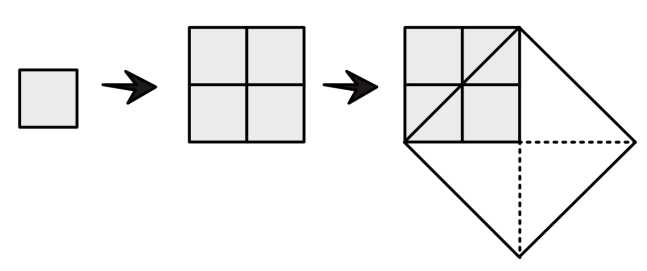
Socrates (to Meno): Mark now the farther development. I shall only ask him, and not teach him, and he shall share the enquiry with me: and do you watch and see if you find me telling or explaining anything to him, instead of eliciting his opinion.
Socrates: Tell me, boy, is not this a square of four feet which I have drawn?
[This is the original small square in the image above, so perhaps by “four feet” he means the side lengths. Later, he refers to the medium square above as four (square) feet.]
Boy: Yes.
Socrates: And now I add another square equal to the former one?
Boy: Yes.
Socrates: And a third, which is equal to either of them?
Boy: Yes.
Socrates: Suppose that we fill up the vacant corner?
Boy: Very good.
Socrates: Here, then, there are four equal spaces?
Boy: Yes.
Socrates: And how many times larger is this space than this other?
Boy: Four times.
Socrates: But it ought to have been twice only, as you will remember.
Boy: True.
Socrates: And does not this line, reaching from corner to corner, bisect each of these spaces?
[The diagonal of the medium square.]
Boy: Yes.
Socrates: And are there not here four equal lines which contain this space?
[The largest square.]
Boy: There are.
Socrates: Look and see how much this space is.
[How big is the largest square?]
Boy: I do not understand.
Socrates: Has not each interior line cut off half of the four spaces?
[Each triangular quarter of the largest square is half of the medium square.]
Boy: Yes.
Socrates: And how many spaces are there in this section?
[The medium square.]
Boy: Four.
Socrates: And how many in this?
[The triangular half of the medium square.]
Boy: Two.
Socrates: And four is how many times two?
Boy: Twice.
Socrates: And this space is of how many feet?
[The whole large square is how many square feet?]
Boy: Of eight feet.
Socrates: And from what line do you get this figure?
[What is the side of this largest square?]
Boy: From this.
Socrates: That is, from the line which extends from corner to corner of the figure of four feet?
Boy: Yes.
Socrates: And that is the line which the learned call the diagonal. And if this is the proper name, then you, Meno’s slave, are prepared to affirm that the double space is the square of the diagonal?
Boy: Certainly, Socrates.
Socrates: What do you say of him, Meno? Were not all these answers given out of his own head?
Meno: Yes, they were all his own.
How to Teach with Questions
If we try to teach like this, we commit the pedagogical sin of funneling, as described in David Butler’s article “Twelve matchsticks: focus or funnel.”
Socratic questions are a valid literary device because the other characters in Plato’s dialogues are mere foils, existing only to show off the wisdom of the teacher.
Our students, however, are not foils but persons with valid ideas of their own. Therefore, try never to ask a question to which you already know the answer. Instead, ask open-ended questions that probe your child’s thinking, like:
- What do you notice?
- What do you wonder?
- Does the problem remind you of anything else you’ve learned?
- Can you describe what you’re trying to find?
- Is there anything you might try, even if you don’t think it will work?
And after you find a solution, that’s never the final end of the story. You can always look back and discover something more.
- Can you think of a way to check your answer?
- Could you do it differently? How many ways might we find to solve this problem?
- What if we changed something in the problem? How would that affect the solution?
“A great discovery solves a great problem but there is a grain of discovery in the solution of any problem.
“Your problem may be modest; but if it challenges your curiosity and brings into play your inventive faculties, and if you solve it by your own means, you may experience the tension and enjoy the triumph of discovery.
“Such experiences at a susceptible age may create a taste for mental work and leave their imprint on mind and character for a lifetime.”
—George Pólya
* * *
“The Problem with Socratic Questions” copyright © 2026 by Denise Gaskins. Image at the top of the blog copyright © Panasevich / Depositphotos.
Are you looking for more creative ways to play math with your kids? Check out all my books, printable activities, and cool mathy merch at Denise Gaskins’ Playful Math Store. Or join my free email newsletter on Substack.
This blog is reader-supported. If you’d like to help fund the blog on an ongoing basis, then please join me on Patreon (or choose the paid level on Substack) for mathy inspiration, tips, and an ever-growing archive of printable activities.
 Denise Gaskins' Let's Play Math