FAQ: Can I Use Your Books as a Math Curriculum?

Father helping girl with math homework

I recently listened to you on Cindy Rollins’ podcast, and I was captivated by your perspective on math. It was exciting, freeing, and wonder-filled. I would absolutely love to be able to teach in the ways you described.

    We use early-elementary Saxon Math right now, which is thorough, but has SO MUCH to do that I’ve always struggled to do it all. Then I feel like I’m missing things, and I never know quite what is important. And yet, the actual lessons move so slowly that my kids get bored with the repetition.

      I use a published curriculum because I have no idea of an appropriate scope and sequence, or similar flow of learning. With your playful approach to math, how do I know where to start, and what to do each day?

        Do you have a suggested order to approach your books to have a full math approach? A sort of curriculum, per se, using your books.

        [For those who missed my chat with Cindy Rollins about a Charlotte Mason approach to math, you can listen to it here.]

        Continue reading FAQ: Can I Use Your Books as a Math Curriculum?

        FAQ: Real Math for Early Learners

        photo of family hiking a rocky trail

        “I love your image of math as a nature walk. My children are ready to start their homeschooling journey, and I want to put them on the right track from the beginning. How can I help them think about math and problem-solving without using a textbook?”

        The most difficult part of teaching our children real math is to change our own way of thinking about the subject you’ve already taken that step, so it looks like your family’s learning journey is off to a great start.

        [For readers who are wondering what I mean by math as a nature walk, check out this post. You may also enjoy my article on natural learning: Math with Young Children.]

        Continue reading FAQ: Real Math for Early Learners

        Memories: The Oral Story Problem Game

        photo of sheep in a field

        Homeschool Memories…

        Perhaps you’ve heard me mention the oral story problem game. It was one of my favorite ways to get my children thinking about math, back in our early days of homeschooling. We played in the car on the way to soccer practice, or while we washed dishes, or sitting in the lobby waiting for a doctor’s appointment.

        The rules are simple: I’ll make up a math problem for you to solve. And then you make up one for me.

        The kids always loved trying to stump me.

        This problem from Henry Ernest Dudeney’s Amusements in Mathematics reminded me of those days. This is exactly the way my eldest loved to torture me…

        Continue reading Memories: The Oral Story Problem Game

        Start the New Year Right: Playful Math Carnival 177 via Math Hombre

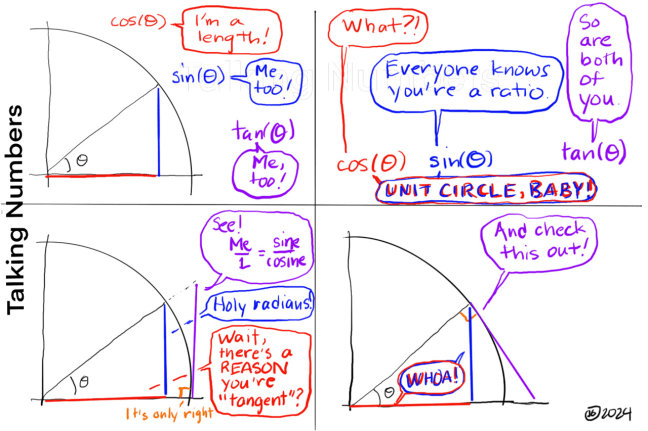
        Talking Numbers from Playful Math Carnival 177

        If you’re looking for an entertaining way to weather the coming storm — or just curious about how learning math could possibly be fun — you’ll definitely want to check out the latest edition of the Playful Math Carnival.

        It’s a collection of awesome blog posts curated by John Golden and published on the Math Hombre website:

        The whole point of the carnival is to show that math doesn’t have to be tedious or repetitive. Through a bunch of fun and engaging posts, we celebrate math that’s playful, creative, and totally relevant to everyday life.

        Because what could be more relevant than having fun while we learn?

        Continue reading Start the New Year Right: Playful Math Carnival 177 via Math Hombre

        Puzzle: Henry Dudeney’s Pebble Game

        photo of girl playing with pebbles on the beach

        English mathematician and puzzle-meister Henry Ernest Dudeney once wrote:

        “It may be said generally that a game is a contest of skill for two or more persons, into which we enter either for amusement or to win a prize. A puzzle is something to be done or solved by the individual.

          “The example that I give here is apparently a game, but, as in every case one player may win if he only play correctly, it is in reality a puzzle. The interest, therefore, lies in attempting to discover the leading method of play.”

          Below is the puzzle game as Dudeney explained it.

          Play it for fun at first, then see if you can solve the puzzle.

          Continue reading Puzzle: Henry Dudeney’s Pebble Game

          Holiday Countdown Craft

          photo of calendar and hourglass timer

          Marking time is hard for children (and often for us adults, as well).

          I don’t mean telling time, which has its own difficulties. But waiting, marking time until the Big Day or Important Event arrives.

          Whether you’re counting down the days to Christmas, or the hours until New Year’s Day, or waiting for a birthday or visit to Grandma — it’s never easy to sit idly during the interim.

          Continue reading Holiday Countdown Craft

          Quick Note: Black Weekend Sale

          Never Just One Way t-shirt photo

          This Weekend Only

          For US customers, ALL merchandise items at my Playful Math Store are on sale for the Black Friday/Small Business Saturday/Cyber Monday season.

          Display your mathy spirit for everyone to see. And they make great gifts, too!

          Plus, each purchase comes with a free bonus book — see product listings for details.

          Check it out:

          Playful Math Merch Sale

          Continue reading Quick Note: Black Weekend Sale

          Charlotte Mason Math: Practical Tips for a Living Math Education

          “Young italian woman with two sleeping children on coast’ painting by August Riedel, public domain

          Focus on the logic of reasoning.

          Correct answers are important, of course, but as children explain their thinking, they will often catch and fix mistakes on their own.

          “Two and two make four and cannot by any possibility that the universe affords be made to make five or three. From this point of view, of immutable law, children should approach Mathematics; they should see how impressive is Euclid’s ‘Which is absurd,’ just as absurd as would be the statements of a man who said that his apples always fell upwards, and for the same reason.”

           — Charlotte Mason, Towards a Philosophy of Education

          “Most remarks made by children consist of correct ideas badly expressed. A good teacher will be wary of saying ‘No, that’s wrong.’ Rather, he will try to discover the correct idea behind the inadequate expression. This is one of the most important principles in the whole of the art of teaching.”

           — W. W. Sawyer, Vision in Elementary Mathematics

          • Tip: If you’re not sure how to draw out your child’s reasoning, read Christopher Danielson’s wonderful examples and advice on talking math with your kids: Talking Math with Your Kids.

          Continue reading Charlotte Mason Math: Practical Tips for a Living Math Education

          Charlotte Mason Math: Wrong Answers and Slovenly Teaching

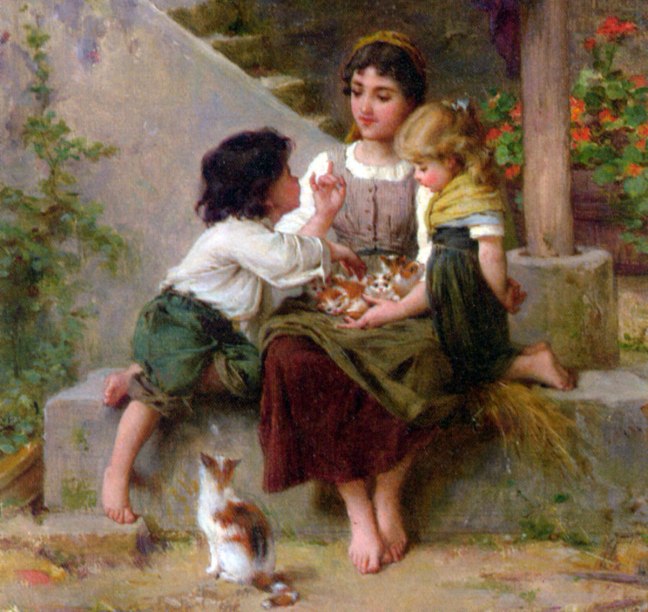
          "Playing with the kittens" painting by Emile Munier, public domain

          The second place where a surface-level reading of Charlotte Mason’s books can lead to misunderstanding involves the treatment of wrong answers. Mason wrote:

          “… quite as bad as these is the habit of allowing that a sum is nearly right, two figures wrong, and so on, and letting the child work it over again. Pronounce a sum wrong, or right — it cannot be something between the two. That which is wrong must remain wrong: the child must not be let run away with the notion that wrong can be mended into right.”

           — Charlotte Mason, Home Education

          Does this call to mind images of your own childhood schoolwork? It does for me: laboring over a worksheet or quiz and then taking it to my teacher to be graded. Right was right, and wrong could not be mended. In such a performance-oriented setting, mistakes can take on the flavor of moral failure.

          Is this authoritarian approach the way Mason wants us to teach math to our children? Where is the summa corda — the joyful praise — in that?

          No. Please, no. Very definitely no.

          Mason wanted us to avoid slovenliness in our teaching. In this passage, she warned against several forms this might take.

          Continue reading Charlotte Mason Math: Wrong Answers and Slovenly Teaching