Count Up to Christmas

secondary-starBack when we were still homeschooling, I always dropped the “regularly scheduled program” in December. School plus holiday prep added up to one stressed-out mom.

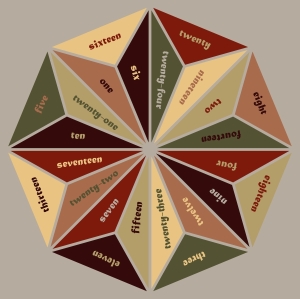
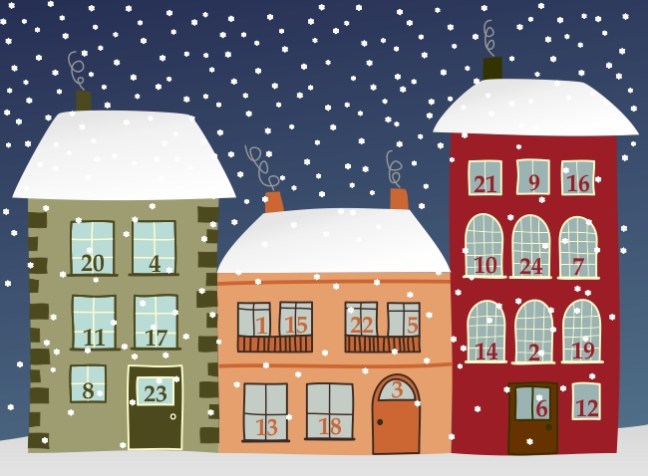
Instead, we read plenty of library books. And we played around with informal activities like the NrichMaths Advent Calendars:

For older students and adults, the online Plus Magazine offers a calendar of daily tidbits from their “Maths in a minute” series, explaining important mathematical concepts in just a few words”

And for still more winter fun, check out the links in my old Christmas Math Puzzles and Activities post.

And a Question for You

How do you handle schoolwork during this busy season? I’m collecting new links for an updated Holiday Math post next month. I’d love to hear your ideas!

Giving Thanks

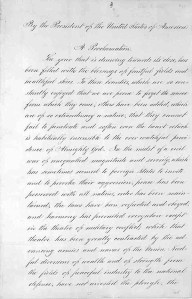
Proclamation 106—Thanksgiving Day, 1863
Portrait

By the President of the United States of America

A Proclamation

The year that is drawing toward its close has been filled with the blessings of fruitful fields and healthful skies. To these bounties, which are so constantly enjoyed that we are prone to forget the source from which they come, others have been added which are of so extraordinary a nature that they can not fail to penetrate and soften even the heart which is habitually insensible to the ever-watchful providence of Almighty God.

In the midst of a civil war of unequaled magnitude and severity, which has sometimes seemed to foreign states to invite and to provoke their aggression, peace has been preserved with all nations, order has been maintained, the laws have been respected and obeyed, and harmony has prevailed everywhere, except in the theater of military conflict, while that theater has been greatly contracted by the advancing armies and navies of the Union.

Needful diversions of wealth and of strength from the fields of peaceful industry to the national defense have not arrested the plow, the shuttle, or the ship; the ax has enlarged the borders of our settlements, and the mines, as well of iron and coal as of the precious metals, have yielded even more abundantly than heretofore. Population has steadily increased notwithstanding the waste that has been made in the camp, the siege, and the battlefield, and the country, rejoicing in the consciousness of augmented strength and vigor, is permitted to expect continuance of years with large increase of freedom.

No human counsel hath devised nor hath any mortal hand worked out these great things. They are the gracious gifts of the Most High God, who, while dealing with us in anger for our sins, hath nevertheless remembered mercy.

It has seemed to me fit and proper that they should be solemnly, reverently, and gratefully acknowledged, as with one heart and one voice, by the whole American people. I do therefore invite my fellow-citizens in every part of the United States, and also those who are at sea and those who are sojourning in foreign lands, to set apart and observe the last Thursday of November next as a day of thanksgiving and praise to our beneficent Father who dwelleth in the heavens. And I recommend to them that while offering up the ascriptions justly due to Him for such singular deliverances and blessings they do also, with humble penitence for our national perverseness and disobedience, commend to His tender care all those who have become widows, orphans. mourners, or sufferers in the lamentable civil strife in which we are unavoidably engaged, and fervently implore the interposition of the Almighty hand to heal the wounds of the nation and to restore it, as soon as may be consistent with the divine purposes, to the full enjoyment of peace, harmony, tranquillity, and union.

In testimony whereof I have hereunto set my hand and caused the seal of the United States to be affixed.

Done at the city of Washington, this 3d day of October, A. D. 1863, and of the Independence of the United States the eighty-eighth.

Abraham Lincoln

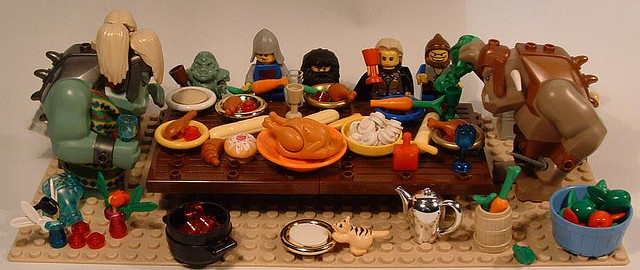
[Feature photo “Thanksgiving at the Troll’s” by martha_chapa95 via Flickr.] (CC-BY 2.0)
Prof. Triangleman’s Abbreviated List of Standards for Mathematical Practice

How can we help children learn to think mathematically? Live by these four principles.

PTALSMP 1: Ask questions.

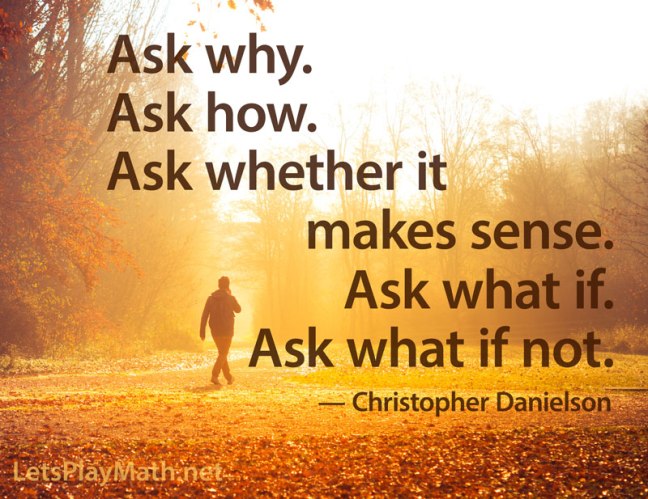
Ask why. Ask how. Ask whether your answer is right. Ask whether it makes sense. Ask what assumptions you have made, and whether an alternate set of assumptions might be warranted. Ask what if. Ask what if not.

PTALSMP 2: Play.

See what happens if you carry out the computation you have in mind, even if you are not sure it’s the right one. See what happens if you do it the other way around. Try to think like someone else would think. Tweak and see what happens.

PTALSMP 3: Argue.

Say why you think you are right. Say why you might be wrong. Try to understand how someone else sees things, and say why you think their perspective may be valid. Do not accept what others say is so, but listen carefully to it so that you can decide whether it is.

PTALSMP 4: Connect.

Ask how this thing is like other things. Try your ideas out on a new problem. Ask whether and how these ideas apply to other situations. Look for similarities and differences. Seek out the boundaries and limitations of your techniques.

— Christopher Danielson

And a Puzzle

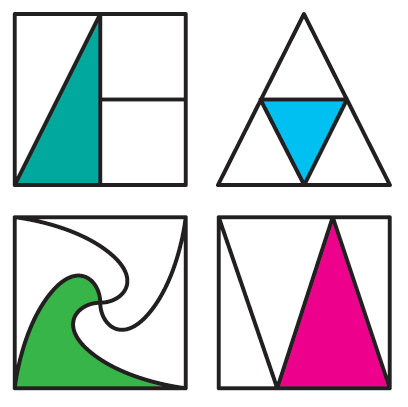
Practice applying Professor Triangleman’s Standards to the puzzle below. Which one doesn’t belong? Can you say why someone else might pick a different one?

wodb

multfrac-300CREDITS: An expanded version of the standards originally posted in Ginger ale (also abbreviated list of Standards for Mathematical Practice). Feature photo by Alexander Mueller via Flicker (CC-BY 2.0, text added). This post is an excerpt from my book Multiplication & Fractions: Math Games for Tough Topics, available now at your favorite online book dealer.

New Book: Multiplication & Fraction Games

It’s here! My long-awaited upper-elementary Math You Can Play games book has finally hit the online bookstores.

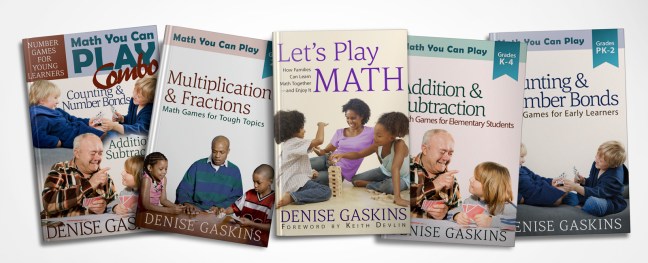
Multiplication & Fractions features 25 kid-tested games, offering a variety of challenges for school-age students. Children master several math models that provide a sturdy foundation for understanding multiplication and fractions. The games feature times table facts and more advanced concepts such as division, fractions, decimals, and multistep mental math.

Click here to find Multiplication & Fractions at your favorite bookstore.

Multiplication & Fraction Games

multfrac-300Maybe you never really understood what multiplication means or what fractions are? As long as you start with an open mind and are willing to engage playfully, the activities in the book can help you as you help your kids.
Anecdotally, these two areas are the first major stumbling point for students in their math studies. The sequencing in the book will help kids develop a strong foundation.
Kids (and parents!) find these games fun. I’ve been field testing math games for the last 18 months and keep seeing how engaged kids get when playing math games.

— Joshua Greene
Multiplication & Fractions Math Games from Denise Gaskins (a review)

Chapters include:

  • Mathematical Models: Learn the basic pictures that help support your child’s comprehension.
  • Conquer the Times Tables: Enjoy practicing the math facts until correct answers become automatic.
  • Mixed Operations: Give mental muscles a workout with games that require number skills and logical thinking.
  • Fractions and Decimals: Master equivalent fractions, work with decimal place value, and multiply fractions and decimal numbers.

If you are a parent, these games provide opportunities to enjoy quality time with your children. If you are a classroom teacher, use the games as warm-ups and learning center activities or for a relaxing review day at the end of a term. If you are a tutor or homeschooler, make games a regular feature in your lesson plans to build your students’ mental math skills.

So what are you waiting for? Clear off a table, grab a deck of cards, and let’s play some math!

Check It Out

It starts with models that are visual explanations of the concepts. Gaskins also breaks learning these concepts into comfortable steps that emphasize patterns and relationships, the real ideas that are behind properly understanding multiplication and fractions (indeed, math generally).
The sequence of games in each section starts by building familiarity and then fluency (speed) to solidify all of that work.

— Joshua Greene
Multiplication & Fractions Math Games from Denise Gaskins (a review)

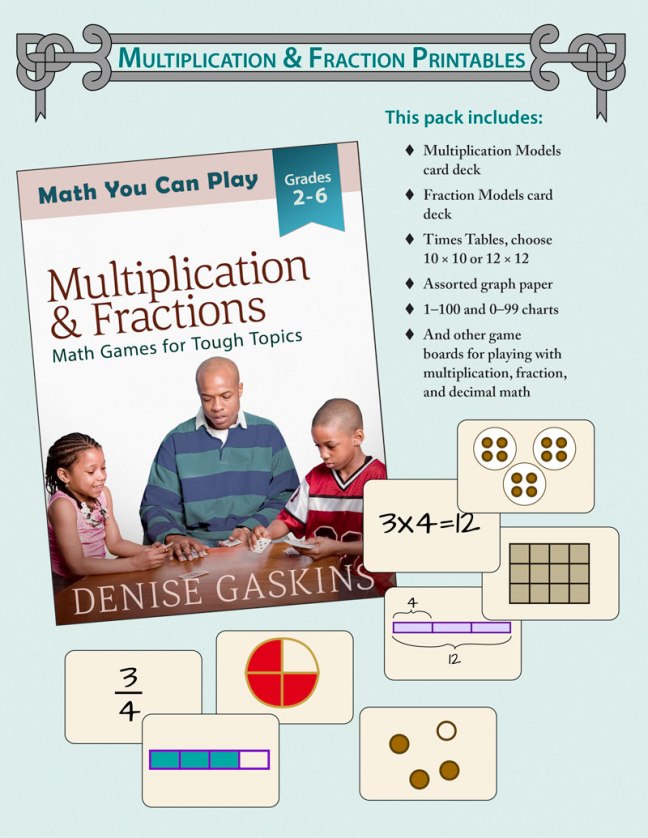
Multiplication & Fraction Printables

Multiplication & Fraction Printables

Most of the Math You Can Play games use materials you already have around the house, such as playing cards or dice. But this book introduces multiplication and fractions with several games using two special mathematical model card decks.

Click here to download the Multiplication & Fraction Printables, featuring all the math model cards, hundred charts, and game boards you will need for any game in the book.

The Value of Math Games

From Peggy Kaye’s classic book Games for Math:

Kaye-Games4Math

“Games put children in exactly the right frame of mind for learning difficult things.

“Children relax when they play — and they concentrate. They don’t mind repeating certain facts or procedures over and over, if repetition is part of the game.

“Children throw themselves into playing games the way they never throw themselves into filling out workbook pages.

“The games solidify the achievements of children who are already good at math, and they shore up children who need shoring up. They teach or reinforce many of the skills that a formal curriculum teaches, plus one skill that formal teaching sometimes leaves out — the skill of having fun with math, of thinking hard and enjoying it.

“If you play these games and your child learns only that hard mental effort can be fun, you will have taught something invaluable.”

Peggy Kaye
Games for Math

Sample Peggy’s Games for Math

 
* * *

This blog is reader-supported.

If you’d like to help fund the blog on an on-going basis, then please join me on Patreon for mathy inspiration, tips, and an ever-growing archive of printable activities.

If you liked this post, and want to show your one-time appreciation, the place to do that is PayPal: paypal.me/DeniseGaskinsMath. If you go that route, please include your email address in the notes section, so I can say thank you.

Which I am going to say right now. Thank you!

“The Value of Math Games” copyright © 2016 by Denise Gaskins.

Number Game Printables

One step closer to getting my long-awaited Multiplication & Fraction Games book out — I finished the printables file! At least, I hope I’ve finished. Sometimes it seems like whack-a-typo never ends…

Multiplication & Fraction Printables

Multiplication & Fraction Printables

Click here to download the Multiplication & Fraction Printables, featuring mathematical model cards, hundred charts, and game boards to accompany the upcoming Math You Can Play: Multiplication & Fractions book.

The Multiplication & Fractions ebook will come out sometime in November, and the paperback should follow in time for Christmas. If you’re interested, my newsletter subscribers will get a special introductory sale price whenever the book is published. Join now!

You may also want to check out:

Number Game Printables Pack

Number Game Printables Pack

Click here to download the Number Game Printables Pack, featuring hundred charts, graph paper, and game boards from the first two Math You Can Play books.

Also, 0–99 charts, and bottoms-up versions, too. (See my blog post Math Debates with a Hundred Chart.) And a fun cut-and-fold game board for playing Shut the Box.

Permission to Use These Files

You have permission to copy and use these game boards and worksheets in your own local classroom, home school, math circle, co-op class, etc. But you may not post them on your own website (though you can link to this post, if you like) or sell them. If you’re not sure how copyright works on the Internet, check out Daniel Scocco’s Copyright Law: 12 Dos and Don’ts.

Playful Math Carnival 101 at Arithmophobia No More

Check out the new carnival of playful math for all ages at Arithmophobia No More blog. You’re sure to enjoy this great collection of puzzles, math conversations, crafts, teaching tips, and all sorts of mathy fun.

The carnival features prime numbers, multiplication, arithmetic puzzles, magic, word problems, picture puzzles, games, mathematical conversations, and much more.

Click here to go read the carnival blog!

Do You Want More Ways to Play with Math?

Past carnivals are still full of mathy treasure. See them all on Pinterest:

Making Sense of Arithmetic

Homeschoolers have an advantage in teaching math: As our students grow, our own understanding of math grows with them because we see how the ideas build on each other.

This is especially true for those of us with large families. We pass through the progression of concepts with each student, and every pass lays down another layer in our own minds.

If you’d like to short-cut that process, check out Graham Fletcher’s Making Sense of Elementary Math video series. He’ll walk you through the topics, showing how manipulatives help build early concepts and gradually give way to abstract calculations.

“Understanding the vertical progression of mathematics is really important in the conceptual development of everyone’s understanding. This whole Making Sense Series has truly forced me to be a better teacher.”

— Graham Fletcher

Continue reading Making Sense of Arithmetic

Math You Can Play Combo in Paperback and Ebook

If you’re interested in helping children learn math, I have special offer just for you:

  • Save 20% off the individual ebooks or 35% off the paperback prices when you buy a combined 2-books-in-1 edition featuring the first two books in the Math You Can Play series together.

The 42 kid-tested games are simple to learn, quick to play, and require minimal preparation. Most use common household items such as cards or dice.

Free Online Preview

Amazon-logo the_book_depository_logo Barnes-Noble-logo kobo-logo Scribd_logo Smashwords-logo CreateSpace-logo

“Although the cover says games for young learners, the beauty of this book is that most of the games can easily be scaled up for older kids, teens, and even adults. My youngest is four and my oldest is 14, and I will be pulling games for all of them out of this book!

“I appreciate that most of the games are low floor, high ceiling – easy for a child to access, but can be played at a higher level through strategy or slight alterations to the rules. These are not drills disguised as games, but activities that require problem solving and strategy as well as calculation.”

Kindle customer review

Continue reading Math You Can Play Combo in Paperback and Ebook