How to Talk Math With Your Kids

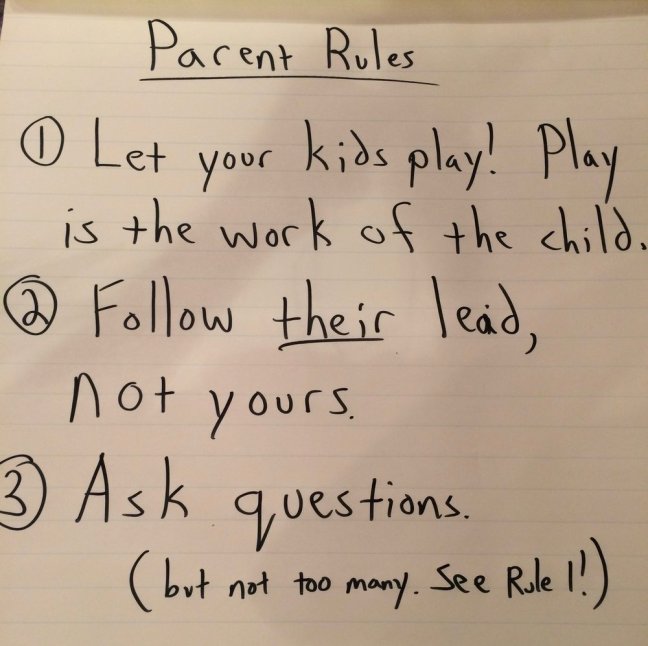
A friend shared this video, and I loved it! From Kent Haines, a father who happens to also be a math teacher…

“I hope that this video helps parents find new ways of interacting with their kids on math topics.”

Kent Haines

More from Kent Haines

Advice and Examples of Talking Math with Kids
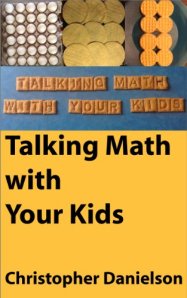
Danielson-Talking Math

If you enjoyed Kent’s video, you’ll love Christopher Danielson’s book and blog.

It’s a short book with plenty of great stories, advice, and conversation-starters. While Danielson writes directly to parents, the book will also interest grandparents, aunts & uncles, teachers, and anyone else who wants to help children notice and think about math in daily life.

“You don’t need special skills to do this. If you can read with your kids, then you can talk math with them. You can support and encourage their developing mathematical minds.
 
“You don’t need to love math. You don’t need to have been particularly successful in school mathematics. You just need to notice when your children are being curious about math, and you need some ideas for turning that curiosity into a conversation.
 
“In nearly all circumstances, our conversations grow organically out of our everyday activity. We have not scheduled “talking math time” in our household. Instead, we talk about these things when it seems natural to do so, when the things we are doing (reading books, making lunch, riding in the car, etc) bump up against important mathematical ideas.
 
“The dialogues in this book are intended to open your eyes to these opportunities in your own family’s life.”

— Christopher Danielson
Talking Math with Your Kids

 
* * *

This blog is reader-supported.

If you’d like to help fund the blog on an on-going basis, then please join me on Patreon for mathy inspiration, tips, and an ever-growing archive of printable activities.

If you liked this post, and want to show your one-time appreciation, the place to do that is PayPal: paypal.me/DeniseGaskinsMath. If you go that route, please include your email address in the notes section, so I can say thank you.

Which I am going to say right now. Thank you!

“How to Talk Math With Your Kids” copyright © 2017 by Denise Gaskins. “Kids Talk” photo (top) by Victoria Harjadi via Flickr (CC BY 2.0). “Parent Rules” by Kent Haines.

FAQ: Trouble Finding the Right Math Program

“I can’t find a home school math program my son likes. We’ve tried Singapore Math, Right Start, Saxon, and Math Mammoth. We subscribed to a month of IXL Math to keep him in practice, but he hates that, too. I know I shouldn’t have changed so many times, but this was our first year of homeschooling, and I was trying to please him. But I’m running out of things to try. Do you think Life of Fred might work?”

Rock-Surfing

You’ve tried all those math programs in one year? Many people recommend that new homeschoolers take a few months off to “detox” from the classroom setting, to relax and enjoy the freedom of making their own choices. But your son might want a few months to detox from his homeschool experience.

I suggest you set aside all those books and focus on games and informal math. Try to avoid schoolish lessons until your son starts to enjoy learning for its own sake.

Continue reading FAQ: Trouble Finding the Right Math Program

Review: Math & Magic in Wonderland

Are you looking for a fun book to read over the summer? I just finished Lilac Mohr’s delightful Math & Magic in Wonderland, and I loved it.

Highly recommended, for kids or adults!

About the Book

Math-Magic-WonderlandA Jubjub bird disguised as a lark,
Borogroves concealing a snark,
When you’re in Tulgey Wood, you must
Be careful whom it is you trust…

With the discovery of Mrs. Magpie’s Manual of Magic for Mathematical Minds, Lulu and Elizabeth embark on an exciting journey to a realm inspired by Lewis Carroll’s poetry. The twins must use ingenuity and sagacity to solve classic logic puzzles that promise to uncover the book’s secrets and earn them The Vorpal Blade. In this interactive novel, the reader is invited to play along with the two heroines on their grand mathematical adventure.

Do you have the smarts to help Lulu and Elizabeth outwit the frumious Bandersnatch?

It’s time to enter Wonderland and find out!

–from the back cover of Math & Magic in Wonderland by Lilac Mohr

What I Liked

Puns, poetry, and plenty of puzzles. Tangrams, tessellations, truth-tellers and liars. History tidbits and many classics of recreational mathematics.

The sisters Lulu and Elizabeth seem real — though perhaps more widely read than most of us. They are different from each other. They make mistakes and have disagreements. But they never deteriorate into the cliché of sibling rivalry that passes for characterization in too many children’s books.

In each chapter, the girls must solve a language, math, or logic puzzle to proceed along their journey. Then a “Play Along” section offers related puzzles for the reader to try.

No matter how challenging the topic, the book never talks down to the reader.

What I Didn’t Like

… Um … Honestly, I can’t think of anything.

Since it’s traditional to criticize the editing of self-published books, I will say this: There was at least one place where the wording seemed a bit awkward. I would have phrased the sentence differently. But don’t ask me to identify the page — I was too caught up in the story to bother jotting down such a quibble. And I tried flipping through the book as I wrote this post, but I can’t find it again.

Buy, or Don’t Buy?

Buy. Definitely buy.

Unless you hate logic puzzles and despise Lewis Carroll’s poetry.

But for everyone else, this book is truly a gem. If you like The Cat in Numberland or The Man Who Counted, then I’m sure you’ll enjoy Math & Magic in Wonderland.

Useful Links

Disclaimer: Like almost all book links on my blog, the links in this post take you to Amazon.com, where you can read descriptions and reviews. I make a few cent’s worth of affiliate commission if you make a purchase — but nowhere near enough to influence my opinion about the book.

And Now for the Giveaway

Math-Magic-WonderlandLilac offered a paperback copy of Math & Magic in Wonderland for one lucky reader of Let’s Play Math blog.

The giveaway is done. Congratulations, Keshua!

But the comments section below remains open, and I’d still love to hear your answers:

  • Tell us about your favorite language, math, or logic puzzle book! Or share a book you’ve been wanting to read.

FAQ: He Won’t Stop Finger-Counting

“My oldest son has somehow developed the horrid habit of counting on his fingers. We worked on the math facts all summer. He knows the answers in simple form, such as 9 + 4, but if it’s in a bigger problem like 249 + 54, he counts up to add or counts down to subtract, all using fingers. My younger children have no problem with mental math, but he can’t seem to get it. Are there any tips or tricks to stop this?”

New Crutches

Counting on fingers is not a horrid habit, it is a crutch. Please think for a moment about the purpose of crutches. The blasted things are an uncomfortable nuisance, but there are times when you can’t get anywhere without them. And if you need them, it does you no good for a friend to insist you should crawl along on your own.

That is how your son feels right now about his fingers. He is struggling with something his younger siblings find easy, and he can tell that you are frustrated. His confidence is broken, in a cast, and needs time for healing. So he falls back on what he knows he can do, counting up the answer.

Think positive: this means he still believes that math ought to make sense — that to understand what he is doing is more important than to guess at an answer. You want him to value sense-making, because otherwise he will try to memorize his way through middle school and high school math. That is the road to disaster.

Continue reading FAQ: He Won’t Stop Finger-Counting

Multiplication Is Not Repeated Addition: Update

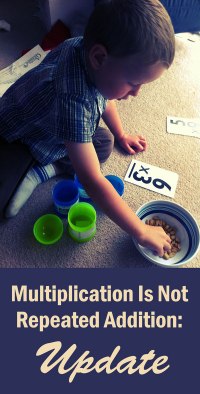
Multiplication Is Not Repeated Addition: Update[Photo “Micah and Multiplication” by notnef via Flickr (CC BY 2.0, text added).]

Some Internet topics are evergreen. I noticed that my old Multiplication Is Not Repeated Addition post has been getting new traffic lately, so I read through the article again. And realized that, even after all those words, I still had more to say.

So I added the following update to clarify what seemed to me the most important point.

I’d love to hear your thoughts! The comment section is open down below . . .


Language Does Matter

Addition: addend + addend = sum. The addends are interchangeable. This is represented by the fact that they have the same name.

Multiplication: multiplier × multiplicand = product. The multiplier and multiplicand have different names, even though many of us have trouble remembering which is which.

  • multiplier = “how many or how much”
  • multiplicand = the size of the “unit” or “group”

Different names indicate a difference in function. The multiplier and the multiplicand are not conceptually interchangeable. It is true that multiplication is commutative, but (2 rows × 3 chairs/row) is not the same as (3 rows × 2 chairs/row), even though both sets contain 6 chairs.

A New Type of Number

In multiplication, we introduce a totally new type of number: the multiplicand. A strange, new concept sits at the heart of multiplication, something students have never seen before.

The multiplicand is a this-per-that ratio.

A ratio is a not a counting number, but something new, much more abstract than anything the students have seen up to this point.

A ratio is a relationship number.

In addition and subtraction, numbers count how much stuff you have. If you get more stuff, the numbers get bigger. If you lose some of the stuff, the numbers get smaller. Numbers measure the amount of cookies, horses, dollars, gasoline, or whatever.

The multiplicand doesn’t count the number of dollars or measure the volume of gasoline. It tells the relationship between them, the dollars per gallon, which stays the same whether you buy a lot or a little.

By telling our students that “multiplication is repeated addition,” we dismiss the importance of the multiplicand. But until our students wrestle with and come to understand the concept of ratio, they can never fully understand multiplication.

For Further Investigation

nunes-doingmathIf you’re interested in digging deeper into how children learn addition and multiplication, I highly recommend Terezina Nunes and Peter Bryant’s book Children Doing Mathematics.

To learn about modeling multiplication problems with bar diagrams, check out the Mad Scientist’s Ray Gun model of multiplication:

And here is an example of the multiplication bar diagram in action:

New Hundred Chart Game: Odd-Even-Prime Race

Counting all the fractional variations, my massive blog post 30+ Things to Do with a Hundred Chart now offers nearly forty ideas for playing around with numbers from preschool to prealgebra.

Here is the newest entry, a variation on #10, the “Race to 100” game:

(11.5) Play “Odd-‌Even-‌Prime Race.″ Roll two dice. If your token is starting on an odd number, move that many spaces forward. From an even number (except 2), move backward — but never lower than the first square. If you are starting on a prime number (including 2), you may choose to either add or multiply the dice and move that many spaces forward. The first person to reach or pass 100 wins the game.
[Hat tip: Ali Adams in a comment on another post.]

And here’s a question for your students:

  • If you’re sitting on a prime number, wouldn’t you always want to multiply the dice to move farther up the board? Doesn’t multiplying always make the number bigger?

 
* * *

This blog is reader-supported.

If you’d like to help fund the blog on an on-going basis, then please join me on Patreon for mathy inspiration, tips, and an ever-growing archive of printable activities.

If you liked this post, and want to show your one-time appreciation, the place to do that is PayPal: paypal.me/DeniseGaskinsMath. If you go that route, please include your email address in the notes section, so I can say thank you.

Which I am going to say right now. Thank you!

“New Hundred Chart Game: Odd-Even-Prime Race” copyright © 2015 by Denise Gaskins. Image at the top of the post copyright © geishaboy500 (CC BY 2.0).

Noticing Fractions in a Sidewalk

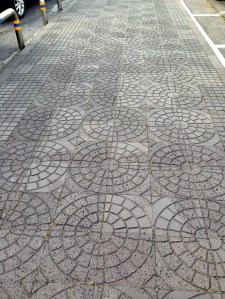
fraction-circle

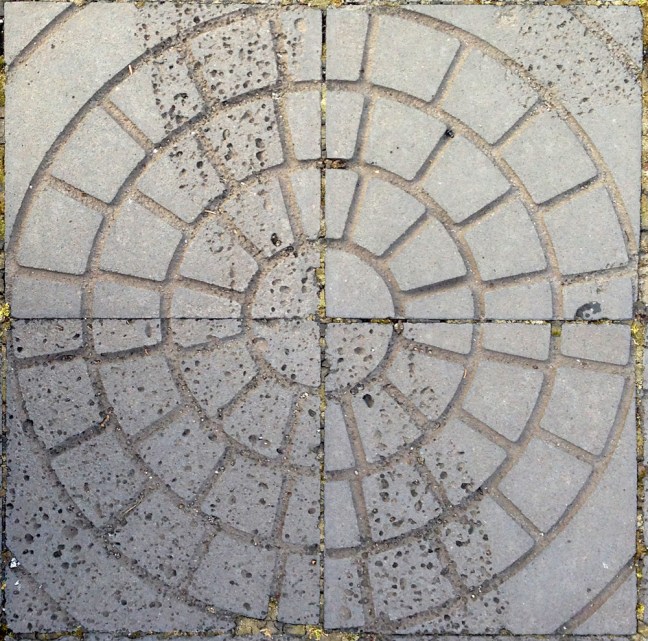
My daughters didn’t want to admit to knowing me, when I stopped to take a picture of the sidewalk along a back street during our trip to Jeju. But aren’t those some wonderful fractions?

What do you see? What do you wonder?

Here is one of the relationships I noticed in the outer ring:

\frac{4 \frac {2}{2}}{20} = \frac {1}{4}

sidewalk

And this one’s a little trickier:

\frac{1 \frac {1}{2}}{12} = \frac {1}{8}

Can you find it in the picture?

Each square of the sidewalk is made from four smaller tiles, about 25 cm square, cut from lava rock. Some of the sidewalk tiles are cut from mostly-smooth rock, some bubbly, and some half-n-half.

I wonder how far we could go before we had to repeat a circle pattern?

Continue reading Noticing Fractions in a Sidewalk

Socks Are Like Pants, Cats Are Like Dogs

Support This New Book from Natural Math

Socks Are Like Pants, Cats Are Like Dogs by Malke Rosenfeld and Gordon Hamilton is filled with a diverse collection of math games, puzzles, and activities exploring the mathematics of choosing, identifying and sorting. The activities are easy to start and require little preparation.

The publisher’s crowdfunding goal is $4,000. The book is almost ready to go to press, and I can hardly wait to see it!

Review Game: Once Through the Deck

Math Concepts: basic facts of addition, multiplication.
Players: one.
Equipment: one deck of math cards (poker- or bridge-style playing cards with the face cards and jokers removed).

The best way to practice the math facts is through the give-and-take of conversation, orally quizzing each other and talking about how you might figure the answers out. But occasionally your child may want a simple, solitaire method for review.

Continue reading Review Game: Once Through the Deck

Math Games with Factors, Multiples, and Prime Numbers

Students can explore prime and non-prime numbers with these free favorite classroom games:

For $15-20 you can buy a downloadable file of the beautiful, colorful, mathematical board game Prime Climb. Or pick up the full Prime Climb game box at Amazon.

Or you can try the following game by retired Canadian education professor Jerry Ameis:

Factor Finding Game

FactorFindingGame

Math Concepts: multiples, factors, composite numbers, and primes.
Players: only two.
Equipment: pair of 6-sided dice, 10 squares each of two different colors construction paper, and the game board (click the image to print it, or copy by hand).

On your turn, roll the dice and make a 2-digit number. Use one of your colored squares to mark a position on the game board. You can only mark one square per turn.

  • If your 2-digit number is prime, cover a PRIME square.
  • If any of the numbers showing are factors of your 2-digit number, cover one of them.
  • BUT if there’s no square available that matches your number, you lose your turn.

The first player to get three squares in a row (horizontal, vertical, or diagonal) wins. Or for a harder challenge, try for four in a row.

 
* * *

This game was featured in the Math Teachers At Play (MTaP) math education blog carnival: MTaP #79. Hat tip: Jimmie Lanley.

This blog is reader-supported.

If you’d like to help fund the blog on an on-going basis, then please join me on Patreon for mathy inspiration, tips, and an ever-growing archive of printable activities.

If you liked this post, and want to show your one-time appreciation, the place to do that is PayPal: paypal.me/DeniseGaskinsMath. If you go that route, please include your email address in the notes section, so I can say thank you.

Which I am going to say right now. Thank you!

“Math Games with Factors, Multiples, and Prime Numbers” copyright © 2015 by Denise Gaskins. Image at the top of the post copyright © Jimmie via flickr (CC BY 2.0).