Or noticed your child having one of those “Aha” moments?
I’d love to hear your story in the comments!
You can think of puzzles and games as the sugar that helps the medicine to down, and you’re at least a bit healthier in your approach to math. But even better than sugar and nasty medicine is food that’s delicious enough to take away our craving for sugar and nutritious enough to take away any need for medicine. In the same way, good problems can help us fall in love with math and make a delicious meal of it, sinking our teeth into tough problems, tenderized by their intrigue.
…
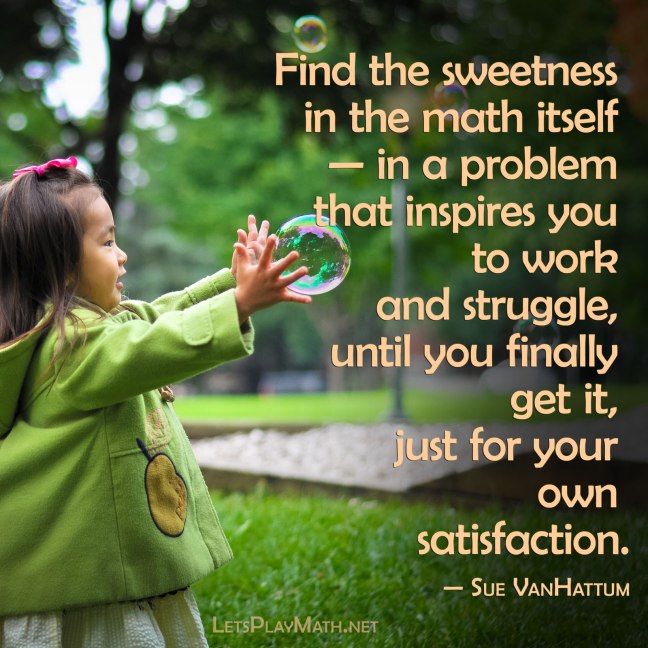
Most people like games, so that’s an easy place to begin. At first, the games can be the sweetness that helps the math medicine go down. Over time perhaps you can find the sweetness in the math itself — in a problem that inspires you to work and struggle, until you finally get it, just for your own satisfaction.
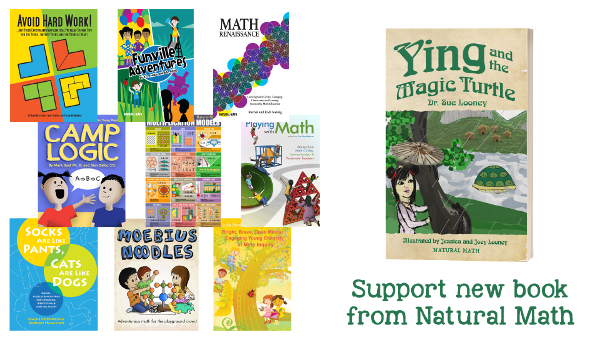
And there’s a new one coming soon, from the wonderful people at Natural Math.
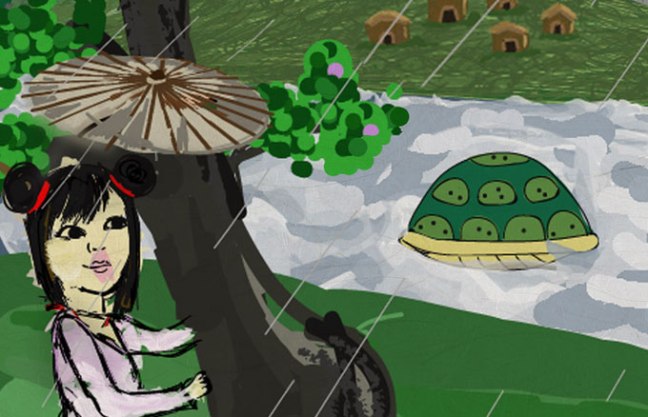
“Long ago in the land of China, there were many rain storms … and the land of China was slowly sinking into the sea. This is the story of how a wise emperor, an observant girl, and a magic turtle saved the villages of China from the great flood.”
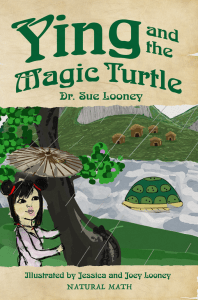
So begins the story of Ying and the Magic Turtle.
Children, parents, and teachers can enjoy the book for its rich beauty in mathematics and as an ancient legend.
We can play with the mathematics, too, solving the puzzle of the turtle’s shell right alongside Ying.
And we can delve deeper into the power of magic squares by working with puzzles presented at the end of the story.
Join the Crowdfunding Campaign
For more details about Ying and the Magic Turtle, including a peek at the delightful illustrations, check out the Kickstarter crowdfunding page:
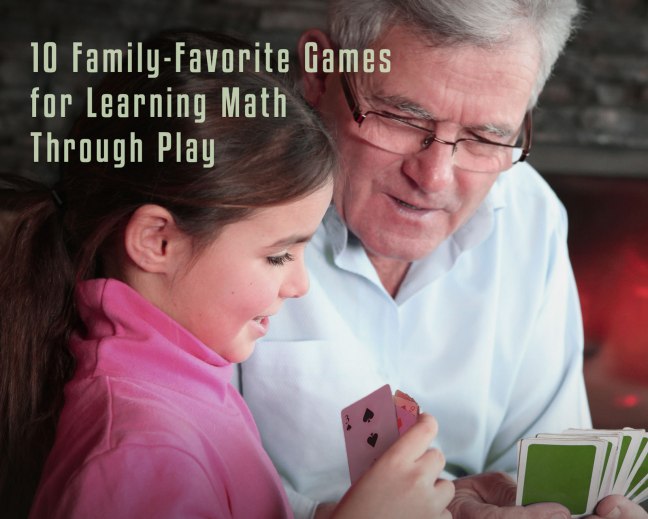
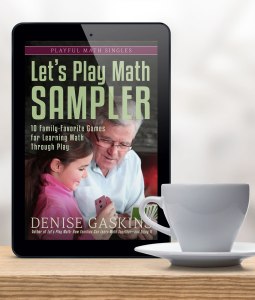
My new Let’s Play Math Sampler: 10 Family-Favorite Games for Learning Math Through Play contains short excerpts from my most popular titles, including a preview of two games from my work-in-progress Prealgebra & Geometry Games.
It’s a great way to get started with playful math!
This week, my publisher Tabletop Academy Press is offering a free copy of the Sampler to TWO lucky winners. [Winners with a U.S. mailing address will receive both paperback (by U.S. Media Mail) and ebook (by online download) versions of the book. International winners will receive ebooks only.]
How to Enter the Giveaway
The giveaway is over, but I’d still love to hear your “math memory” comments.
Share a math memory! Scroll down to leave a comment with something from your school days, a cute thing your child has said, or anything else about learning or playing with math.
Congratulations to our winners: Michael and Caroline. Check your email for details on how to claim your Let’s Play Math Sampler books.
John put together this carnival of mathematical fun with numbers and shapes, math art, creative wordplay, games, a calculus beach towel, tips on using play to heal a broken relationship with math, and more — even Shakespeare!
Each monthly Playful Math Education Blog Carnival brings you a great new collection of puzzles, math conversations, crafts, teaching tips, and all sorts of mathy fun.
It’s like a free online magazine of mathematical adventures, helpful and inspiring no matter when you read them. Enjoy!
Do you have a favorite blog post about math activities, games, lessons, or hands-on fun? The Playful Math Blog Carnival would love to feature your article!
We welcome math topics from preschool through the first year of calculus. Old posts are welcome, as long as they haven’t been published in past editions of this carnival.
To submit a blog article for consideration, fill out this form:
Have you noticed a new math blogger on your block that you’d like to introduce to the rest of us? Feel free to submit another blogger’s post in addition to your own. Beginning bloggers are often shy about sharing, but like all of us, they love finding new readers.
CREDITS: “Bubbles of light” photo (top) by Ignat Kushanrev and “Flamingo” photo by Vicko Mozara on Unsplash.
Check out the new playful math blog carnival at Math Misery? blog. Manan Shah put together a great collection of number puzzles along with some math games, teaching tips, and more:
Oops! I can’t believe I forgot to post these links when my latest book came out way back in March. Indie author fail…
Do you want your children to enjoy learning math?
Teach them how to play!
In excerpts from five of my most popular books, the Let’s Play Math Sampler features ten kid-tested games covering math concepts from counting to prealgebra.
Pick up a copy of the Let’s Play Math Sampler today, and make math a playful family adventure.
Yes, your kids CAN learn to love math. Keep your children’s math skills fresh with my 8-week email series of math games and activities.
No purchase necessary! Just sign up for my email newsletter, and every week for the next two months you’ll automatically receive one of my favorite math club activities or an excerpt from my series of math game books.
And I’ll send you occasional news updates with playful math tips, resource links, and book sales or other promotions.
Did you know that numbers can be polite? In math, a polite number is any number we can write as the sum of two or more consecutive positive whole numbers.
(Consecutive means numbers that come one right after another in the counting sequence.)
For example, five is a polite number, because we can write it as the sum of two consecutive numbers:
5 = 2 + 3
Nine is a doubly polite number, because we can write it two ways:
9 = 4 + 5
9 = 2 + 3 + 4
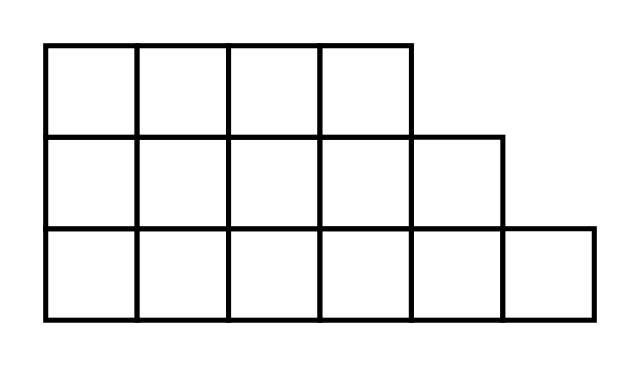
And fifteen is an amazingly polite number. We can write fifteen as the sum of consecutive numbers in three ways:
15 = 7 + 8
15 = 4 + 5 + 6
15 = 1 + 2 + 3 + 4 + 5
How many other polite numbers can you find?
You can build polite numbers (like fifteen) with a staircase of blocks.
What Do You Notice?
Are all numbers polite?
Or can you find an impolite number?
Can you make a collection of polite and impolite numbers? Find as many as you can.
How many different ways can you write each polite number as a sum of consecutive numbers?
What do you notice about your collection of polite and impolite numbers?
Can you think of a way to organize your collection so you can look for patterns?
What Do You Wonder?
Make a conjecture about polite or impolite numbers. A conjecture is a statement that you think might be true.
For example, you might make a conjecture that “All odd numbers are…” — How would you finish that sentence?
Make another conjecture.
And another.
Can you make at least five conjectures about polite and impolite numbers?
What is your favorite conjecture? Does thinking about it make you wonder about numbers?
Can you think of any way to test your conjectures, to know whether they will always be true or not?
Real Life Math Is Social
This is how mathematics works. Mathematicians play with numbers, shapes, or ideas and explore how those relate to other ideas.
After collecting a set of interesting things, they think about ways to organize them, so they can look for patterns and connections. They make conjectures and try to imagine ways to test them.
And mathematicians compare their ideas with each other. In real life, math is a very social game.
So play with polite and impolite numbers. Compare your conjectures with a friend.
I had forgotten this video, and then rediscovered it yesterday and loved it just as much as ever. Perhaps you’ll enjoy it, too — especially if you think of yourself as “not a math person.”
Annie Fetter is talking to classroom teachers, but her message is just as important for homeschoolers. Math is all about making sense. Let’s help our kids see it that way.
“Sense-making is the first mathematical practice for a reason. If we don’t do this one, the rest of them don’t matter. If we’re not doing this, our children are not going to learn mathematics.”
Iva put together this carnival of mathematical fun with numbers and shapes, math art and creative writing, games, Desmos activities, books to read with your kids, history, optical illusions, fractions, exponents, statistics, linear equations, and more — even an egg hunt.
Each monthly Playful Math Education Blog Carnival brings you a great new collection of puzzles, math conversations, crafts, teaching tips, and all sorts of mathy fun.
It’s like a free online magazine of mathematical adventures, helpful and inspiring no matter when you read them. Enjoy!
Do you have a favorite blog post about math activities, games, lessons, or hands-on fun? The Playful Math Blog Carnival would love to feature your article!
We welcome math topics from preschool through the first year of calculus. Old posts are welcome, as long as they haven’t been published in past editions of this carnival.
To submit a blog article for consideration, fill out this form:
Have you noticed a new math blogger on your block that you’d like to introduce to the rest of us? Feel free to submit another blogger’s post in addition to your own. Beginning bloggers are often shy about sharing, but like all of us, they love finding new readers.
CREDITS: “Fireworks” photo (top) by Ray Hennessy and “Adulting done right” (treats) photo by Toa Heftiba on Unsplash.
 Want to help your children learn math?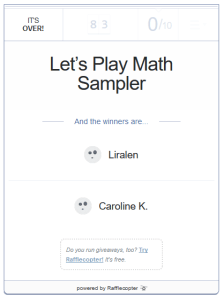




 Yes, your kids CAN learn to love math. Keep your children’s math skills fresh with my 8-week email series of math games and activities.
 Are all numbers polite?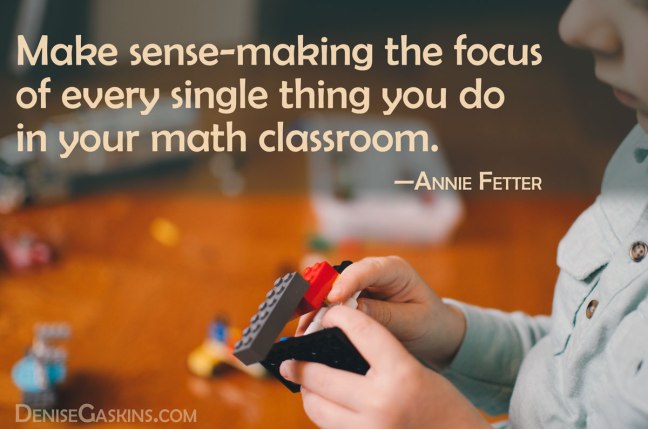

 Denise Gaskins' Let's Play Math