The Value of Math Games

From Peggy Kaye’s classic book Games for Math:
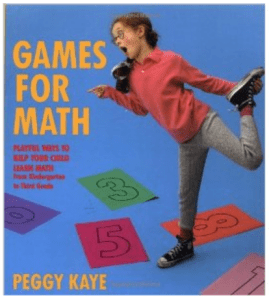
Kaye-Games4Math

“Games put children in exactly the right frame of mind for learning difficult things.

“Children relax when they play — and they concentrate. They don’t mind repeating certain facts or procedures over and over, if repetition is part of the game.

“Children throw themselves into playing games the way they never throw themselves into filling out workbook pages.

“The games solidify the achievements of children who are already good at math, and they shore up children who need shoring up. They teach or reinforce many of the skills that a formal curriculum teaches, plus one skill that formal teaching sometimes leaves out — the skill of having fun with math, of thinking hard and enjoying it.

“If you play these games and your child learns only that hard mental effort can be fun, you will have taught something invaluable.”

Peggy Kaye
Games for Math

Sample Peggy’s Games for Math

 
* * *

This blog is reader-supported.

If you’d like to help fund the blog on an on-going basis, then please join me on Patreon for mathy inspiration, tips, and an ever-growing archive of printable activities.

If you liked this post, and want to show your one-time appreciation, the place to do that is PayPal: paypal.me/DeniseGaskinsMath. If you go that route, please include your email address in the notes section, so I can say thank you.

Which I am going to say right now. Thank you!

“The Value of Math Games” copyright © 2016 by Denise Gaskins.
Dreams for our Children

Don’t you love this quotation?

For our children, we dream that mathematics…

… makes sense
… is more than just arithmetic
… is joyous
… makes them strong
… is meaningful
… is creative
… is full of fascinating questions
… opens up many paths to solutions
… is friendly
… solves big problems and makes the world better
… is a powerful tool they can master
… is beautiful
… lets them learn in their own ways
… is connected to their lives
… asks “why” and not just “how”
… opens the world

Avoid Hard WorkFrom the upcoming new book Avoid Hard Work by James Tanton and the Natural Math team.

Join the crowdfunding campaign and reserve your copy today!

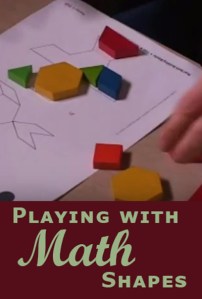
Playing with Math Shapes

Playing-with-shapesI love it when a plan — or rather, a series of math thoughts — comes together.
On Monday, Emily Grosvenor (author of the Tessalation! picture book) asked me how parents who are insecure in math could help their children learn through play, and I responded with this quote from my Let’s Play Math book:

If you are intimidated by numbers, you can look for patterns of shape and color. Pay attention to how they grow. Talk about what your children notice.

But I wasn’t entirely satisfied with that answer. So many adults have come away from their own school experience thinking math is only numbers. Even with shapes, isn’t it the numbers about them — how many sides, what size of angles, calculate the the area or perimeter — that are important? That’s what school math tends to focus on.

Those of us who are comfortable with math know that there are many more things to notice and think about than just numbers. We know that it’s this noticing, thinking, and wondering that is at the heart of math. And that just playing with shapes can build a powerful foundation for future math learning.

And then yesterday, Malke Rosenfeld posted a beautiful article about a paper manipulative created by Paula Krieg. Which included this video:

The ability to create, and maintain, and manipulate shapes mentally — that’s the goal. Just like kids who can put numbers together in their heads, kids who can rotate, flip, and think of how shapes fit together in their heads have a powerful tool to analyze not only simple shape puzzles, but dividing up an area that’s a more complex room shape … to look at a piece of artwork … or look at a building … For these kids, all the world around becomes a playground to use mathematical ideas.

— Doug Clements
Problem Solving Development: Composing Shapes

Of course, pattern blocks are good for much more than just filling in worksheet pictures. But I love this peek into how a child’s understanding grows, in bits and spurts — without any numbers at all — until the world itself becomes a playground for mathematical ideas.

Want more?

You know what? Children like mathematics. Children see the world mathematically … When we do a puzzle, when we count things, when we see who’s got more, or who’s taller … Play and mathematics are not on opposite sides of the stage.

— Doug Clements
Why Early Childhood is the Right Time to Start Learning Math

Did You Get Your Playful Math Snacks?

Circumferències de FordMy April “Let’s Play Math” newsletter went out early this morning to everyone who signed up for Tabletop Academy Press math updates. This month’s issue celebrated the 200th anniversary of the Farey Sequence.

The Farey Sequence was described in 1816 by English geologist John Farey, who was disparaged by the famous mathematical snob* G.H. Hardy as “at the best an indifferent mathematician.”

“I rather like the idea that the Farey Sequences are named after someone who noticed a pattern and asked a question — and not even the first person to notice the pattern, ask the question, or provide the answer. As math teachers, we teach plenty of indifferent mathematicians who wake up when they experience the joy of discovering something that is new to them, not necessarily new to the whole world.”

— Debra K. Borkovitz,
Farey Fraction Visual Patterns

If you’re a subscriber but didn’t see your newsletter, check your Updates or Promotions tab (in Gmail) or your Spam folder. And to make sure you get all the future newsletters, add “Denise at Tabletop Academy Press” [denise.gaskins @ tabletop academy press .com, without spaces] to your contacts or address book.

If you missed this month’s edition, no worries—‌there will be more playful math snacks coming soon. Click the link below to sign up today!

And remember: Newsletter subscribers are always the first to hear about new books, revisions, and sales or other promotions.


* See A Mathematician’s Apology Revisited by W.W. Sawyer.

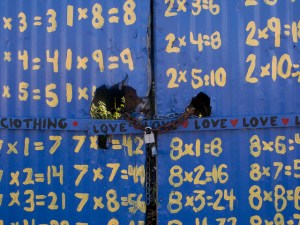
Memorizing the Math Facts

Central City Times Tables[Photo by dsb nola via flickr. (CC BY 2.0)]

The most effective and powerful way I’ve found to commit math facts to memory is to try to understand why they’re true in as many ways as possible. It’s a very slow process, but the fact becomes permanently lodged, and I usually learn a lot of surrounding information as well that helps me use it more effectively.

Actually, a close friend of mine describes this same experience: he couldn’t learn his times tables in elementary school and used to think he was dumb. Meanwhile, he was forced to rely on actually thinking about number relationships and properties of operations in order to do his schoolwork. (E.g. I can’t remember 9×5, but I know 8×5 is half of 8×10, which is 80, so 8×5 must be 40, and 9×5 is one more 5, so 45. This is how he got through school.) Later, he figured out that all this hard work had actually given him a leg up because he understood numbers better than other folks. He majored in math in college and is now a cancer researcher who deals with a lot of statistics.

Ben Blum-Smith
Comment on Math Mama’s post What must be memorized?

The entire discussion (article and comments) is well worth reading:

You may also enjoy:

Quotable: On Teaching

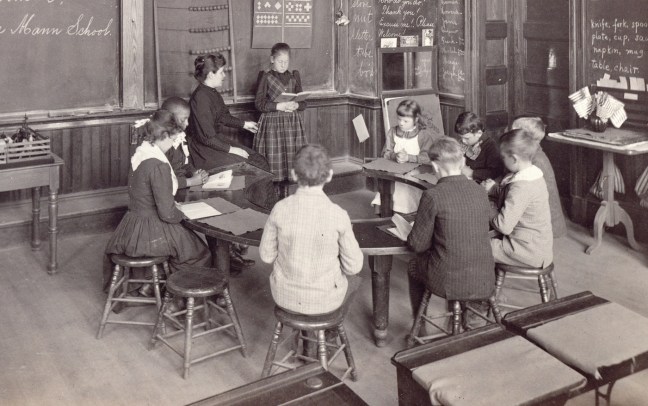
classroom scene

[Photo by City of Boston Archives via Flickr (CC BY 2.0).]

I’ve started collecting quotes about teaching math for the chapter pages in my next Math You Can Play book. Here are a couple snippets that don’t fit the theme of “Multiplication & Fractions,” but they struck my fancy anyway:

If teachers would only encourage guessing. I remember so many of my math teachers telling me that if you guess, it shows that you don’t know. But in fact there is no way to really proceed in mathematics without guessing. You have to guess! You have to have intuitive judgment as to the way it might go. But then you must be willing to check your guess. You have to know that simply thinking it may be right doesn’t make it right.

teaching

[Photo by Nathan Russell via Flickr (CC BY 2.0).]

One of the big misapprehensions about mathematics that we perpetrate in our classrooms is that the teacher always seems to know the answer to any problem that is discussed. This gives students the idea that there is a book somewhere with all the right answers to all of the interesting questions, and that teachers know those answers. And if one could get hold of the book, one would have everything settled. That’s so unlike the true nature of mathematics.

Leon Henkin
from “Round and Round at the Round Table”
Teaching Teachers, Teaching Students: Reflections on Mathematical Education

What Are Your Favorite Quotes?

Do you have some favorite quotes on math and teaching? I’d love to hear them! Please share in the Comments section below.

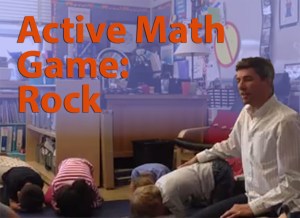
Active Math Game: Rock

Gordon Hamilton of Math Pickle posted Rock – Low unique number game for grades K–2. If you have a set of active kids and a few minutes to spare, give it a try!

https://youtu.be/QzDCosAIuZA&rel=0

How to Play Rock

  • Everyone makes a rock shape with eyes closed.
  • Everyone chooses a number: 0, 1, 2, 3, 4, 5, 6, 7, 8 …
  • Teacher calls out numbers consecutively, starting at 0.
  • When a student hears their number being called they immediately raise a hand. When the teacher tags the hand, they stand up.
  • If more than one hand was raised, those students lose. They become your helpers, tagging raised hands.
  • If only one hand was raised, that child wins the round.

Rock-game

“Each game takes about 45 seconds,” Hamilton says. “This is part of the key to its success. Children who have not learned the art of losing are quickly thrown into another game before they have a chance to get sad.”

The experience of mathematics should be profound and beautiful. Too much of the regular K-12 mathematics experience is trite and true. Children deserve tough, beautiful puzzles.

Gordon Hamilton

What Happens When Grownups Play Rock

What are the best numbers to pick? Patrick Vennebush hosted on online version of the game at his Math Jokes 4 Mathy Folks blog a few years back, though we didn’t have to bend over into rocks‌—‌which is a good thing for some of us older folks.

Vennebush also posted a finger-game version suitable for small groups of all ages, called Low-Sham-Bo:

  • On the count of 1-2-3, each person “throws” out a hand showing any number of fingers from zero to five.
  • The winner is the person who throws the smallest unique number.

You may want to count “Ready, set, go!” for throwing out fingers, so the numbers in the count don’t influence the play.

The official name for this sort of game is Lowest Unique Bid Auction.

 
* * *

This blog is reader-supported.

If you’d like to help fund the blog on an on-going basis, then please join me on Patreon for mathy inspiration, tips, and an ever-growing archive of printable activities.

If you liked this post, and want to show your one-time appreciation, the place to do that is PayPal: paypal.me/DeniseGaskinsMath. If you go that route, please include your email address in the notes section, so I can say thank you.

Which I am going to say right now. Thank you!

“Active Math Game: Rock” copyright © 2015 by Denise Gaskins. .

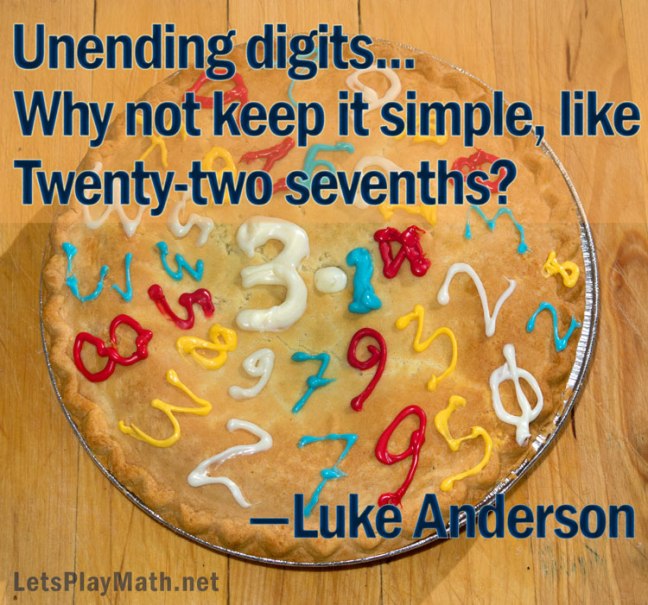
Unending Digits… Why Not Keep It Simple?

Unending-digits

Unending digits …
Why not keep it simple, like
Twenty-two sevenths?

—Luke Anderson

Math Poetry Activity

Encourage your students to make their own Pi Day haiku with these tips from Mr. L’s Math:

And remember, Pi Day is also Albert Einstein’s birthday! Check out this series of short videos about his life and work: Happy Birthday, Einstein.

CREDITS: Today’s quote is from Luke Anderson, via TeachPi.org. Background photo courtesy of Robert Couse-Baker via Flickr, text added (CC BY 2.0).