New Book: Word Problems from Literature

The posts on my Let’s Play Math blog are, for the most part, first-draft material. Of course, I’ve proofread each post — many times! because I’m a perfectionist that way, and yet I still miss typos :-/ — but these articles haven’t gotten the sort of feedback that polishes a book manuscript.

Well, now I’m taking some of the best of my old blog posts, expanding them with a few new games or activities, and giving them that book-quality polish. Let me introduce my newest series, the Playful Math Singles.

Under Construction …
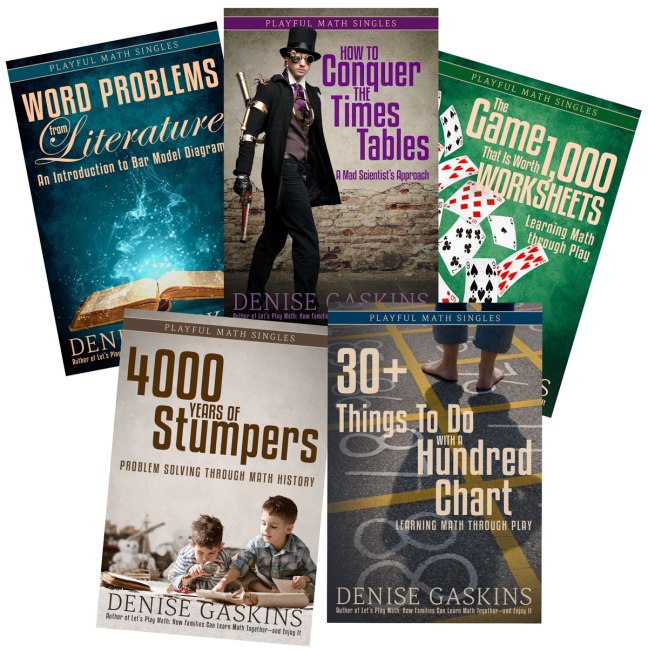
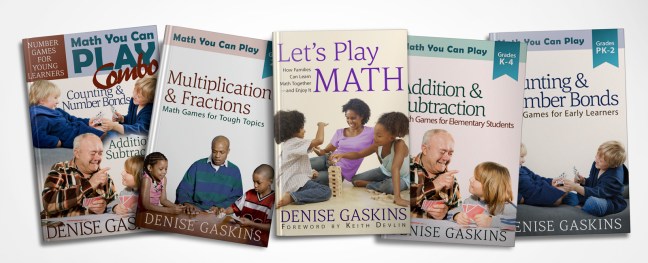
The Playful Math Singles from Tabletop Academy Press will be short, topical books featuring clear explanations and ready-to-play activities.

I’m hoping to finish up two or three of these this year. Watch for them at your favorite online bookstore.

The first one is done …

Word Problems from Literature: An Introduction to Bar Model Diagrams
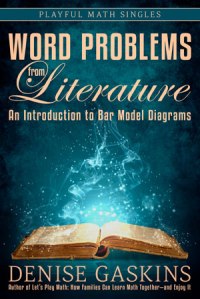
You can help prevent math anxiety by giving your children the mental tools they need to conquer the toughest story problems.

Young children expect to look at a word problem and instantly see the answer. But as they get older, their textbook math problems also grow in difficulty, so this solution-by-intuitive-leap becomes impossible.

Too often the frustrated child concludes, “I’m just not good at math.”

But with guided practice, any student can learn to master word problems.

Word Problems from Literature features math puzzles for elementary and middle school students from classic books such as Mr. Popper’s Penguins and The Hobbit.

For each puzzle, I demonstrate step by step how to use the problem-solving tool of bar model diagrams, a type of pictorial algebra. For children who are used to playing with Legos or other blocks — or with computer games like Minecraft — this approach reveals the underlying structure of a math word problem. Students can make sense of how each quantity in the story relates to the others and see a path to the solution.

And when you finish the puzzles in this book, I’ll show you how to create your own word problems from literature, based in your children’s favorite story worlds.

Buy now at your favorite online bookstore.

If you’re using these word problems with your children, consider buying them the paperback companion Word Problems from Literature Student Workbook.

… and People Like It!

A screen shot from this past weekend:

“I found this method really clarified for me what was going on visually and conceptually. Particularly when it came to more complex questions, for which I would normally write out an equation, I felt that thinking about what was going on with the bars actually made more sense … This is a wonderful book for those who want to support their children in finding better ways to work on word problems.”

—Miranda Jubb, Amazon customer reviewer
Even a Math Workbook Can Be a Game

Homeschool Memories…

My youngest daughter wanted to do Singapore math. Miquon Red was her main math text at the time, but we added a bit of Singapore Primary Math 1B whenever she was in the mood.

We turned to the lesson on subtracting with numbers in the 30-somethings.

Continue reading Even a Math Workbook Can Be a Game

Rabbit Trails and Fibonacci Poetry

Homeschool Memories…

Well, I hadn’t planned on spending my day that way. But one of the great things about homeschooling is the freedom to follow rabbit trails.

While browsing the Carnival of Homeschooling, I found a link to Farm School blog’s article Fib Foolery, which sent me to Gotta Book for his articles The Fib and More Fibbery (read the comments on both threads, but be warned that some are crude) and several other posts, all of which set me off on a morning of poetic fun.

A “Fib” is a Fibonacci poem. It’s based on syllable count, like a haiku, but the lines follow the Fibonacci counting series: 1, 1, 2, 3, 5, 8… Each number is the sum of the previous two numbers.

I knew what I was going to share at our Tuesday Teatime and Poetry Reading that afternoon.

Continue reading Rabbit Trails and Fibonacci Poetry

How To Break In Your New Math Journal

I love my new paperback math journal series. The books are sturdy, inexpensive, and fit nicely in my purse.

But as with any paperback book, these have one problem. How do I use them without cracking the spine?

When we exercise, we need to warm up our bodies with a bit of stretching to prevent injury. In the same way, we need to warm up a new book to protect it. The process is called “breaking it in.”

It only takes a few minutes to break in a paperback book:

Step by Step

Never force the book but help it limber up gradually, and it will serve you well.

Because my journals are working books, I take the breaking-in process a bit further than shown in the video:

(1) Set the book on its back and follow the process above. Press down each cover, but not completely flat — let it bend at the fold line, about 1 cm from the actual spine. Then press a couple pages at a time, alternating front and back, down flat on each cover.

(2) Flip through the pages of the book forward and backward to limber them up.

(3) Repeat the steps of the video. This time, gently lean the main part of the book away from the part you are pressing down. Aim for a 130–140 degree angle.

(4) Flip through the pages again. For paperbacks, you can even roll the whole book back and forth a bit — gently curving the cover and pages almost as if you’re trying to fold the book in half — to encourage flexibility.

(5) Optional: Repeat the breaking-in process one more time. This time, fold each section back as close to 180 degrees as it will go.

And you’re done!

The pages will still curve in at the fold line, where they connect to the spine of the book. You want that because it makes the book strong. But now they’ll also open up to provide a nice, wide area for writing or math doodling.

Dot Grid Journals with Coloring Pages

My newest book project began with a few simple coloring pages for my homeschool co-op kids. You may recall when I collected those into a downloadable coloring book last December. Well, I kept tinkering with the designs into January. And then it was time to buy a new planner…

The problem is, I’m not a naturally organized person. I like making lists and plans, but sticking to them is tougher. And I’ve never found a planner or organizational system that I could follow for longer than two weeks at a go. That is until I heard of bullet journaling.

But journaling requires a journal — a notebook of some sort. And I couldn’t find any that I liked. Either the pages were too narrow and felt cramped, or the thing didn’t fit even in my oversized purse. Or the fancy, hardcover binding made it heavy to lug around. Or there weren’t enough pages to last more than a few weeks. Or the lines were too dark, or too widely spaced.

Never quite what I wanted.

So I decided to make my own.

I started with dot-grid pages for flexible layouts and for doodling. I scattered some of my favorite math and education quotations through each book. And then I added several of my most flexible geometric coloring pages (loosely based on Islamic tessellation designs).

And I had so much fun I couldn’t stop with just one. So let me introduce my Dot Grid Notebook with Coloring Pages series:

Inspirations: A Recreational Mathematics Journal
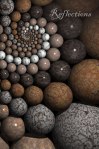
Reflections: A Math Teacher’s Journal
Explorations: A Math Student’s Journal
Contemplations: A Homeschooler’s Journal

With 170 roomy pages, each book gives you plenty of space to record memories, plan projects, and keep track of tasks. The dot grid makes it easy to draw graphs or diagrams. Take notes, jot down ideas, copy your favorite quotations, or doodle to your heart’s content.

  • Light gray dots at 5 mm spacing provide guidance for flexible page layouts.
  • 11 geometric coloring pages allow a multitude of artistic possibilities.
  • 31 favorite quotes offer a vision for creative math education.
  • 6 × 9 inch (about 15 × 23 cm) pages are wider than many journals, yet still fit comfortably into a large purse or bag.
  • Paperback binding makes the journal sturdy but lightweight. Carry it anywhere!

Prevent cracked spines: How to Break In Your New Math Journal.

The ebook edition features all 124 quotations (31 from each journal) about mathematics, education, and problem solving. Read through for your own pleasure, post them by your workspace, or use them as writing prompts for yourself or your students. [Yes, all of the ebooks are the same.]

But, what can you DO with all those nice, dotty pages?

Of course, you can use them for bullet journaling. That’s why I originally created the books, because I couldn’t find planners that fit my personal style. My bullet journal is basically an anthology of To-Do lists, bound together so they don’t get lost in the clutter. It’s the only planner system I’ve been able to stick with for more than two weeks at a go.

Or you could use the dotty pages for a commonplace book. That’s my favorite kind of journaling. Like a magpie, I collect shiny tidbits from books, websites, conversations overheard, and more. Passages. Definitions. Poems. Recipes. Proverbs. Things I’m wondering about. Cute kid sayings. It all goes into the mix.

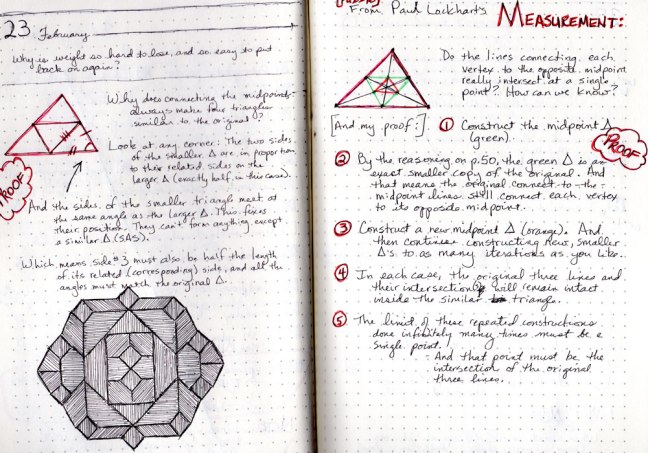
And math puzzles, of course! Below, I’m playing my way through Paul Lockhart’s Measurement. I use the cloud-like labels in the outer margins of each page for keywords that identify what I’m writing, because someday I’ll need to skim back and find an old note.

But where dot grid pages really excel is at doodling — I’m sure you noticed the faceted design filling the lower half of my journal page above and the gem almost overrunning my February calendar. So watch for tomorrow’s blog post featuring a variety of ways to create your own mathematical doodles.

Best wishes, and happy mathing!


P.S.: Do you have a blog? If you’d like to feature a Dot Grid Journal review and giveaway, I’ll provide the prize. Leave a comment below, and we’ll work out the details.

How to Build Your Math Blog’s Audience

New Year, New Blog!

The first way to make your math blog grow is to write posts. Here’s an #MTBoS blog challenge that seems doable: Only one post a week, so maybe even I can keep up.

With the start of a new year, there is no better time to start a new blog! For those of you who have blogs, it is also the perfect time to get inspired to write again! Please join us to participate in this years blogging initiative…

Click Here for Details

Join the Math Education Blog Carnival

Once you’ve got your post blogged, please share it with us!

The Math Teachers at Play (MTaP) blog carnival is a monthly collection of tips, tidbits, games, and activities for students and teachers of preschool through pre-college mathematics. We welcome entries from parents, students, teachers, homeschoolers, and just plain folks…

Click Here to Learn More

CREDITS: Spiral fractal photo (above) by Kent Schimke via Flickr (CC BY 2.0).]/span>

Hapollonian Holidays: Did You Get Your Playful Math Snacks?

Greetings from my Math Circle kids, and best wishes for a grace-filled holiday season.

My December “Let’s Play Math” newsletter went out yesterday to everyone who signed up for Tabletop Academy Press math updates. This month’s issue featured infinite series and Vi Hart’s Apollonian Doodle Game.

If you’re a subscriber but didn’t see your newsletter, check your Updates or Promotions tab (in Gmail) or your Spam folder.

And if you missed this month’s edition, no worries — there will be more playful math snacks coming soon. Click the link below to sign up today!

And remember: Newsletter subscribers are always the first to hear about new books, revisions, and sales or other promotions.

CREDITS: “Circle Packing” feature graphic by fdecomite via Flickr (CC BY 2.0).

Playful Family Math on Facebook

If you want to know more about my playful math books, check out my new author page. You can post comments or send me a message. I’d love to hear from you!

Visit Denise Gaskins on Facebook

You can also join the Playful Family Math discussion group or find plenty of online mathy goodness at my original Let’s Play Math Facebook page.

🙂 See you there!

Giving Thanks

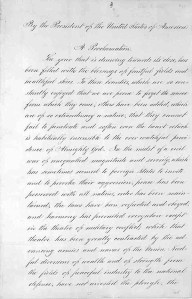
Proclamation 106—Thanksgiving Day, 1863

Portrait

By the President of the United States of America

A Proclamation

The year that is drawing toward its close has been filled with the blessings of fruitful fields and healthful skies. To these bounties, which are so constantly enjoyed that we are prone to forget the source from which they come, others have been added which are of so extraordinary a nature that they can not fail to penetrate and soften even the heart which is habitually insensible to the ever-watchful providence of Almighty God.

In the midst of a civil war of unequaled magnitude and severity, which has sometimes seemed to foreign states to invite and to provoke their aggression, peace has been preserved with all nations, order has been maintained, the laws have been respected and obeyed, and harmony has prevailed everywhere, except in the theater of military conflict, while that theater has been greatly contracted by the advancing armies and navies of the Union.

Needful diversions of wealth and of strength from the fields of peaceful industry to the national defense have not arrested the plow, the shuttle, or the ship; the ax has enlarged the borders of our settlements, and the mines, as well of iron and coal as of the precious metals, have yielded even more abundantly than heretofore. Population has steadily increased notwithstanding the waste that has been made in the camp, the siege, and the battlefield, and the country, rejoicing in the consciousness of augmented strength and vigor, is permitted to expect continuance of years with large increase of freedom.

No human counsel hath devised nor hath any mortal hand worked out these great things. They are the gracious gifts of the Most High God, who, while dealing with us in anger for our sins, hath nevertheless remembered mercy.

It has seemed to me fit and proper that they should be solemnly, reverently, and gratefully acknowledged, as with one heart and one voice, by the whole American people. I do therefore invite my fellow-citizens in every part of the United States, and also those who are at sea and those who are sojourning in foreign lands, to set apart and observe the last Thursday of November next as a day of thanksgiving and praise to our beneficent Father who dwelleth in the heavens. And I recommend to them that while offering up the ascriptions justly due to Him for such singular deliverances and blessings they do also, with humble penitence for our national perverseness and disobedience, commend to His tender care all those who have become widows, orphans. mourners, or sufferers in the lamentable civil strife in which we are unavoidably engaged, and fervently implore the interposition of the Almighty hand to heal the wounds of the nation and to restore it, as soon as may be consistent with the divine purposes, to the full enjoyment of peace, harmony, tranquillity, and union.

In testimony whereof I have hereunto set my hand and caused the seal of the United States to be affixed.

Done at the city of Washington, this 3d day of October, A. D. 1863, and of the Independence of the United States the eighty-eighth.

Abraham Lincoln

[Feature photo “Thanksgiving at the Troll’s” by martha_chapa95 via Flickr.] (CC-BY 2.0)