Musings: A Common Misconception

Father and son thinking together about a math problem

One of my favorite podcasts to listen to is Pam Harris’s Math Is Figure-Out-Able because she puts so many of my thoughts into words.

For example:

“We have a misconception in math education that we think we need to teach methods so that kids can answer the craziest kind of a particular problem.

    “We would be far better served to teach kids to think about the most common kinds of questions WELL, and let the cranky ones go to ChatGPT. Because they’ll recognize the sense of the answer.

      “Let technology handle the crankiest, and REASON about the rest of them.”

      —Pam Harris,
      the Math is Figure-out-able Fractions Challenge

      Well, I do think she’s wrong about the AI chatbot, because ChatGPT comes up with the strangest bald-faced nonsense about math problems. Wolfram Alpha is a much more reliable resource.

      But Harris’s main point stands. This misconception, this math-education myth, drives much of what happens in our classrooms and home schools today.


      Continue reading Musings: A Common Misconception

      Musings: A Philosophy of Education

      I’ve tried a few times over the years to express my philosophy of teaching math. Back when I first started doing workshops for homeschooling parents, I told them:

      “Instead of drudgery, mathematics should be a game of discovery. It should give children the same ‘Eureka!’ thrill that sent Archimedes running through town in his birthday suit. I call this the ‘Aha!’ factor, the delight in solving a challenging puzzle.”

      Years later, as the internet developed and much of life moved online, I started a blog about playing with math. And since all good blogs need an “About Me” page, I had another chance to sum up my thoughts:

      “Math is like ice cream, with more flavors than you can imagine — and if all your children ever see is textbook math, that’s like feeding them broccoli-flavored ice cream.”

      But over the years, some people got the impression that my goal was all about playing games. They asked, “How can we make math fun for our kids?” — as if gamification adds a candy coating to make the disgusting medicine more palatable.

      And of course, I do write a lot of books about games. I think games serve much better than worksheets for practicing basic math skills.

      Still, I wanted people to see that the ideas of math themselves are tasty tidbits worth playing with.

      Continue reading Musings: A Philosophy of Education

      FAQ: The Necessity of Math Facts

      Ah, math facts — the topic that just won’t stop giving grief to students and anxiety to their parents. So it happened that I got another question, but this one leaned in a more philosophical direction…

      “I enjoyed your podcast interview on Cultivating Math Curiosity and Reasoning in Kids. I love the idea that we don’t have to make our children memorize everything in math. We can give them freedom to make mental connections for themselves.

        “But on the other hand, we don’t have unlimited time for them to figure things out on their own, do we? What about children who can’t make these connections for themselves?

          “For example, what about the math facts? If my kids aren’t picking them up, don’t they just have to memorize them?”

          Continue reading FAQ: The Necessity of Math Facts

          Math Musings: Lies My Teacher Told Me

          I mentioned last time that the common phrase “Multiplication is repeated addition” is a mathematical lie we tell our children. And it’s not the only one.

          Did you ever say, “Subtraction means take-away”? Or how about “Division is sharing”? I know I have, but both of those statements are also mathematical lies.

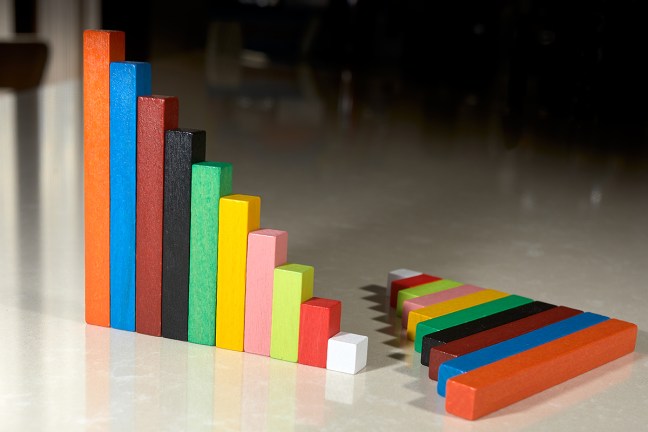
          One of the reasons I like Cuisenaire rods so much is that they can help us avoid lying to our children about math.

          Continue reading Math Musings: Lies My Teacher Told Me

          Math Musings: Teaching the Big Ideas

          Earlier, I wrote that “the big ideas of number relationships are found in algebra, not in arithmetic. If we want to bring our children into direct contact with these ideas, we need to teach with algebra in mind from the very beginning.”

          Whether we teach the traditional way, beginning with counting and whole number arithmetic or take the road less traveled and explore algebra first — either way, we need to look at number relationships with an algebraic mindset.

          So you might wonder, what are these big ideas of number relationships? How can we recognize them?

          Continue reading Math Musings: Teaching the Big Ideas

          Homeschool Musings: Math Manipulatives Part 3

          We’ve talked about several types of math manipulative that homeschooling parents might use to help their children learn math (see part 1 and part 2), but we never stopped to ask the most basic question:

          Why use math manipulatives at all?

          Math manipulatives are a tool for solving educational problems, so we should first decide what problem we are trying to solve. That will help us know which tool to use.

          Continue reading Homeschool Musings: Math Manipulatives Part 3

          Homeschool Musings: Math Manipulatives Part 2

          In my previous post, I examined fingers and found items (beans, buttons, leaves, and so on) as tools that can help our children learn math. This time, we move on to the kinds of math manipulatives you’ll find in stores or packaged with your favorite curriculum.

          Standard base ten blocks

          The standard base ten blocks consist of plastic or wooden cubes, a rod with the length of ten cubes, a flat shape the size of ten rods side-by-side, and a large cube equivalent to ten of the flat shapes stacked atop each other.

          These are used primarily for modeling place value as a means of developing the standard arithmetic algorithms for addition and subtraction.

          They can also be used for modeling decimals as a place value notation, without relying on fraction concepts. And with a bit of imagination (“Pretend the rods are stretchy, so we don’t know how long they really are”) they can model simple algebraic expressions.

          Continue reading Homeschool Musings: Math Manipulatives Part 2

          Homeschool Musings: Math Manipulatives Part 1

          I stumbled across another blogger’s post on the common question, “What are the best math manipulatives for homeschooling?”

          My answer to this question has changed over the years, as I’ve grown in my understanding of math and of education. As my current stance is far different from much of what I read from other homeschoolers, I’m going to lay out my reasoning below.

          I’d love to hear your thoughts, especially if you disagree, because comparing ideas with one another is a great way to learn.

          Continue reading Homeschool Musings: Math Manipulatives Part 1

          Living Books for Math

          What is a “living book”? English education reformer Charlotte Mason introduced this term for any book that brings the reader directly into contact with the major ideas that have fascinated humans across the ages.

          We know that reading aloud helps build our children’s love for books. But did you know it works for math as well?

          And that it can transform the parent’s attitude as well as the child’s?

          A playful math book fleshes out the bones of abstract math,
          brings it alive,
          makes it human, relatable,
          interesting to readers of all ages,
          opening our eyes to the wonderful world of big ideas,
          where concepts meet and topics intertwine
          in a beautifully intricate dance
          of understanding.

          We live in an age of abundance, with more new creative math books being published every year, so many that I can’t keep track of them all, not to mention the older classics, some out of print, that can still be found in public libraries.

          Here are a few of my favorite books of playful, living math, both old and new:

          Continue reading Living Books for Math

          Musings: School Math vs. Real Math

          I was asked to do an interview for a new podcast called Learning is Disruptable, and that got me thinking…

          Is Math Education Ripe for Disruption?

          Math education is not working. Too many people come out of school with math avoidance, math anxiety or even phobia, a profound conviction that math is not for them.

          Generally, humans enjoy success, the feeling that things make sense, that they are capable of understanding big ideas. People like subjects that give them this type of success, where they are meeting and making sense of new ideas, growing in mastery.

          But they hate subjects that make them feel like a failure, where things don’t make sense and there seems to be no real chance of success.

          Therefore, understanding our students’ attitude toward math gives us a solid indication of how well they are learning.

          Continue reading Musings: School Math vs. Real Math