“The Principality of Mathematics is a mountainous land, but the air is very fine and health-giving. People who seek their work or play in this principality find themselves braced by effort and satisfied with truth.”
— Charlotte Mason, Ourselves
Charlotte Mason (1842-1923) was a British school reformer at the turn of the twentieth century, a contemporary of William James and John Dewey. She advocated strongly for poor children, arguing they were equally capable of learning a wide and liberal curriculum as were the children of privilege.
Mason believed that all children from the time they are born share a natural curiosity and hunger for learning, and the adult’s role is to spread a “wide and generous feast” of inspiring ideas.
She was also a homeschooling pioneer, and the homeschooling revival of the late twentieth century rediscovered and popularized her books. Many found her principles a refreshing balance to the dominant educational paradigm of pragmatism.
Ah, math facts — the topic that just won’t stop giving grief to students and anxiety to their parents. So it happened that I got another question, but this one leaned in a more philosophical direction…
“I enjoyed your podcast interview on Cultivating Math Curiosity and Reasoning in Kids. I love the idea that we don’t have to make our children memorize everything in math. We can give them freedom to make mental connections for themselves.
“But on the other hand, we don’t have unlimited time for them to figure things out on their own, do we? What about children who can’t make these connections for themselves?
“For example, what about the math facts? If my kids aren’t picking them up, don’t they just have to memorize them?”
Earlier, I wrote that “the big ideas of number relationships are found in algebra, not in arithmetic. If we want to bring our children into direct contact with these ideas, we need to teach with algebra in mind from the very beginning.”
Whether we teach the traditional way, beginning with counting and whole number arithmetic or take the road less traveled and explore algebra first — either way, we need to look at number relationships with an algebraic mindset.
So you might wonder, what are these big ideas of number relationships? How can we recognize them?
Do you enjoy math? I hope so! If not, browsing this post just may change your mind. Welcome to the Math Teachers At Play blog carnival — a smorgasbord of ideas for learning, teaching, and playing around with math from preschool to pre-college.
Let the mathematical fun begin!
POLYHEDRON PUZZLE
By tradition, we start the carnival with a puzzle in honor of our 62nd edition:
An Archimedean solid is a polyhedron made of two or more types of regular polygons meeting in identical vertices. A rhombicosidodecahedron (see image above) has 62 sides: triangles, squares, and pentagons.
How many of each shape does it take to make a rhombicosidodecahedron?
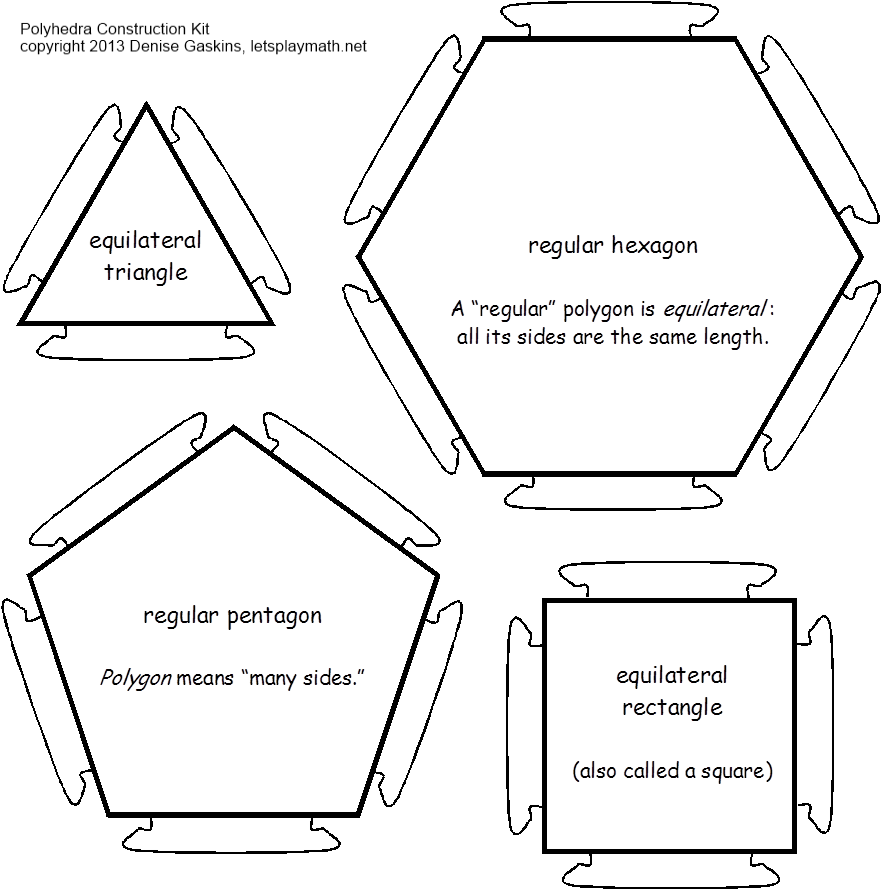
Click for template.
My math club students had fun with a Polyhedra Construction Kit. Here’s how to make your own:
Collect a bunch of empty cereal boxes. Cut the boxes open to make big sheets of cardboard.
Print out the template page (→) and laminate. Cut out each polygon shape, being sure to include the tabs on the sides.
Turn your cardboard brown-side-up and trace around the templates, making several copies of each polygon. I recommend 20 each of the pentagon and hexagon, 40 each of the triangle and square.
Draw the dark outline of each polygon with a ballpoint pen, pressing hard to score the cardboard so the tabs will bend easily.
Cut out the shapes, being careful around the tabs.
Use small rubber bands to connect the tabs. Each rubber band will hold two tabs together, forming one edge of a polyhedron.
So, for instance, it takes six squares and twelve rubber bands to make a cube. How many different polyhedra (plural of polyhedron) will you make?
Can you build a rhombicosidodecahedron?
And now, on to the main attraction: the 62 blog posts. Many of the following articles were submitted by their authors; others were drawn from the immense backlog in my blog reader. If you’d like to skip directly to your area of interest, here’s a quick Table of Contents:




 Denise Gaskins' Let's Play Math