Only Two Days Left for Math Journaling Adventures

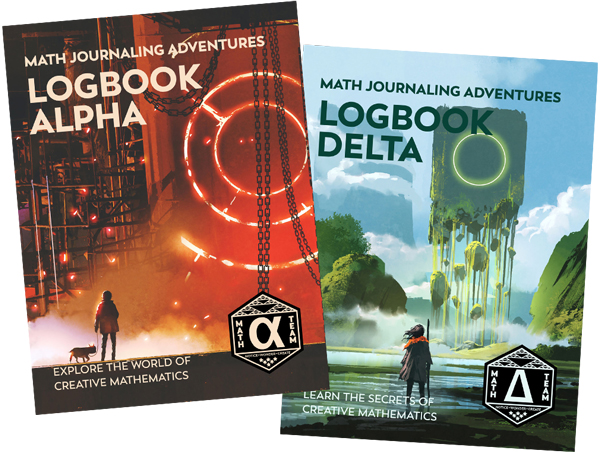
Math Journaling Adventures series by Denise Gaskins
  • If you’re a parent trying to help your child learn math…
  • Or a teacher looking for creative ideas for your classroom…
  • Or a homeschooling parent hoping to enrich your student’s understanding…

Then you’ll love the Math Journaling Adventures series because these logbooks guide your children to explore mathematics at a deeper level, building a strong foundation to support future learning.

It’s a fun way to enrich any math curriculum, and great for unschoolers, too.

But you have to ACT FAST: The Kickstarter campaign ends in 2 days!

Order Your Copy Today ❯

Continue reading Only Two Days Left for Math Journaling Adventures

Math Journal: Playing with My Own Ignorance

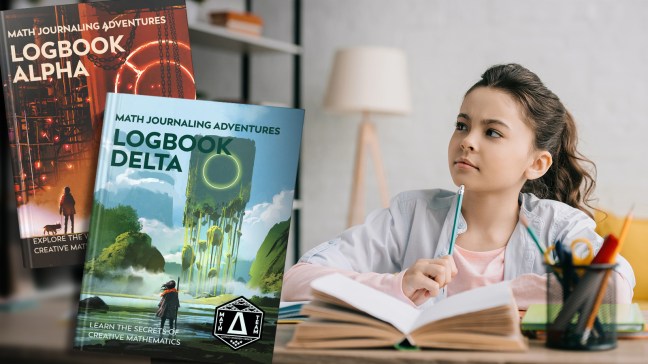
photo of a girl wondering about math

Mary Everest Boole, wife of English mathematician George Boole, once described algebra as “thinking logically about the fact of our own ignorance.”

This definition made me chuckle. Like any human being, I am ignorant on many things, but I usually avoid thinking about that.

So I wondered what would happen if I took Mrs. Boole’s advice and tried thinking logically about my ignorance.

How far could I go?

Perhaps you’d like to try this experiment with your children. All you need is a pen and paper or a whiteboard and markers and a bit of curiosity.

Math Journaling Adventures series by Denise GaskinsAnd if you enjoy this exploration, check out my Math Journaling Adventures project to discover how playful writing activities can help your students learn mathematics. Preorder your books today!

Continue reading Math Journal: Playing with My Own Ignorance

Math Journaling Adventures Launched: Order Your Copy Today

Math Journaling Adventures: Creative Logbooks for All Ages

And so it begins: the Math Journaling Adventures is LIVE on Kickstarter!

Check It Out ❯

⭐ Don’t delay! First-day backers get the best deals. Choose one of the Earlybird rewards:

  • Earlybird 2-Logbook Sets in Digital, Paperback, Spiral-Bound, or Hardcover
  • Earlybird Everything Bundles in Digital or Paperback

To have a successful campaign, we need plenty of people to back the project early. The more supporters we get in these early days, the more likely the Kickstarter platform folks will help spread the news for us.

Continue reading Math Journaling Adventures Launched: Order Your Copy Today

Playful Math 179: Our Sweet Sixteen Carnival

Welcome to the sweet-16 birthday edition of the Playful Math Carnival. Originally called Math Teachers at Play, our first carnival was published in February 2009.

Each Playful Math Carnival offers a smorgasbord of delectable tidbits of mathy fun. It’s like a free online magazine devoted to learning, teaching, and playing around with math from preschool to high school.

There’s so much playful math to enjoy!

By tradition, we start the carnival with a math activity in honor of our 179th edition. But if you’d rather jump straight to our featured blog posts, click here to see the Table of Contents.

NOTE: Our wonderful volunteer hosts have kept the Playful Math Carnival going when so many other blog carnivals died off. If you’d like to sign up to host the carnival for a month, email Denise for information.

Try These Prime Puzzles

Did you know there are 179 even-numbered days this year?

  • How many even-numbered days will there be in a leap year?
  • But there are 365 days in a standard year and 366 in a leap year. Shouldn’t there be half that many even-numbered days?

179 is a prime number, and it’s also a knockout prime. You can knock out any of the digits, and what’s left is still prime: 17, 19, or 79.

  • Can you find another knockout prime number?

179 is a twin prime. That means that one of its odd-numbered neighbors is also prime.

  • Is the other twin 177 or 181? Can you tell without looking it up?
  • Why are twin primes limited to the odd numbers? That doesn’t seem fair!

179 is also an emirp. That’s a special kind of prime that forms a different prime number when you write it backwards: 971 is also prime.

  • How many emirps can you find?

“A palindrome is a word that when written in reverse results in the same word. for example, ‘racecar’ reversed is still ‘racecar’. Related to palindromes are semordnilaps. These are words that when written in reverse result in a distinct valid word. For example, ‘stressed’ written in reverse is ‘desserts’. Not all words are palindromes or semordnilaps.

    “While certainly not all numbers are palindromes, all non-palindromic numbers when written in reverse will form semordnilaps.

      “Narrowing to primes brings back the same trichotomy as with words: some numbers are emirps, some numbers are palindromic primes, but some are neither.”

      The On-Line Encyclopedia of Integer Sequences A006567

      Click here for all the mathy goodness!

      Coming Soon: Math Journaling Adventures

      Math Journaling Adventures Kickstarter

      Coming Soon! On March 3, I’ll be launching the first installment in my new book series, the Math Journaling Adventures.

      You’ll love these books because they make creative math investigations open-and-go for busy parents and teachers.

      And the Kickstarter prelaunch page is now live. That means you can sign up to get an email from Kickstarter as soon as the campaign launches:

      Visit the Prelaunch Page ❯

      If you back the campaign on launch day, you can catch a great deal with the Earlybird discount pledge levels.

      Continue reading Coming Soon: Math Journaling Adventures

      Playful Math 178: Nicomachus’s Carnival

      Playful Math Blog Carnival 178

      Welcome to the 178th edition of the Playful Math Education Blog Carnival — a smorgasbord of delectable tidbits of mathy fun. It’s like a free online magazine devoted to learning, teaching, and playing around with math from preschool to high school.

      Bookmark this post, so you can take your time browsing.

      There’s so much playful math to enjoy!

      By tradition, we start the carnival with a puzzle/activity in honor of our 178th edition. But if you’d rather jump straight to our featured blog posts, click here to see the Table of Contents.

      Activity: Nicomachus’s Theorem

      Welcome to 2025, a perfectly square year — and the only one this century!

      2025 = (20 + 25)2

      • When is the next time we’ll have a perfect-square year?
      • Can you find the only perfect square less than 2025 that works by this pattern? When you split the number’s digits into two smaller numbers and square their sum, you get back to that number.

      2025 = the sum of all the numbers in the multiplication table, from 1×1 to 9×9

      2025 = the sum of the first 9 perfect cubes

      • When is the next time this will happen, that the year is the sum of the first n perfect cubes?

      And by Nicomachus’s theorem:

      2025 = 13 + 23 + 33 + 43 + 53 + 63 + 73 + 83 + 93
      so it must also = (1 + 2 + 3 + 4 + 5 + 6 + 7 + 8 + 9)2

      Try it for yourself with small numbers: Get some blocks, and build the first few perfect cubes. Then see if you can rearrange the block to form the sum of those numbers squared.

      Can you show that…

      • 13 = 12
      • 13 + 23 = (1 + 2)2
      • 13 + 23 + 33 = (1 + 2 + 3)2
      • 13 + 23 + 33 + 43 = (1 + 2 + 3 + 4)2
      • 13 + 23 + 33 + 43 + 53 = (1 + 2 + 3 + 4 + 5)2

      Nicomachus theorem 3D

      Older Students: Can you see that the pattern would continue as long as you want? How might you prove that?

      Here’s the formula for triangular numbers, to get you started:

      (1 + 2 + 3 + … + n) = n(n + 1)/2

      Click here for all the mathy goodness!
      FAQ: Can I Use Your Books as a Math Curriculum?

      Father helping girl with math homework

      I recently listened to you on Cindy Rollins’ podcast, and I was captivated by your perspective on math. It was exciting, freeing, and wonder-filled. I would absolutely love to be able to teach in the ways you described.

        We use early-elementary Saxon Math right now, which is thorough, but has SO MUCH to do that I’ve always struggled to do it all. Then I feel like I’m missing things, and I never know quite what is important. And yet, the actual lessons move so slowly that my kids get bored with the repetition.

          I use a published curriculum because I have no idea of an appropriate scope and sequence, or similar flow of learning. With your playful approach to math, how do I know where to start, and what to do each day?

            Do you have a suggested order to approach your books to have a full math approach? A sort of curriculum, per se, using your books.

            [For those who missed my chat with Cindy Rollins about a Charlotte Mason approach to math, you can listen to it here.]

            Continue reading FAQ: Can I Use Your Books as a Math Curriculum?

            FAQ: Real Math for Early Learners

            photo of family hiking a rocky trail

            “I love your image of math as a nature walk. My children are ready to start their homeschooling journey, and I want to put them on the right track from the beginning. How can I help them think about math and problem-solving without using a textbook?”

            The most difficult part of teaching our children real math is to change our own way of thinking about the subject you’ve already taken that step, so it looks like your family’s learning journey is off to a great start.

            [For readers who are wondering what I mean by math as a nature walk, check out this post. You may also enjoy my article on natural learning: Math with Young Children.]

            Continue reading FAQ: Real Math for Early Learners

            Memories: The Oral Story Problem Game

            photo of sheep in a field

            Homeschool Memories…

            Perhaps you’ve heard me mention the oral story problem game. It was one of my favorite ways to get my children thinking about math, back in our early days of homeschooling. We played in the car on the way to soccer practice, or while we washed dishes, or sitting in the lobby waiting for a doctor’s appointment.

            The rules are simple: I’ll make up a math problem for you to solve. And then you make up one for me.

            The kids always loved trying to stump me.

            This problem from Henry Ernest Dudeney’s Amusements in Mathematics reminded me of those days. This is exactly the way my eldest loved to torture me…

            Continue reading Memories: The Oral Story Problem Game