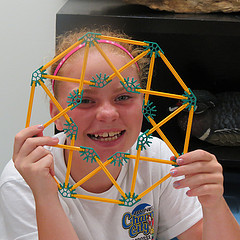
This month’s Math Teachers at Play blog carnival features games, activities, and playful math from preschool to high school. Here are just a few treats from the carnival:
proofs for elementary students
Barbie does math
the dangers of timed testing
a puzzle for factoring trinomials
Minecraft math
coordinate graph-iti
and much more
It’s great fun! If you’re interested in how children learn math, check it out:
Welcome to the Math Teachers At Play blog carnival — which is not just for math teachers! If you like to learn new things and play around with ideas, you are sure to find something of interest.
By tradition, we start the carnival with a couple of puzzles in honor of our 66th edition.
Let the mathematical fun begin!
Puzzle 1
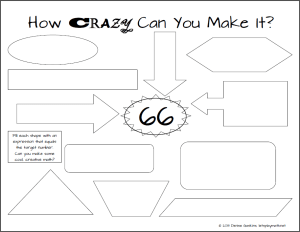
Our first puzzle is based on one of my favorite playsheets from the Miquon Math workbook series. Fill each shape with an expression that equals the target number. Can you make some cool, creative math?
Click the image to download the pdf playsheet set: one page has the target number 66, and a second page is blank so you can set your own target number.
The new Math Teachers at Play blog carnival is up for your browsing pleasure. Featured articles include activities and enrichment from preschool through high school:
The Math Teachers at Play blog carnival is a monthly blogging round-up shared at a different blog each month, featuring posts from parents, teachers, homeschoolers, and students — anyone who is interested in playing around with school-level (preschool to pre-college) or recreational math.
This month’s edition is ready for your browsing pleasure:
Welcome to my humble online abode! Take a seat – I’ve lost the carnival number under a chunk of paperwork. Whoops…
Wait, you might be able to help me out! Would you like to help me out?
The following sequences contain the missing carnival number – I’m a bit stuck, and I need your help!
Can you tell me what the next number is? There’s a prize!
Do you enjoy math? I hope so! If not, browsing this post just may change your mind. Welcome to the Math Teachers At Play blog carnival — a smorgasbord of ideas for learning, teaching, and playing around with math from preschool to pre-college.
Let the mathematical fun begin!
POLYHEDRON PUZZLE
By tradition, we start the carnival with a puzzle in honor of our 62nd edition:
An Archimedean solid is a polyhedron made of two or more types of regular polygons meeting in identical vertices. A rhombicosidodecahedron (see image above) has 62 sides: triangles, squares, and pentagons.
How many of each shape does it take to make a rhombicosidodecahedron?
Click for template.
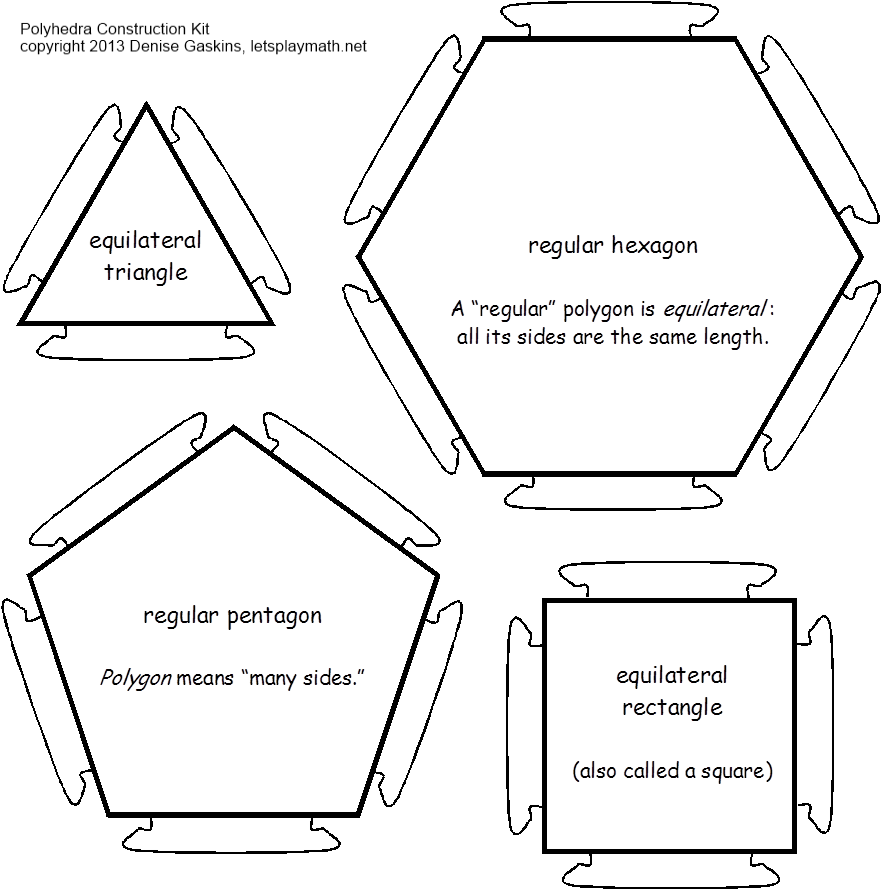
My math club students had fun with a Polyhedra Construction Kit. Here’s how to make your own:
Collect a bunch of empty cereal boxes. Cut the boxes open to make big sheets of cardboard.
Print out the template page (→) and laminate. Cut out each polygon shape, being sure to include the tabs on the sides.
Turn your cardboard brown-side-up and trace around the templates, making several copies of each polygon. I recommend 20 each of the pentagon and hexagon, 40 each of the triangle and square.
Draw the dark outline of each polygon with a ballpoint pen, pressing hard to score the cardboard so the tabs will bend easily.
Cut out the shapes, being careful around the tabs.
Use small rubber bands to connect the tabs. Each rubber band will hold two tabs together, forming one edge of a polyhedron.
So, for instance, it takes six squares and twelve rubber bands to make a cube. How many different polyhedra (plural of polyhedron) will you make?
Can you build a rhombicosidodecahedron?
And now, on to the main attraction: the 62 blog posts. Many of the following articles were submitted by their authors; others were drawn from the immense backlog in my blog reader. If you’d like to skip directly to your area of interest, here’s a quick Table of Contents:
The Math Teachers at Play blog carnival is a monthly blogging round-up shared at a different blog each month, featuring posts from parents, teachers, homeschoolers, and students — anyone who is interested in playing around with school-level (preschool to pre-college) or recreational math.
This month’s edition is ready for your browsing pleasure:
Due to an apparent glitch with the submissions, it’s a frustratingly short carnival this month. But you will still find plenty of fun, from elementary kitchen math to algebra 2 and fractions to fractals:
The number sixty happens to be the smallest number divisible by the numbers 1 to 6. Also, it has the honour being a unitary perfect number, i.e. it can be interpreted as being the overall sum of its unitary divisors (excluding itself). Give this a try to convince yourself: 1 + 3 + 4 + 5 + 12 + 15 + 20 indeed equals 60.
… Click here to read the math carnival post.
Math Teachers at Play is a monthly Blog Carnival showcasing math activities and puzzles from teachers, parents, and homeschoolers all around the blogosphere.
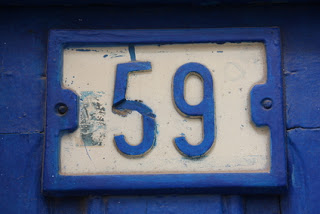
59 is the smallest prime that can be expressed using the digits 1 through 9 in order with only the addition and multiplication symbols between them. Can you find a way to express it with these rules? (one solution is at the end of this post).
And now on to the great ideas that were submitted this month…
Welcome to the Math Teachers At Play blog carnival — a smorgasbord of ideas for learning, teaching, and playing around with math from preschool to pre-college. If you like to learn new things and play around with ideas, you are sure to find something of interest.
Let the mathematical fun begin…
PUZZLE 1
By tradition, we start the carnival with a pair of puzzles in honor of our 58th edition. Click to download the pdf: