New Book: Multiplication & Fraction Games

It’s here! My long-awaited upper-elementary Math You Can Play games book has finally hit the online bookstores.

Multiplication & Fractions features 25 kid-tested games, offering a variety of challenges for school-age students. Children master several math models that provide a sturdy foundation for understanding multiplication and fractions. The games feature times table facts and more advanced concepts such as division, fractions, decimals, and multistep mental math.

Click here to find Multiplication & Fractions at your favorite bookstore.

Multiplication & Fraction Games

multfrac-300Maybe you never really understood what multiplication means or what fractions are? As long as you start with an open mind and are willing to engage playfully, the activities in the book can help you as you help your kids.
Anecdotally, these two areas are the first major stumbling point for students in their math studies. The sequencing in the book will help kids develop a strong foundation.
Kids (and parents!) find these games fun. I’ve been field testing math games for the last 18 months and keep seeing how engaged kids get when playing math games.

— Joshua Greene
Multiplication & Fractions Math Games from Denise Gaskins (a review)

Chapters include:

  • Mathematical Models: Learn the basic pictures that help support your child’s comprehension.
  • Conquer the Times Tables: Enjoy practicing the math facts until correct answers become automatic.
  • Mixed Operations: Give mental muscles a workout with games that require number skills and logical thinking.
  • Fractions and Decimals: Master equivalent fractions, work with decimal place value, and multiply fractions and decimal numbers.

If you are a parent, these games provide opportunities to enjoy quality time with your children. If you are a classroom teacher, use the games as warm-ups and learning center activities or for a relaxing review day at the end of a term. If you are a tutor or homeschooler, make games a regular feature in your lesson plans to build your students’ mental math skills.

So what are you waiting for? Clear off a table, grab a deck of cards, and let’s play some math!

Check It Out

It starts with models that are visual explanations of the concepts. Gaskins also breaks learning these concepts into comfortable steps that emphasize patterns and relationships, the real ideas that are behind properly understanding multiplication and fractions (indeed, math generally).
The sequence of games in each section starts by building familiarity and then fluency (speed) to solidify all of that work.

— Joshua Greene
Multiplication & Fractions Math Games from Denise Gaskins (a review)

Multiplication & Fraction Printables
Multiplication & Fraction Printables

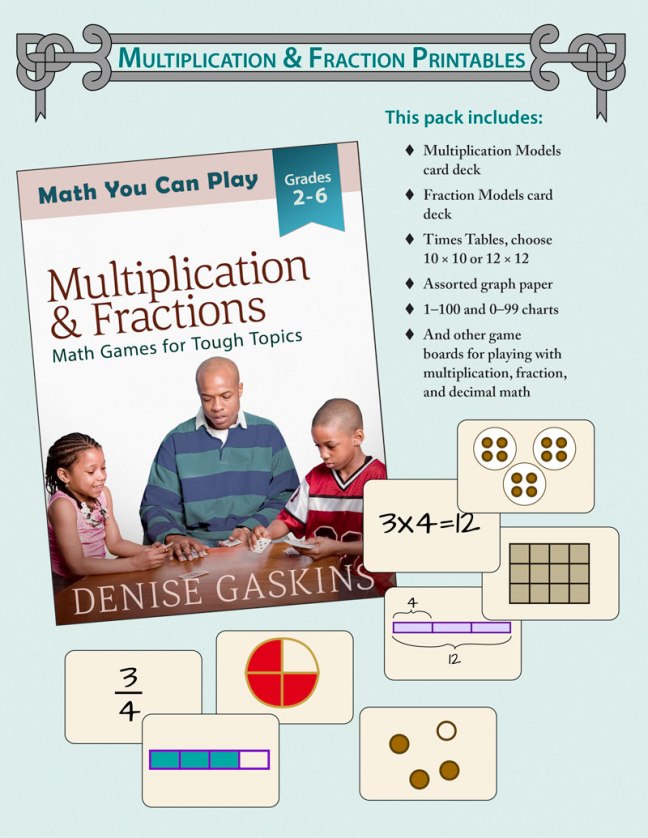
Most of the Math You Can Play games use materials you already have around the house, such as playing cards or dice. But this book introduces multiplication and fractions with several games using two special mathematical model card decks.

Click here to download the Multiplication & Fraction Printables, featuring all the math model cards, hundred charts, and game boards you will need for any game in the book.
Number Game Printables

One step closer to getting my long-awaited Multiplication & Fraction Games book out — I finished the printables file! At least, I hope I’ve finished. Sometimes it seems like whack-a-typo never ends…

Multiplication & Fraction Printables

Multiplication & Fraction Printables

Click here to download the Multiplication & Fraction Printables, featuring mathematical model cards, hundred charts, and game boards to accompany the upcoming Math You Can Play: Multiplication & Fractions book.

The Multiplication & Fractions ebook will come out sometime in November, and the paperback should follow in time for Christmas. If you’re interested, my newsletter subscribers will get a special introductory sale price whenever the book is published. Join now!

You may also want to check out:

Number Game Printables Pack

Number Game Printables Pack

Click here to download the Number Game Printables Pack, featuring hundred charts, graph paper, and game boards from the first two Math You Can Play books.

Also, 0–99 charts, and bottoms-up versions, too. (See my blog post Math Debates with a Hundred Chart.) And a fun cut-and-fold game board for playing Shut the Box.

Permission to Use These Files

You have permission to copy and use these game boards and worksheets in your own local classroom, home school, math circle, co-op class, etc. But you may not post them on your own website (though you can link to this post, if you like) or sell them. If you’re not sure how copyright works on the Internet, check out Daniel Scocco’s Copyright Law: 12 Dos and Don’ts.

Math You Can Play Combo in Paperback and Ebook

If you’re interested in helping children learn math, I have special offer just for you:

  • Save 20% off the individual ebooks or 35% off the paperback prices when you buy a combined 2-books-in-1 edition featuring the first two books in the Math You Can Play series together.

The 42 kid-tested games are simple to learn, quick to play, and require minimal preparation. Most use common household items such as cards or dice.

Free Online Preview

Amazon-logo the_book_depository_logo Barnes-Noble-logo kobo-logo Scribd_logo Smashwords-logo CreateSpace-logo

“Although the cover says games for young learners, the beauty of this book is that most of the games can easily be scaled up for older kids, teens, and even adults. My youngest is four and my oldest is 14, and I will be pulling games for all of them out of this book!

“I appreciate that most of the games are low floor, high ceiling – easy for a child to access, but can be played at a higher level through strategy or slight alterations to the rules. These are not drills disguised as games, but activities that require problem solving and strategy as well as calculation.”

Kindle customer review

Continue reading Math You Can Play Combo in Paperback and Ebook

Amazon Bestseller Today

Bookselling stats rise and fall like a roller-coaster, but the top of the curve is always fun. Today Let’s Play Math hit the Top Ten in homeschooling (“parent participation in education”) at Amazon.com:

LPMtop10-2016-04-14highlight

Update: Top 25 in STEM Resources

I noticed the “STEM Education” category at Amazon, so I updated my book’s keywords. And the Let’s Play Math paperback zipped into the Top 25!

LPMtop25-STEM-2016-04-16

Review and Giveaway

LPM-book-with-coffee-800There’s still time to enter the book giveaway at Our Home on the Range blog:
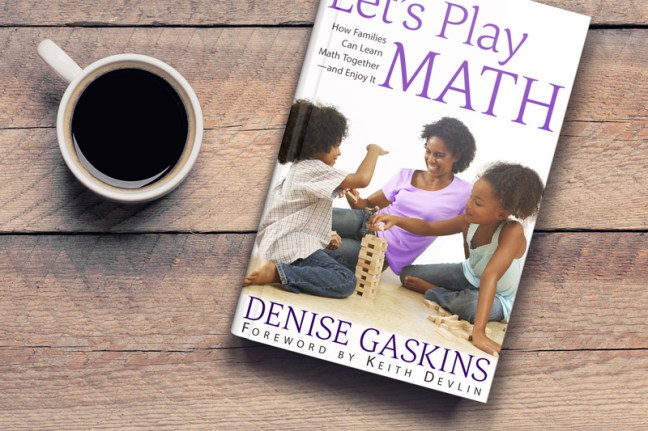

Here on the Range, I’m determined to establish an environment where math is not just numbers and answers. I firmly believe my children can learn all the math they want, when they’re ready, as long as they don’t convince themselves they can’t learn it, they don’t like it, or that it’s too hard. To reach this goal, math must be a regular part of our lives in a way that encourages conversation and exploration.

  • Let’s Play Math could be the very introduction a young family needs as they contemplate the first few years of homeschooling. First Son’s early years may have been completely different if I had read this book when he was five.
  • It could be a fantastic book for a family with a child that’s struggling (in homeschool or otherwise) with math. A few years ago, when First Son first showed signs of a potentially life-long hatred of all things numerical, reading this book may have helped me adapt the curriculum we were then using to meet his needs and enrich him. (We ended up switching and I’m happy with that, but I could have avoided quite a bit of angst.)
  • This book would be perfect for a parent who has always struggled with inadequacies in math or for someone like me, who always did just fine in math but never understood the claims of math’s beauty or fascination. I find myself excited to explore some of the resources the author has gathered together for my own growth and new challenges.

—Kansas Mom

Let’s Play Math Back Cover Blurbs

LPM-book-with-coffee-800

Advance review comments for Let’s Play Math: How Families Can Learn Math Together—and Enjoy It:

Want to help your kids with math? Don’t help with the homework. Get them to engage with math by doing things together — many of which don’t even look like math. Let’s Play Math is charming, intelligent, and practical; full of family fun and sound advice.

—Ian Stewart, author of Professor Stewart’s Casebook of Mathematical Mysteries

This book is well researched, well annotated, and includes loads of activities you can try with kids K-12 at home.

—Jennifer Bardsley, credentialed teacher and author of TeachingMyBabytoRead.com

This is the math helper I wish I’d had years ago.

—Anne White, author of Minds More Awake

A crash course in how to enjoy math with your children! Denise Gaskins uses her years of experience to show parents how to teach math with games, stories, puzzles, manipulatives, and living books. Full of useful advice and pedagogical insight, this book is a treasure trove for parents who want to help their children appreciate the beauty, history, and fun of math but don’t know where to start.

—Kate Snow, KatesHomeschoolMath.com and author of Preschool Math at Home

Buy now:
Amazon-logo ibookstore-badg Barnes-Noble-logo kobo-logo nook-logo Scribd_logo Smashwords-logo CreateSpace-logo

Updated to Add

More details about the book:

How to Update Your Let’s Play Math Ebook

LetsPlayMath-300

I love how seeing math as a playful game can help even the busiest parents enjoy learning alongside their children.

My math books grew from more than a quarter-century of playing math with children — my own and those of our friends — at my house, at the library, in the park, and in group workshops. The kids and I learned from each other as we shared the adventure of learning mathematics.

Now that the publication dust has settled and the typos and formatting glitches have been sorted out, I’ve updated all the Let’s Play Math ebook files to match my shiny new, greatly expanded paperback edition.

Changes Include

Do You Need an Update?

If your version shows the family playing together on the cover, then you’re all set. The copyright notice should say “Ebook version 3.0.”

But if you have an earlier edition of Let’s Play Math, you will probably want to update to this new, revised edition. Be warned: this is a totally new file, so you’ll lose all your highlights and bookmarks. But the expanded version has SO many wonderful changes, believe me, it’s well worth the inconvenience.

The following instructions are for Amazon.com. If you bought your book somewhere else, check the book dealer’s webpage — if the new cover (above) is showing, then they have the updated file. Find the Customer Service section of their website and follow their procedure.

Amazon Policy Change

I’ve asked Amazon to release the new ebook files to everyone who bought the earlier edition — as used to be their standard policy. But they’ve had too many complaints about people losing their bookmarks, so they no longer issue updates except by customer request.

The only way to get the updated file is to contact Customer Service and ask for it yourself.

Step by step instructions:

  1. Click the contact Customer Service link. Log into your account.
  2. Under “What can we help you with?” click the option “Digital Services.”
  3. Under “Tell us more about your issue,” click “Kindle eBooks” and then “Something else.”
  4. Under “Enter short summary of issue,” copy and paste the following text:
    I bought the ebook Let's Play Math (ASIN B0095POAX4). This book has recently been updated with new material. Would you please send the updated ebook files to my account? Thank you.
  5. Choose how you want to be contacted. I always pick “Email,” but you can pick a more immediate option if you like.

And then wait for the support people to do their magic. You should get the new file within 24 hours.

What About the Paperbacks?

What if you got a bad copy of a paperback book?

The machines that print POD (Print On Demand) books — like my math book or my daughter’s fantasy novels — are basically giant computer printers. As everyone knows, printers get glitches. And the humans who take a book off the machine and put it in a shipping box won’t necessarily notice the mistake.

If you ever get a messed-up copy of my math paperbacks (or any book by anyone, for that matter), you can always contact customer service to have it replaced.

Just follow the same steps as above, but choose the options that make sense for whatever complaint you have. Or if you didn’t buy from Amazon, then find the Customer Service section for whatever book dealer you used, and follow their procedure.

Let’s Play Math Paperback Edition Now Available

LetsPlayMath-300

Finally, the revised and much-expanded paperback edition of Let’s Play Math: How Families Can Learn Math Together—and Enjoy It is finished and loaded up on Amazon worldwide. Other bookstores will follow as soon as they update their files.

My book shows you new ways to explore math as a family adventure:

  • Introduce your kids to the “Aha!” factor, the thrill of solving a challenging puzzle.
  • Help them build thinking skills with toys, games, and library books.
  • Find out how to choose math manipulatives, or make your own.
  • And learn how to tackle story problems with confidence.

True mathematical thinking involves the same creative reasoning that children use to solve puzzles. Let’s Play Math turns math into a learning adventure for the whole family. Your children will build a stronger foundation of understanding when you teach math as a game, playing with ideas.

LPM 4-9stars

Buy now:
Amazon-logo ibookstore-badg Barnes-Noble-logo kobo-logo nook-logo Scribd_logo Smashwords-logo CreateSpace-logo

This blog originally grew out of my long-out-of-print books for homeschoolers, and now it has come full circle. The new edition of my book ripened on the vine, expanding to include families of every schooling style, with useful tips and resources for classroom teachers, too.

Wouldn’t you like to share in the harvest?

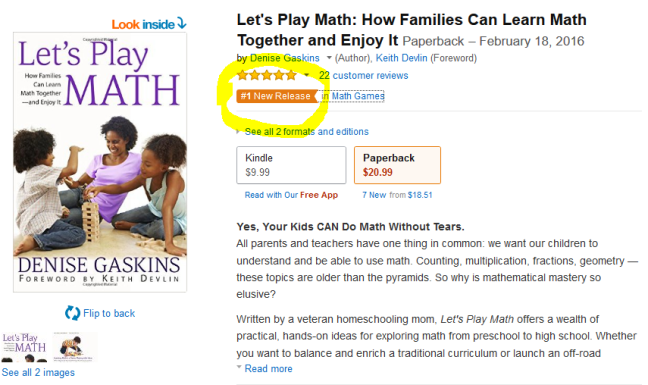
LPM no1new release highlight

Detailed Review (and a Giveaway)

If you’d like to know more about Let’s Play Math — and have a chance to win a free copy — check out Kate Snow’s review post:

Updated to Add

More details about the book:

A Penny for Your Math

You know you’re a math teacher when you see a penny in the parking lot, and your first thought is, “Cool! A free math manipulative.”

penny

My homeschool co-op math students love doing math with pennies. They’re rather heavy to carry to class, but worth it for the student buy-in.

This month, I’m finishing up the nearly 150 new illustrations for the upcoming paperback edition of my Let’s Play Math book. I’m no artist, and it’s been a long slog. But a couple of the graphics involved pennies‌—‌so when I saw that penny on the ground, it made me think of my book.

And thinking of my book made me think it would be fun to share a sneak peek at coming attractions…

The Penny Square: An Example of Real Mathematics

Real mathematics is intriguing and full of wonder, an exploration of patterns and mysterious connections. It rewards us with the joy of the “Aha!” feeling. Workbook math, on the other hand, is several pages of long division by hand followed by a rousing chorus of the fraction song: “Ours is not to reason why, just invert and multiply.”

Real math is the surprising fact that the odd numbers add up to perfect squares (1, 1 + 3, 1 + 3 + 5, etc.) and the satisfaction of seeing why it must be so.

Did your algebra teacher ever explain to you that a square number is literally a number that can be arranged to make a square? Try it for yourself:

  • Gather a bunch of pennies‌—‌or any small items that will not roll away when you set them out in rows‌—‌and place one of them in front of you on the table. Imagine drawing a frame around it: one penny makes a (very small) square. One row, with one item in each row.
  • Now, put out three more pennies. How will you add them to the first one in order to form a new, bigger square? Arrange them in a small L-shape around the original penny to make two rows with two pennies in each row.
  • Set out five additional pennies. Without moving the current four pennies, how can you place these five to form the next square? Three rows of three.
  • Then how many will you have to add to make four rows of four?
pennies
Twenty-five is a square number, because we can arrange twenty-five items to make a square: five rows with five items in each row.

Each new set of pennies must add an extra row and column to the current square, plus a corner penny where the new row and column meet. The row and column match exactly, making an even number, and then the extra penny at the corner makes it odd.

Can you see that the “next odd number” pattern will continue as long as there are pennies to add, and that it could keep going forever in your imagination?

The point of the penny square is not to memorize the square numbers or to get any particular “right answer,” but to see numbers in a new way‌—‌to understand that numbers are related to each other and that we can show such relationships with diagrams or physical models. The more relationships like this our children explore, the more they see numbers as familiar friends.

The Penny Birthday Challenge: Exponential Growth

Penny-Challenge-1

A large jar of assorted coins makes a wonderful math toy. Children love to play with, count, and sort coins.

Add a dollar bill to the jar, so you can play the Dollar Game: Take turns throwing a pair of dice, gathering that many pennies and trading up to bigger coins. Five pennies trade for a nickel, two nickels for a dime, etc. Whoever is the first to claim the dollar wins the game.

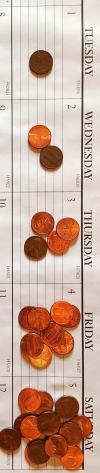
Or take the Penny Birthday Challenge to learn about exponential growth: Print out a calendar for your child’s birthday month. Put one penny on the first day of the month, two pennies on the second day, four pennies on the third day, etc. If you continued doubling the pennies each day until you reach your child’s birthday, how much money would you need?

Warning: Beware the Penny Birthday Challenge! Those pennies will add up to dollars much faster than most people expect. Do not promise to give the money to your child unless the birthday comes near the beginning of the month.

A Penny Holiday Challenge

The first time I did pennies on a calendar with my homeschool co-op class was during December, so we called it the Penny Christmas Challenge:

  • How many pennies would you need to cover all the days up to the 25th?

I told the kids that if their grandparents asked what gift they wanted for Christmas, they could say, “Not much. Just a few pennies…”


LPM-ebook-300The Penny Square, Dollar Game, and Penny Birthday Challenge are just three of the myriad math tips and activity ideas in the paperback edition of Let’s Play Math: How Families Can Learn Math Together and Enjoy It. Coming in early 2016 to your favorite online bookstore…