The Problem with Books These Days

For an indie business, weekends are just another workday. But I suppose with the pandemic and so many people working at home, perhaps that’s true of everyone these days.

I finished the index work on Prealgebra & Geometry Games, and I think I might have the book layout under control. Time to order a proof copy.

I can get an instant digital proof. It looks just like the file I already have on my computer. But the physical book is a whole different thing from a computer file. There are always surprises.

So I want to see a real proof — an actual paperback copy — before I release a book to readers. Wouldn’t you?

And that may be a problem.

Continue reading The Problem with Books These Days

It’s Almost Gone

Kickstarter Sample Games Download

“Denise’s books are always the first math books I recommend to parents. I have used them both with co-ops and at home, and I couldn’t be more thrilled for her latest book, Prealgebra & Geometry Games, because there is SUCH a need for games at this level! I could even scale down many of the games for my second grader. Middle school moms and those with math loving kids of any age, check this out!”

—Casey Ogg Maupin
Big Juicy Conversations about Math (Facebook group)

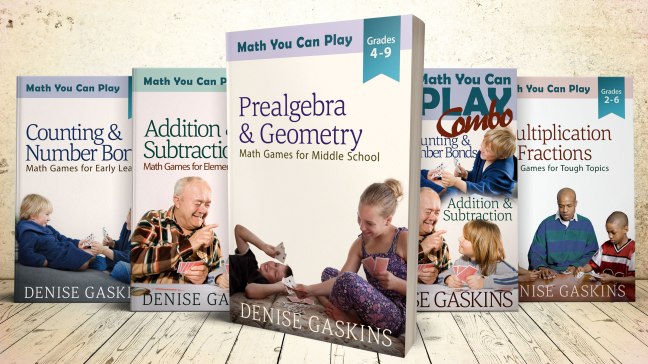
UPDATE: The Kickstarter deals have ended, but my playful math books are still available through your favorite online store or by special order at your local bookshop. (Except for the Prealgebra & Geometry Games book, scheduled for publication in early 2021. Sign up for my email list to get the latest news.)

Continue reading It’s Almost Gone

How Mathematics Works

The full quote, as it appears in my new book:

Make a conjecture. A conjecture is a statement that you think might be true.

For example, you might make a conjecture that “All odd numbers are…” How would you finish that sentence?

Make another conjecture. And another. Does thinking about your conjectures make you wonder about math?

Can you think of any way to test your conjectures, to discover if they will always be true?

This is how mathematics works. Mathematicians notice something interesting about certain numbers, shapes, or ideas. They play around and explore how those relate to other ideas. After collecting a set of interesting things, they think about ways to organize them. They wonder about patterns and connections. They make conjectures and try to imagine ways to test them.

And mathematicians talk with one another and compare their ideas. In real life, math is a very social game.

—Denise Gaskins
Prealgebra & Geometry: Math Games for Middle School

Excerpted from my new book, Prealgebra & Geometry: Math Games for Middle School. Look for it at your favorite online bookstore.

CREDITS: “Three girls counting” photo by Charlein Gracia on Unsplash.

Language and Math

Still working on my Prealgebra & Geometry Games book. I’m amazed at how much of learning math is really about language.

With the current layout, the book will be 250+ pages long, depending on how the index turns out. A total of 41 games plus four math investigation activities. I’ve defined more than 100 vocabulary words — so averaging more than two new math words per game.

Of course, several of these are words (or at least concepts) students will have learned before. But a large part of prealgebra is consolidating previous ideas and mastering their names (sum, quotient, factor, multiple, etc.) before moving on to apply them in algebra class.

But it’s not all review! There’s a cool game about polar coordinates, a rabbit trail into combinatorics, and plenty of other challenges to keep students learning.

And plenty of clear definitions for adult readers who have long ago forgotten all the math terms they learned in school.

Prealgebra & Geometry: Math Games for Middle School is scheduled for publication in early 2021. Sign up for my newsletter to get updates.

Behind the Scenes with the Index Edit

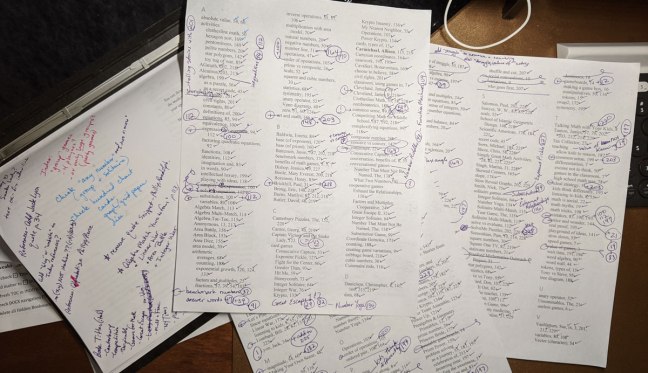
Gel pens are wonderful for editing because they show up so well against the manuscript text. Each pass gets a new color. The picture above is the 5th cycle through my Prealgebra & Geometry Games index, this time with purple ink.

When I printed the output from cycle #4, everything looked so neat in three columns with alphabet headers in place. I thought, “This is almost done!”

Moral: Don’t judge an index by how nice it looks.

Still, it’s also not as bad as the marked-up pages make it seem. Only a few of those will be major tweaks. (Like, how did we not notice that the Jack Lyon quote got left out of the reference section?!)

Plenty of work to go, but the end is in sight…

Prealgebra & Geometry: Math Games for Middle School is scheduled for publication in early 2021. Sign up for my newsletter to get updates.

Still Working on the Index

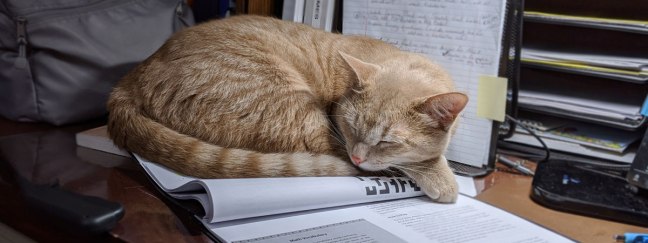
With the less-than-help of my daughter’s cat, I’ve made it through several cycles of editing my Prealgebra & Geometry index. If you’re curious about the process, you may enjoy my behind-the-scenes peek at How to DIY a Nonfiction Index.

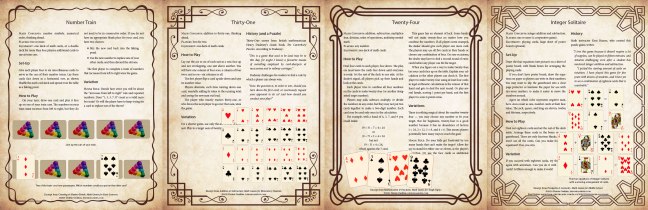
There’s yet a ways to go, but it’s starting to look like what I want. The index includes game listings by category: card games, pencil and paper games, cooperative games, solitaires, etc.

One of the entries is “Games, Complete List of.”

So I counted…

Officially, the book features 41 games that help prepare students for high school math by playing with number properties, mixed operations, integers, algebraic functions, coordinate geometry, and more.

But when I counted all the official game listings plus all the game variations that were different enough to have their own names — 62 games.

Wow!

Prealgebra & Geometry: Math Games for Middle School is scheduled for publication in early 2021. Sign up for my newsletter to get updates.

Only by Thinking

The full quote, as it appears in my new book:

When we give students a rule, we give them permission not to think. All they need to do is remember our instructions.

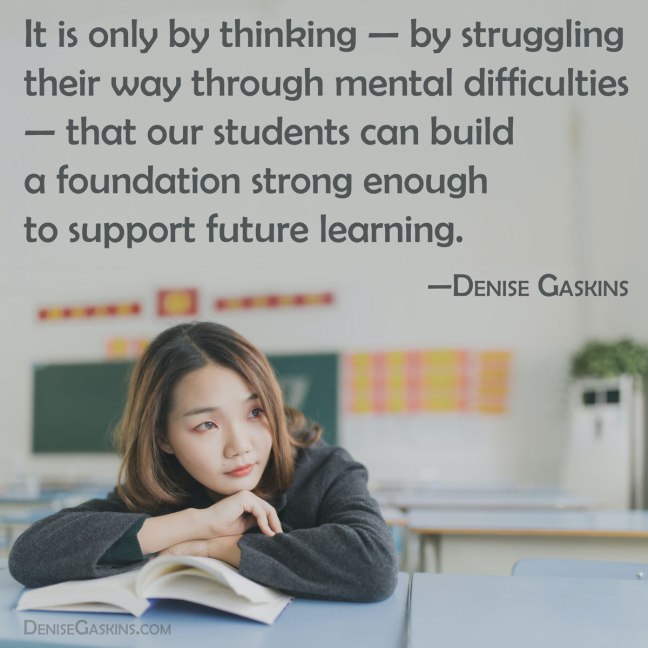
But it is only by thinking — by struggling their way through mental difficulties — that our students can build a foundation of mathematical knowledge strong enough to support future learning.

—Denise Gaskins
Prealgebra & Geometry: Math Games for Middle School

 
* * *

Excerpted from my upcoming book, Prealgebra & Geometry: Math Games for Middle School, scheduled for publication in early 2021. Sign up for my newsletter to get updates.

This blog is reader-supported.

If you’d like to help fund the blog on an on-going basis, then please join me on Patreon for mathy inspiration, tips, and an ever-growing archive of printable activities.

If you liked this post, and want to show your one-time appreciation, the place to do that is PayPal: paypal.me/DeniseGaskinsMath. If you go that route, please include your email address in the notes section, so I can say thank you.

Which I am going to say right now. Thank you!

“Only by Thinking” copyright © 2020 by Denise Gaskins. Image at the top of the post copyright © Sean Kong on Unsplash.

Working on the Index — Part Two

This morning is day-of-rest time, streaming the church service. I’m still avoiding as much contact with people as I can manage since I may be going back at any time to help my elderly mom, and I don’t want to carry the virus to her.

But this evening, I’ll probably be back at my desk, slogging through the Index work on my Prealgebra & Geometry Games book — scheduled for publication in early 2021. (Sign up for my newsletter to get updates.)

So here’s the second installment of my behind-the-scenes peek at just part of what goes into making a book, reprinted from the Alliance of Independent Authors blog.

Continue reading Working on the Index — Part Two

Working on the Index — Part One

Now I’ve got a tiny streak going, it seems like a shame to miss a day of blogging. So here’s a bit of behind-the-scenes as I work on finishing up the new book.

By the way: Prealgebra & Geometry: Math Games for Middle School is scheduled for publication in early 2021. Sign up for my newsletter to get updates.

So, back to the Index. Here’s a post I wrote for the Alliance of Independent Authors blog last year. If you ever wondered what goes into designing a book, this is just a little of the detail work…

Continue reading Working on the Index — Part One